 ultimate-guide
What Is Ethical Coffee Sourcing? A 2026 Guide
Table of Contents
- What Is Ethical Coffee Sourcing?
- Why Ethical Sourcing Matters for Farmers and the Planet
- Fair Trade vs Direct Trade Coffee: What's the Difference?
- How to Identify Ethically Sourced Coffee Beans
- Coffee Supply Chain Transparency: From Farm to Cup
- Common Myths and Bad Advice About Ethical Coffee
- Frequently Asked Questions
Last Updated: September 12, 2026
What Is Ethical Coffee Sourcing?
Ethical coffee sourcing protects the people who grow coffee, the land it grows on, and the supply chain: paying farmers above the commodity market rate, verifying working conditions, and tracing beans to specific farms or cooperatives rather than anonymous blends.
At Third Space Coffee, we roast in-house and source with that framework in mind: the difference between a bag of beans and a genuinely ethical one comes down to documentation, not marketing.
Here's the part most guides skip: ethical sourcing is not a single certification you can print on a label. It is a set of practices that can be verified, audited, and traced. Below, we break down the pillars, the economics, and the vetting questions that separate substance from greenwashing.
The core pillars come down to four things: fair compensation, safe labor conditions, environmental stewardship, and traceability. Miss any one and the label is doing more work than the supply chain is.
The Core Pillars of Ethical Sourcing
- Fair compensation, paying above the commodity market price, ideally tied to a living income benchmark rather than a floor.
- Labor rights, verified working conditions, no child labor, and documented safety practices at the farm and processing level.
- Environmental stewardship, farming methods that protect soil, water, and biodiversity, including shade-grown and agroforestry systems.
- Traceability, the ability to name the cooperative, region, and often the specific farm a lot came from.
Many roasters claim all four. Far fewer can produce an audit that confirms them.
Why Ethical Sourcing Matters for Farmers and the Planet
The stakes are economic before they are environmental. Coffee is one of the most traded agricultural commodities in the world, and price volatility hits smallholder farmers hardest: when the market drops, those with the least buffer absorb the loss first (usda.gov).
Ethical sourcing shifts risk away from the grower. A cooperative receiving a stable, above-market price can reinvest in equipment, replant aging trees, and pay laborers fairly; one selling at commodity rates cannot.
The Economic Reality for Smallholder Farmers
Most coffee farms are small operations, and many sit in regions where a single bad harvest can wipe out a year of income. Living income, not minimum wage, is the benchmark that matters: a farmer earning above the commodity price but below a living income has not escaped poverty.
This is where price premiums and direct relationships do their real work. A guaranteed premium lets a cooperative plan. A one-time high payment does not.
Environmental Stewardship in Coffee Farming
Coffee grows best in shaded, biodiverse systems, and agroforestry, where coffee is grown under a canopy of other trees, protects soil and supports wildlife. Pesticide reduction and water management at the processing stage matter just as much as what happens in the field.
Sustainable agriculture is not a marketing layer on top of coffee. It is the condition that keeps the crop viable as climate patterns shift.
Fair Trade vs Direct Trade Coffee: What's the Difference?
Fair trade certification sets a floor price and a social premium, verified by a third party, for cooperatives that meet the standard (fairtradecertified.org). Direct trade skips the certifier and builds a relationship directly between roaster and producer, usually with a negotiated price and more frequent farm visits.
The nuance most comparisons miss: fair trade guarantees a minimum, direct trade guarantees a relationship. A roaster can pay above fair trade rates through direct trade, or pay the fair trade floor and nothing more. Neither model is automatically better, what matters is whether the price is disclosed and clears a living income, not just a commodity floor.
How the Fair Trade Price Mechanism Actually Works
Fair trade pricing is not a single number. It is a floor price that adjusts by origin and by whether the coffee is washed or natural, plus a separate social premium. The floor covers the cost of sustainable production, not a living income on its own: a cooperative can sell every pound at the fair trade floor and still fall short of what a household needs for food, housing, school fees, and healthcare (fairtrade.net).
That gap is why living income has moved to the center of the conversation. Benchmarks are calculated per region by estimating what a typical household needs for a decent standard of living, then comparing it to what coffee income delivers. When the two are far apart, a floor price alone cannot close the distance, premiums, quality differentials, and second payments have to do the rest.
A few mechanics worth knowing:
- The social premium is paid to the cooperative, not to individual farmers, and is voted on democratically for community projects or farm investment.
- The minimum price only kicks in when the commodity market falls below it. In high-market years, the floor is irrelevant and farmers earn the market rate.
- Volume commitments matter as much as price. A high price on a small lot does not stabilize a cooperative the way a multi-year commitment on a larger volume does.
How Direct Trade Pricing Differs
Direct trade has no universal standard, which is both its strength and its weakness. The strength is flexibility: a roaster can pay a price tied to actual production costs at a specific farm, adjust for quality, and commit to buying the same lot next harvest. The weakness is that nothing enforces the claim, "direct trade" is a marketing term, not a regulated one, so the only proof is the roaster's own documentation.
In practice, the strongest direct trade relationships share a few traits:
- Multi-year contracts rather than one-off purchases, so the producer can plan replanting and equipment investment.
- Published prices or price ranges relative to the commodity market, so buyers can verify the premium.
- Farm-level traceability down to the lot, not just the cooperative or region.
- Quality feedback loops, where the roaster communicates cupping results back to the producer so the relationship improves the coffee, not just the price.
Where the Two Models Overlap
The most durable sourcing programs combine both: a roaster can buy from a fair trade certified cooperative and pay above the certified floor through a direct relationship, capturing third-party verification plus price flexibility. This is increasingly common among specialty roasters who want both proof and premium.
| Model | Verification | Price Mechanism | Best For |
|---|---|---|---|
| Fair trade | Third-party certifier | Floor price + social premium | Cooperatives needing stable minimums |
| Direct trade | Roaster-producer relationship | Negotiated, often above market | Roasters with farm access and volume |
| Both combined | Certifier + direct relationship | Premium above certified floor | Buyers wanting proof and relationship |
The practical takeaway: ask what price was paid and how it compares to both the commodity market and a living income benchmark for that region. A roaster who can answer that is doing the work regardless of model.
How to Identify Ethically Sourced Coffee Beans
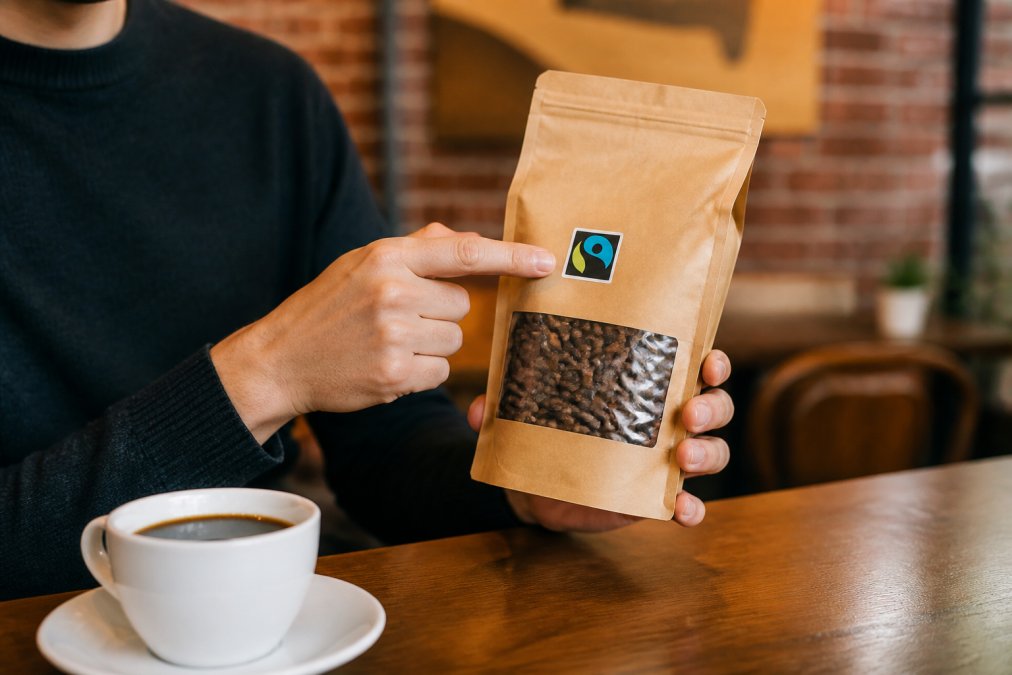
Start with the label, then verify it. A certification mark is a starting point, not a finish line. The real test is whether the roaster can tell you where the beans came from and what was paid for them.
A common mistake is treating any single logo as proof of an ethical supply chain. Certifications vary widely in what they audit, and some cover environmental practices while saying nothing about labor.
Reading Certification Labels
- Fair trade marks, confirm a floor price and social premium were paid to a certified cooperative.
- Organic marks, address pesticide and farming inputs, not wages.
- Rainforest-style marks, focus on shade, biodiversity, and water, with limited labor scope.
- Direct trade claims, no universal standard; require the roaster's own documentation.
Questions to Ask Your Roaster
- Which farm or cooperative is this lot from, and in which region?
- What price was paid relative to the commodity market?
- Is there a current supply chain audit for this origin?
- How is post-harvest processing handled, and who does that work?
A roaster who can answer all four is doing the work. A roaster who deflects to "we care about farmers" is not.
Coffee Supply Chain Transparency: From Farm to Cup
Transparency means a buyer can trace a bag of beans from farm through processing, export, import, and roasting. Full traceability is rare at scale, which is exactly why it is a useful signal when you find it.
The more useful question is what transparency looks like at each handoff, and where the money goes along the way.
The Cost Breakdown of a Cup of Coffee
The retail price of a cup splits across a long chain, and the farmer's share is almost always the smallest slice. A rough pattern for a commodity cup:
- The farmer receives a small fraction of the retail price, often in the low single digits as a percentage of what the consumer pays.
- The exporter and importer each take a margin for logistics, financing, and risk.
- The roaster captures value through roasting, blending, and branding.
- The cafe or retailer absorbs rent, labor, and overhead, which is often the largest single cost in the cup.
In a specialty cup with a documented premium, the farmer's share grows but is still rarely the largest slice. This is the cost breakdown most consumers never see, and the reason "ethically sourced" has to mean a documented price, not a feeling.
The practical implication: a few cents per pound of premium at the farm level can decide whether a household replants, even though that premium is a rounding error in the retail price of a latte. Small changes at the top of the chain have outsized effects at the bottom.
Traceability Technology and Supply Chain Audits
Traceability technology has changed what is possible here. Digital lot tracking, QR-coded bags, and blockchain-based records let a roaster document each handoff from washing station to roastery. The technology does not make a supply chain ethical on its own, but it makes claims checkable, the precondition for accountability.
A few mechanisms worth understanding:
- Lot-level QR codes let a buyer scan a bag and see the farm, harvest date, processing method, and sometimes the price paid.
- Digital ledger systems create a tamper-resistant record of each transfer, which reduces the risk of a lot being substituted or blended without disclosure.
- Third-party audits verify labor and environmental conditions at the source, adding an independence layer that self-reported claims cannot match.
Supply chain audits are not perfect. They are snapshots, not continuous monitoring, and a farm can pass one season and fall short the next. But an audited claim is still more verifiable than an unaudited one, and the industry is moving toward more frequent, more granular verification.
Post-Harvest Processing Ethics
Most content focuses on the field. The ethics of what happens after harvest are just as consequential, and far less covered.
After picking, coffee cherries are processed at a washing station or mill. The method, washed, natural, honey, or experimental, affects quality, price, and the labor conditions of the people doing the work. Washing stations are often the least visible link in the chain, and the workers there are frequently seasonal and informally employed.
A few questions that separate serious sourcing from marketing:
- Who owns the washing station? A cooperative-owned station returns more value to members than one owned by an outside buyer.
- How is wastewater managed? Traditional washing uses large volumes of water, and untreated runoff affects local waterways. Ecological pulping and recirculation systems reduce that impact.
- How are seasonal workers paid? Processing is labor-intensive and time-sensitive, which creates pressure to cut corners on wages and hours.
- Is the processing method disclosed? A roaster who can name the washing station and the method is almost always working closer to the source than one who cannot.
Community development programs, cooperative structures, and processing decisions all sit inside this traceability layer. How a cherry is processed affects both quality and the price a farmer can command, so processing decisions are economic decisions too.
Common Myths and Bad Advice About Ethical Coffee
Myth: Certification always means ethical. Certification verifies specific standards, not the whole chain. A certified bag can still fall short on living income.
Myth: Direct trade is always better than fair trade. Direct trade has no universal standard, so quality depends entirely on the roaster's transparency.
Myth: Ethical coffee has to cost dramatically more. Premiums exist, but the gap between commodity and ethical is often smaller than the gap between ethical and luxury branding.
Myth: Environmental labels cover labor. They usually do not. Environmental stewardship and labor rights are separate audits.
The honest take: ethical consumption is a practice of asking better questions, not buying a single logo. Roasters who welcome those questions are worth your money.
The challenge with ethical coffee sourcing is that the claims are easy and the proof is hard. Third Space Coffee roasts in-house so we can speak to what is in the cup and where it came from, and we built our space as a genuine third place for remote workers, students, and community groups who want more than a grab-and-go counter. Our in-house roasted beans, meeting room rental for teams and nonprofits, and after-hours event space for private gatherings all run on the same idea: coffee is a reason to bring people together. Get started with Third Space Coffee and taste the difference a documented supply chain makes.
Frequently Asked Questions
What is the difference between Fair Trade and direct trade coffee?
Fair Trade certification sets a minimum price floor and requires cooperative structures, third-party verification, and social premiums for community development. Direct trade skips the certification body entirely: roasters negotiate directly with coffee farmers, often paying above commodity market rates for higher quality. Direct trade can offer more supply chain transparency and better prices, but it lacks standardized third-party oversight, so the relationship depends heavily on the roaster's own commitment to fair wages and labor rights.
How can I verify if coffee is truly ethically sourced?
Start by looking for third-party verification labels such as Fair Trade Certified, Rainforest Alliance, or USDA Organic. Then go further: check whether the roaster publishes farm names, harvest dates, or pricing information. A roaster committed to supply chain transparency will share details about which cooperatives or farms they buy from and what they paid. If a brand uses vague terms like 'sustainably sourced' without specifics, that may be greenwashing. Asking your local roaster direct questions about their sourcing is one of the fastest ways to get real answers.
Does ethical sourcing actually raise the price of a cup of coffee?
It can, but the increase is smaller than most people expect. Green coffee beans represent a small fraction of the retail price of a cup; most of the cost goes to rent, labor, roasting, and overhead. When roasters pay price premiums for certified or direct trade beans, that difference often amounts to cents per cup rather than dollars. The bigger price driver is the overall specialty coffee market, where quality, origin, and processing method matter more to the final cost than certification alone.
What certifications should I look for on coffee packaging?
The most recognized certifications in the U.S. include Fair Trade Certified (fair wages and community premiums), Rainforest Alliance (environmental and social standards), USDA Organic (no synthetic pesticides), and Bird Friendly (Smithsonian certification for shade-grown coffee that protects habitats). Each addresses different aspects of ethical sourcing. No single label covers everything, so combining a certification with a roaster who shares farm-level details gives you the most complete picture of how your coffee was produced.
Why does ethical sourcing matter for coffee farmers?
Many coffee farmers are smallholders in regions where price volatility on the commodity market can push incomes below the cost of production. Ethical sourcing addresses this through fair wages, living income initiatives, and price premiums that stabilize earnings. It also supports labor rights, pesticide reduction, and community development projects like schools and healthcare. When farmers earn a living income, they can invest in better harvesting practices, agroforestry, and sustainable agriculture, which improves both their livelihoods and the long-term supply of quality coffee.
What is supply chain transparency and why does it matter?
Supply chain transparency means a coffee company can trace its beans from the specific farm or cooperative all the way to your cup, and is willing to share that information publicly. It matters because transparency is what separates real ethical sourcing from marketing claims. Without traceability, there is no way to confirm fair wages, labor rights, or environmental practices at the farm level. Some roasters now use blockchain and digital traceability tools to document each step of the supply chain, making it easier for consumers to verify claims rather than trust them blindly.