 how-to
Best Water Temperature for Brewing Coffee
Table of Contents
- Why Water Temperature Matters for Coffee Extraction
- The Ideal Water Temperature Range for Brewing Coffee
- How Water Temperature Affects Coffee Taste and Balance
- Pour-Over Water Temperature and Brew Method Adjustments
- French Press Water Temperature and Immersion Brewing
- Coffee Brewing Temperature Chart and Quick Reference
- Measuring and Adjusting Temperature Without a Thermometer
- Troubleshooting Brew Problems by Temperature and Taste
- Frequently Asked Questions
Last Updated: October 8, 2026
Why Water Temperature Matters for Coffee Extraction
The best water temperature for brewing coffee is one of the most overlooked factors in a great cup.
Water temperature controls how fast coffee dissolves. Cold water extracts slowly; hot water extracts fast.
When water contacts grounds, it dissolves soluble compounds that create flavor, body, and sweetness. Too-cold water dissolves too little, leaving coffee sour and thin.
Extraction is the foundation of consistent brewing. Get the temperature right and everything else gets easier.
The Ideal Water Temperature Range for Brewing Coffee
The best water temperature for brewing coffee falls between 195 and 205 degrees Fahrenheit (90 to 96 degrees Celsius).
Why 195-205°F? At this temperature, water dissolves the right amount of soluble compounds in a reasonable time. Below 195°F, extraction stalls. Above 205°F, you pull too much too fast.
The exact best temperature for your cup depends on three things:
- Roast level, darker roasts need cooler water
- Grind size, finer grinds need cooler water
- Brew method, immersion brewing (French press) uses different temps than pour-over
Start at 200°F, brew, and taste. Sour means go hotter next time; bitter means go cooler. This feedback loop teaches you more than any guide.
How Water Temperature Affects Coffee Taste and Balance
Coffee grounds contain hundreds of soluble compounds. Organic acids and fruity esters dissolve quickly, even at lower temperatures.
That means temperature doesn't just change how much you extract. It changes what you extract.
Cooler water (190-195°F) favors fast-dissolving compounds: bright acidity, lighter body, and more origin character (fruit, floral, tea-like notes).
Very hot water (above 210°F) over-extracts quickly, flooding the cup with phenolic compounds.
A taste-to-temperature diagnostic map
Use this to translate what you taste into a temperature move. Change one variable at a time.
| What you taste | Likely temperature cause | First adjustment |
|---|---|---|
| Sharp sourness, lemon-pith bite | Water too cool; acids extracted, sugars left behind | +5°F next brew |
| Thin body, watery finish | Water too cool; low total extraction | +5°F, then check grind |
| Bitter, dry, chalky finish | Water too hot; phenolics pulled forward | -5°F next brew |
| Ashy, burnt, campfire | Water far too hot (near boiling) | -10°F and re-check kettle calibration |
| Sweet up front, bitter on the swallow | Water too hot late in the brew; over-extraction tail | -5°F or shorten brew time |
| Flat, muted, "nothing there" | Often grind or ratio, sometimes cool water | Check grind first, then +5°F |
| Salty or metallic | Water chemistry, not temperature | Switch to filtered water |
The completeness-vs-rate distinction
Extraction rate and extraction completeness are different things, and conflating them confuses temperature advice. A long, cool brew can hit the same total extraction percentage as a short, hot one, but the flavor profile differs because the compound mix differs. Cool-and-slow tastes sweeter and more balanced; hot-and-fast tastes more intense but harsher. That's why a 4-minute French press at 197°F and a 2.5-minute pour-over at 202°F can both land in a good range yet taste completely different.
Pour-Over Water Temperature and Brew Method Adjustments
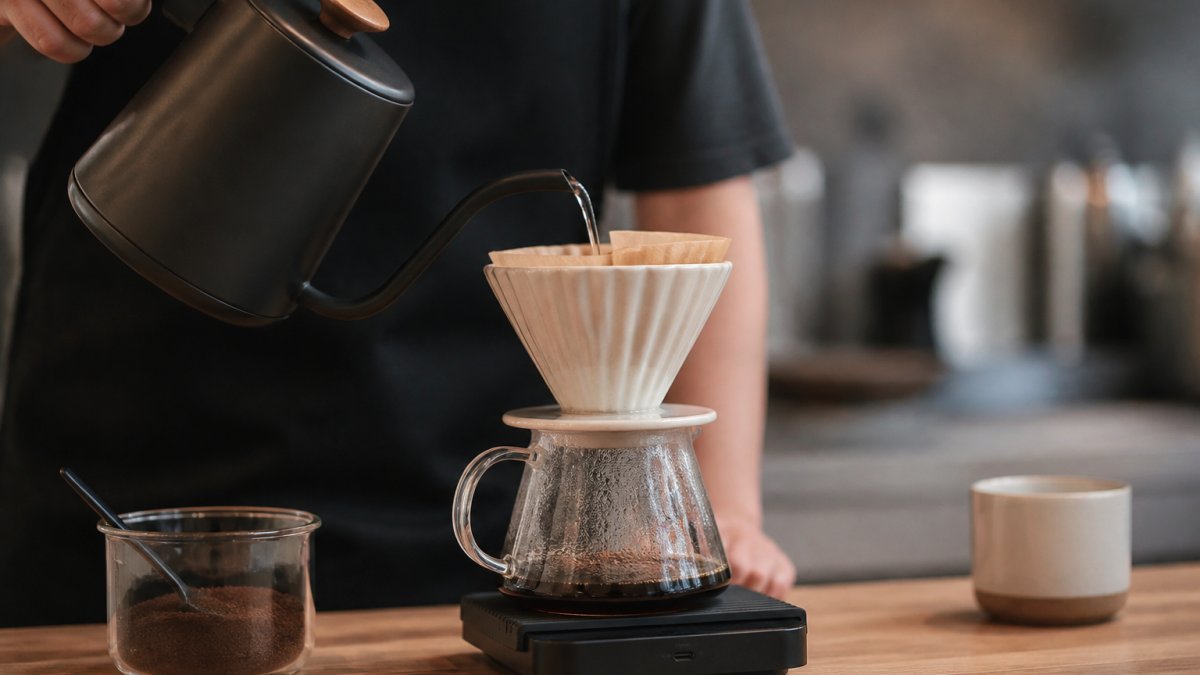
Pour-over brewing (V60, Chemex, Melitta) is temperature-sensitive because you control the water heat directly, with no machine buffering the swings.
For pour-over, start at 200°F. That gives a 2-3 minute brew and balanced extraction. Water cools as it moves through the grounds, so the bed ends up around 190-195°F.
Adjust based on taste:
- Sour, weak coffee → increase water temperature to 205°F
- Bitter, harsh coffee → decrease water temperature to 195°F
- Flat, muddy coffee → check your grind size (too coarse) before adjusting temp
The thicker-walled Chemex holds heat better, so 198°F still extracts fully. The thinner V60 cools faster, use 202°F to compensate.
Pouring boiling water (212°F) into a pour-over is a common mistake. It over-extracts in seconds. The first pour tastes harsh. By the end, it tastes burnt. Always let your kettle cool for 30 seconds after boiling.
French Press Water Temperature and Immersion Brewing
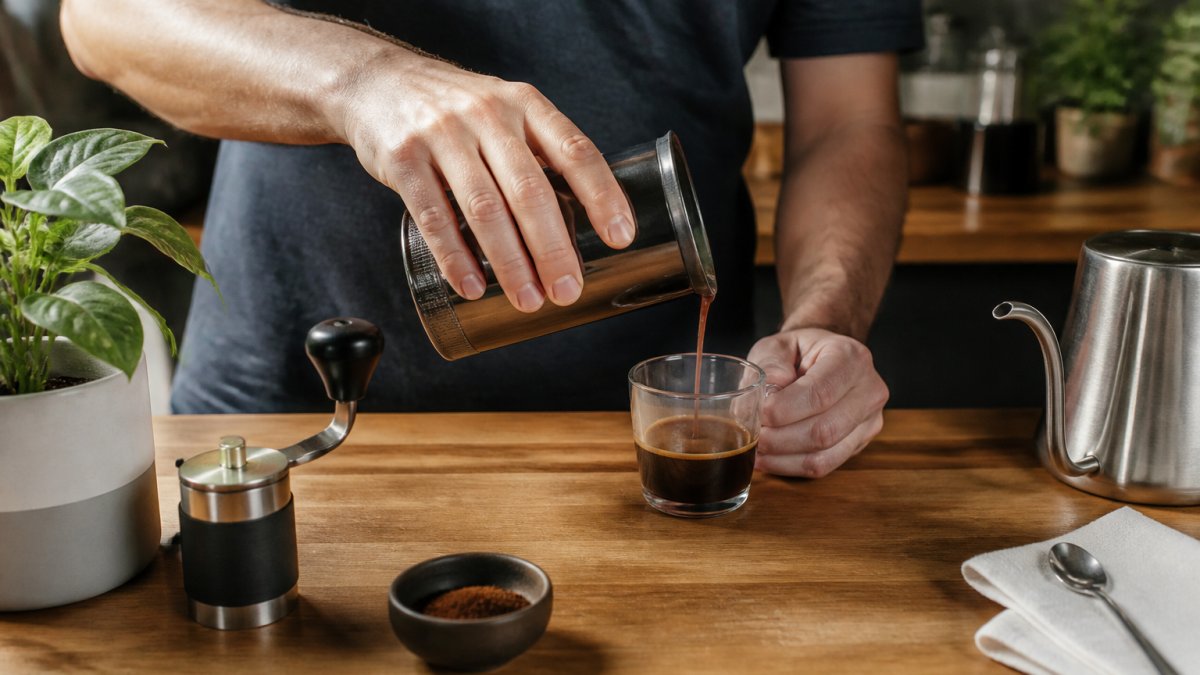
French press (press pot) is immersion brewing: grounds sit in hot water for 4 minutes, so temperature matters differently.
For French press, use 195-200°F water. The grounds stay in contact the whole time, so you don't need as much heat.
The AeroPress works similarly, immersion-based despite the pressure.
Cold brew is the exception: room-temperature or cold water for 12-24 hours, where time, not temperature, controls extraction speed.
Coffee Brewing Temperature Chart and Quick Reference
Use this table to find your starting point. Taste your coffee, then adjust up or down by 5°F as needed.
| Brewing Method | Ideal Temperature | Brew Time | Grind Size |
|---|---|---|---|
| Pour-Over (V60, Melitta) | 200-202°F | 2-3 minutes | Medium |
| Chemex | 198-200°F | 3-4 minutes | Medium-Coarse |
| French Press | 195-200°F | 4 minutes | Coarse |
| AeroPress | 195-205°F | 1-2 minutes | Medium |
| Moka Pot | 200-205°F | 5-10 minutes | Fine |
| Turkish Coffee | 200-205°F | 3-5 minutes | Very Fine |
| Cold Brew | 40-50°F | 12-24 hours | Coarse |
This chart is a starting point, not a rule. Your specific coffee, your water, and your equipment will push you slightly higher or lower. Keep notes on what works.
Measuring and Adjusting Temperature Without a Thermometer
A thermometer is the cheapest upgrade to your coffee, but many people who own one measure the wrong thing. Here's how to hit a target temperature without gear, and how to measure what actually matters when you have it.
Kettle temperature is not brewing temperature
Your kettle display shows the water temperature in the kettle. What matters is the temperature at the coffee bed, where water meets grounds. Those two numbers are never the same.
Heat loss happens in three places:
- The pour. Water leaves the kettle spout, travels through air, and hits the grounds. A slow gooseneck pour loses more heat than a fast pour.
- The brewer. A thick-walled ceramic or double-walled brewer holds heat. A thin glass V60 or a bare metal cone sheds it. A preheated brewer can close most of the gap; a cold one can drop bed temperature by 5-10°F in the first pour.
- The room. A cold kitchen in winter pulls more heat out of the slurry than a warm one. This is why the same recipe can taste different on a January morning versus a July afternoon.
A common pattern: kettle set to 205°F, bed measured at 195-198°F during the pour. That 7-10°F gap is normal, and why "brew at 200°F" advice is fuzzy. 200°F where?
Preheating the brewer
Before pouring, rinse the brewer and filter with hot water and dump it. This removes papery taste from the filter and warms the brewer walls so they stop stealing heat from your slurry. Skipping this is a common cause of cups that taste cooler than intended.
If you have a thermometer
Any instant-read digital thermometer works. Look for one that reads in under 3 seconds and is accurate to ±1°F. Basic kitchen models run $10-$25; thin-tip thermocouple probes are faster and more accurate but cost more.
How to check it:
- Ice bath test. Fill a glass with crushed ice and a little water. Stir for 30 seconds. Insert the probe without touching the sides. It should read 32°F. If it's off by more than 2°F, note the offset and adjust your readings.
- Boiling test. Bring water to a rolling boil. Insert the probe. At sea level it should read 212°F. At 5,000 feet it should read about 203°F. Altitude changes the boiling point, so this test doubles as a check on your elevation assumptions.
Once calibrated, measure in two places: the kettle (to confirm your target) and the slurry (to see what the coffee actually experienced). The slurry reading is the one to write down.
If you don't have a thermometer
You can still get repeatable results. Pick one method and use it identically every time, so results are consistent even if not precise.
The cooling curve. Boil water, then wait. In a typical room-temperature kitchen with a standard kettle:
- Boiling (212°F) → wait 30 seconds → roughly 205°F
- Boiling (212°F) → wait 1 minute → roughly 200°F
- Boiling (212°F) → wait 2 minutes → roughly 195°F
- Boiling (212°F) → wait 3 minutes → roughly 190°F
The bubble test. Watch the water as it heats:
- Tiny bubbles clinging to the pot sides, no movement: around 160-180°F
- Small bubbles rising steadily, surface starting to shimmer: around 190-200°F
- Large rolling bubbles, visible steam: around 205-210°F
- Vigorous, continuous, splashing boil: 212°F
The bubble test is coarse. It's useful for confirming you're in the right zone, not for hitting a specific degree.
The hand test. Hold your palm 5 inches above the water surface. Count seconds until the heat is uncomfortable:
- 3 seconds: very hot, roughly 205-210°F
- 5 seconds: hot, roughly 195-205°F
- 8 or more seconds: warm, roughly 185-195°F
This is the least precise method, but repeatable if done the same way every time. Use it as a sanity check, not a target.
Temperature-controlled kettles
If you brew pour-over regularly, a variable-temperature gooseneck kettle pays off fastest.
Even with a good kettle, remember the gap: set it 5-10°F above your target bed temperature to account for pour and brewer losses.
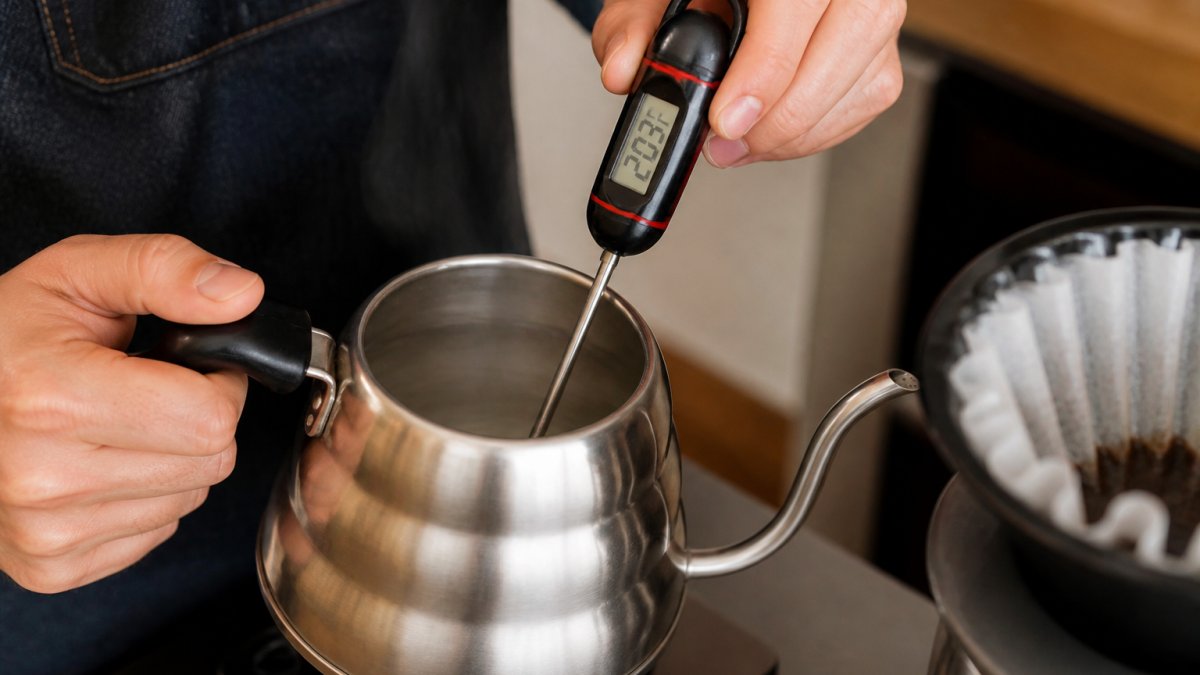
Write down two numbers for every brew: kettle temperature and slurry temperature (if you can measure it). After a few sessions you'll know your personal offset, the gap between what you set and what the coffee actually got. That offset is more useful than any generic recipe.
Troubleshooting Brew Problems by Temperature and Taste
Your cup tells you what happened. Learn to read it.
Sour, thin, weak coffee: water too cool, extraction incomplete. Fix: increase water temperature by 5°F next brew.
Bitter, harsh, burnt coffee: water too hot, extraction too fast or too complete.
Salty, metallic taste: a water quality issue, not temperature, high mineral content or chlorine. Fix: use filtered water.
The feedback loop works. Brew, taste, adjust, repeat. After five brews, you'll know your coffee and your water.
Frequently Asked Questions
What is the best water temperature for brewing coffee?
The ideal water temperature for brewing coffee is 195-205°F (90-96°C). This range extracts the right amount of soluble compounds from coffee grounds to produce balanced flavor, sweetness, and body. Most brewing methods perform best within this window. If your water is too hot, you risk over-extraction and bitter taste; too cool causes under-extraction and sourness. Start at 200°F and adjust based on your roast level and brew method.
How does water temperature affect the taste of coffee?
Water temperature directly controls extraction rate, how quickly flavor compounds dissolve into your brew. Hotter water extracts faster and pulls out more compounds, increasing bitterness and body. Cooler water extracts slowly, leaving behind sweetness and acidity, which can taste sour if extraction is too low. The sweet spot at 195-205°F balances these compounds for clean, complex flavor with proper acidity and sweetness. Roast level and grind size also influence how temperature affects taste.
Should you use different water temperatures for different coffee beans?
Yes. Lighter roasts benefit from slightly hotter water (200-205°F) because they're denser and need more extraction to reveal their complexity. Darker roasts work better at slightly cooler temperatures (195-200°F) because they're already more soluble and over-extraction at high heat produces harsh bitterness. Experiment within the 195-205°F range and adjust 2-3 degrees based on whether your brew tastes sour (too cool) or bitter (too hot).
What temperature should water be for pour-over coffee?
Pour-over coffee typically brews best at 195-205°F. Start at 200°F for medium roasts. Because pour-over exposes grounds to water quickly, hotter temperatures work well here. If your pour-over tastes sour, increase temperature to 203-205°F. If it tastes bitter, drop to 195-198°F. The contact time is short (2-4 minutes), so temperature consistency matters more than in immersion methods. Use a gooseneck kettle and thermometer for precision.
Getting the best water temperature for brewing coffee right transforms your daily cup. Start at 200°F, taste your results, and adjust by 5°F based on what you experience. Third Space Coffee's in-house roasted beans are designed to shine at this temperature range, our roasters dial in roast profiles knowing you'll brew at these standards. Visit us to taste the difference quality water temperature makes, and explore our meeting space for your next team gathering.