
Which permit you need depends on where your event happens and what it involves. Street closures, beer gardens, high-risk activities, or crowds over 10,000 people all require a Citywide Special Event Permit. If your event stays entirely inside a city park with none of those triggers, you'll likely file the Parks, Recreation and Cultural Services (PRCS) Special Event Permit instead. Serving alcohol adds a third layer: the Special Event Liquor Permit, reviewed by both the city and the Colorado Department of Revenue's Liquor Enforcement Division.
Your first 48 to 72 hours matter more than people realize. Confirm your event's exact location first, since that single fact determines your entire application path. Check whether you need a street closure, a beer garden, or anything the city classifies as high-risk. Then open the Permit Partner portal and start an account, even before you've nailed down every detail.
Do these now, in order:
- Reserve your park or venue location if the event isn't on private property.
- Start shopping for a Commercial General Liability policy, since underwriting takes time.
- Call the Office of Special Events to get your Application Review Meeting on the calendar.
Three resources to bookmark immediately: the Permit Partner community events portal, the PRCS Special Event FAQ for park-only events, and the Special Event Liquor Permit packet if alcohol is involved anywhere in your plans.
Key Takeaways
Choosing the correct permit category early and filing well before the 90 day deadline is what separates a smooth approval from a last minute scramble.
| Point | Details |
|---|---|
| Identify your triggers first | Street closures, beer gardens, high-risk activities, or over 10,000 attendees mean you need the Citywide permit. |
| File early, not at the deadline | Submit well before 90 days out since completeness review and the Application Review Meeting both take time. |
| Budget for the minimum insurance coverage | Commercial General Liability naming the City as additional insured is required for every special event. |
| Treat liquor permits separately | Expect $100 per event day plus a $12.50 poster fee, capped at 15 permit days per organization yearly. |
| Consider a small venue for private events | Third Space Coffee offers space for up to 150 guests with catering built in, often bypassing citywide review entirely. |
Table of Contents
- Which Events in Colorado Springs Require a Permit?
- Which Permit Should You Apply For?
- How to Apply: A Step-by-Step Checklist
- What Insurance and Safety Documents Do You Need?
- Serving Alcohol: Special Event Liquor Permit Rules
- How Do Road Closures and Traffic Control Work?
- What Are the Park-Specific Rules for Events?
- What Do Event Permits and Fees Typically Cost?
- What Happens After You Submit Your Application?
- What Happens if Your Permit Is Denied or Suspended?
- Organizer's Timeline and Checklist
- How Third Space Coffee Handles a Permitted Event
- What City Staff Wish More Organizers Knew
- Need a Small, Flexible Venue Without the Permit Headache?
- Frequently Asked Questions
- Sources
Which Events in Colorado Springs Require a Permit?
A surprising number of gatherings that feel "small" still trigger a permit requirement. The city's own guidance lays out specific triggers, and if any one of them applies to your event, you need to file the Citywide Special Event Application.
The main triggers are:
- Closing any public street, alley, or right-of-way, even temporarily.
- Expecting a very large number of participants at any point during the event.
- Operating a beer garden or any alcohol service area open to the public.
- Running high-risk activities such as fireworks, pyrotechnics, motorized racing, or aerial performances.
- Holding an event on public property outside a designated city park or open space.
A neighborhood block party that closes off one street falls under Citywide review, even with fewer than 200 attendees. A brewery-sponsored festival with a fenced beer garden needs the same review, regardless of park location. Compare that to a birthday picnic reserving a pavilion at Palmer Park: no street closure, no alcohol sales, no fireworks. That one likely only needs the PRCS Special Event Permit.
When you're not sure which category fits, the safer move is applying anyway. A rejected or unnecessary application costs you a phone call. A missing permit for an event that needed one can shut down your event on the day itself.
Which Permit Should You Apply For?
Four separate applications cover almost every scenario, and picking the wrong one is the single biggest cause of delayed approvals. Here's the decision flow that actually works:
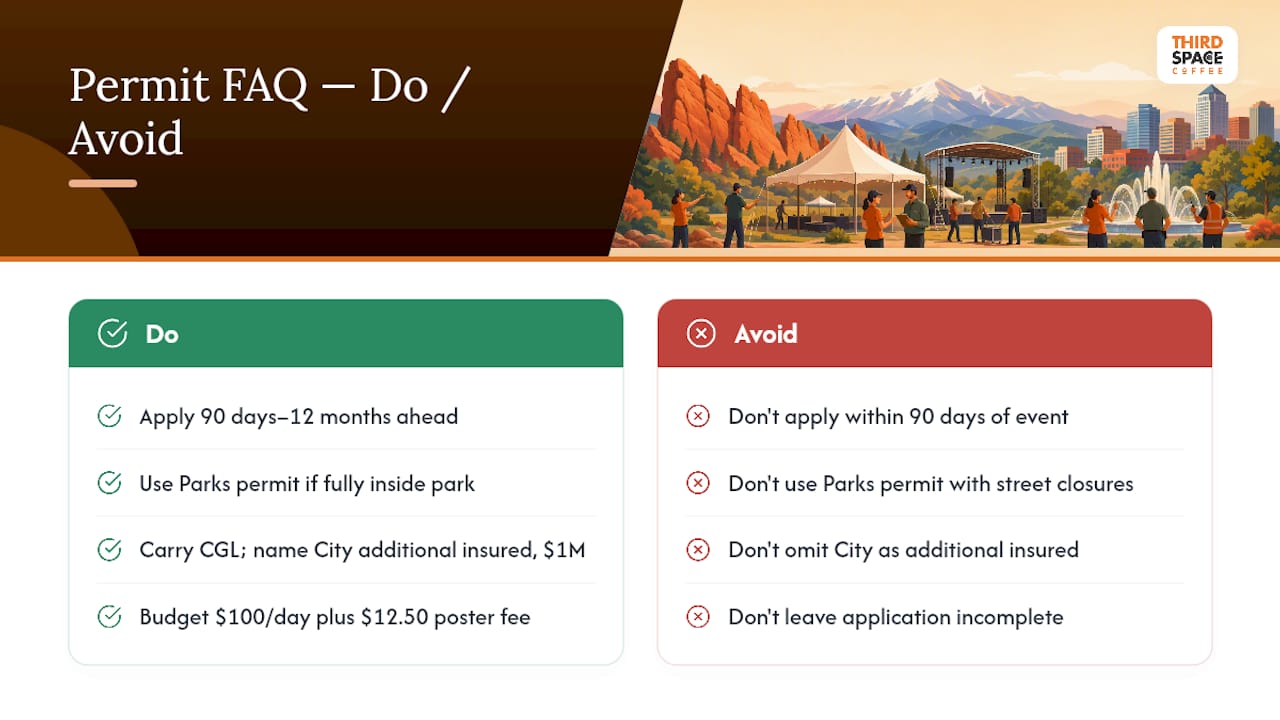
If your event has a street closure, beer garden, high-risk activity, or more than 10,000 attendees: file the Citywide Special Event Permit Application through Permit Partner. This is the broadest and most heavily reviewed permit category.
If your event happens entirely inside a City Park or Open Space and has none of those triggers: use the Parks/PRCS Special Event Permit. Events contained fully within park boundaries follow PRCS-specific rules rather than the citywide process.
If you're using a parking lot or private commercial property for a short-term event: you may need a Temporary Use Permit instead. This applies to pop-up markets, food truck rallies, and similar short-duration uses that don't fit neatly into park or street categories.
If alcohol will be sold or served at any point: you need a Special Event Liquor Permit on top of whatever base permit applies to your venue and activities.
Many events need more than one permit stacked together. A summer festival held in a city park that also sells beer needs the PRCS permit and the liquor permit simultaneously. A parking-lot food truck rally with a beer garden might need a Temporary Use Permit plus a liquor permit. Don't assume one application covers everything just because you filed something.
- Citywide Special Event Permit: street closures, beer gardens, high-risk activities, >10,000 attendees.
- Parks/PRCS Special Event Permit: fully contained within a park or open space.
- Temporary Use Permit: parking lots or private property, short-term use.
- Special Event Liquor Permit: any alcohol sale or service, filed alongside the base permit.
Pro Tip: Call the Office of Special Events before you submit anything if your event touches a park boundary but also spills onto an adjacent street. Staff can tell you in one conversation whether you need the citywide review or just the PRCS permit, which saves you from filing the wrong paperwork and starting the clock over.
How to Apply: A Step-by-Step Checklist
Getting your application accepted on the first try comes down to preparation, not luck. Here's the sequence that works:
- Create an account on the Permit Partner portal or contact the Office of Special Events directly for paper forms.
- Confirm your event location and date, then check availability if you're reserving a specific park or pavilion.
- Draft your site plan showing entrances, vendor placement, restrooms, and any barricades or fencing.
- Build a traffic control plan if any street closure or detour is involved.
- Secure your Commercial General Liability insurance quote and confirm the policy language names the City as additional insured.
- Collect vendor insurance certificates from any food trucks, contractors, or third-party sellers.
- Submit the complete application package through Permit Partner at least 90 days before your event date.
- Respond promptly to any completeness-review requests from city staff.
- Attend your scheduled Application Review Meeting with final documents in hand.
The completeness check trips up more organizers than any other step. Reviewers aren't grading your event idea. They're checking whether every required document is present and internally consistent.
| Document | Why the City Requires It | When to Submit |
|---|---|---|
| Site plan | Shows layout for emergency access and crowd flow | With initial application |
| Traffic control plan | Documents detours, barricades, and signage for closures | With initial application if streets are affected |
| Vendor insurance certificates | Confirms third parties carry adequate coverage | Before the Application Review Meeting |
| Certificate of Good Standing | Verifies your organization is legally registered | When required for nonprofit or corporate applicants |
| Liquor license documentation | Confirms sales tax registration and permit eligibility | With Special Event Liquor Permit application |
Pro Tip: The three most common reasons applications bounce back are incomplete site plans missing exact measurements, insurance certificates that don't explicitly name the City of Colorado Springs as additional insured, and organization names on the application that don't match the name on the insurance policy. Fix all three before you hit submit and you'll skip an entire review cycle.
What Insurance and Safety Documents Do You Need?
Every special event in Colorado Springs needs Commercial General Liability insurance naming the City as additional insured, with a minimum of $1,000,000 per claim and in the aggregate. That's the floor, not the ceiling. Larger events, or those involving higher-risk activities, can be required to carry additional coverage beyond that minimum.
Serving alcohol adds liquor legal liability to the mix. If you're using a third-party bartending service or caterer to pour drinks, that vendor typically needs their own liquor liability certificate on file before the event, separate from your general liability policy.
Beyond insurance, expect to document:
- A site-specific emergency action plan covering medical response and evacuation routes.
- Security staffing plans for events expecting large or unpredictable crowds.
- Written approval for any pyrotechnics, fireworks, or open-flame elements.
- Certification for any temporary structures, stages, or amusement equipment.
Concerts, motorized events, and festivals with capacities in the thousands routinely get asked for coverage well above the $1,000,000 baseline, plus dedicated security staffing plans reviewed by police before approval.
Serving Alcohol: Special Event Liquor Permit Rules
Alcohol service triggers a separate regulatory track that runs through both city and state authorities. A licensed organization applies through the city, but the underlying rules come from Colorado's liquor code, enforced jointly with the Colorado Department of Revenue's Liquor Enforcement Division.
The fee structure is straightforward on paper: $100 per event day plus a one-time $12.50 poster fee. A three-day festival serving alcohol each day would run $300 in daily fees plus the single poster charge, though you should always confirm current pricing with the city before budgeting, since fee schedules shift.
There's a hard cap worth planning around: a Special Event Liquor Permit holder can get a maximum of fifteen permits per calendar year, with each permit valid for a single day. If your organization runs a recurring event series with alcohol service, that 15-day cap can sneak up on you faster than expected.
Special event liquor permits also carry tighter restrictions than a standard liquor license on service windows and total operating days, which is why organizers should treat the liquor piece as its own regulatory process rather than an add-on to the base event permit. Vendors pouring on your behalf need their own liquor liability certificate, and the permit holder's coverage generally needs to reflect the added liability of alcohol sales to the public.
How Do Road Closures and Traffic Control Work?
Any event affecting a public street pulls in more than one city department. Traffic Engineering reviews your traffic control plan for signage and detour logic. Police coordinate staffing for closures and crowd control. Fire needs clear emergency access maintained through your site plan. Public Works gets involved when barricades or road equipment are needed.
Your traffic control plan has to show exactly where barricades, cones, and detour signs go, plus how emergency vehicles can still reach the site if needed. Costs for officer overtime and barricade rental add up fast, and Permit Partner's fee estimator is the best place to get a rough number before you're locked into a budget.
Here's who typically pays: the event organizer, not the city. Traffic control costs get billed directly, often requiring payment or a deposit before final approval. If your event crosses onto a state highway or spans multiple jurisdictions, expect an additional layer of coordination with the Colorado Department of Transportation, and build extra lead time into your timeline for that back and forth.
- Traffic Engineering: reviews and approves the traffic control plan.
- Police Department: staffs closures and manages crowd safety.
- Fire Department: confirms emergency access stays clear.
- Public Works: coordinates barricade and signage logistics.
What Are the Park-Specific Rules for Events?
Booking a park pavilion for a small gathering isn't the same process as reserving one for a permitted event, and that distinction trips up a lot of first-time organizers. Small groups can often use certain pavilions on a first-come, first-served basis. Anything larger, or anything involving vendors, amplified sound, or paid admission, needs the PRCS Special Event Permit Application.
Some park rules surprise people who assume a reservation covers everything. Bounce houses and inflatables are commonly restricted under standard pavilion rentals, even when the rest of your event is approved. Reserved pavilions come with restoration expectations, meaning you're on the hook for returning the space to its original condition after teardown.
If you're running fee-based activities inside a park, such as ticketed access or paid vendor booths, you may need an additional Permit for Organized Fee-based Activity (POFA) or a Temporary Use Permit layered on top of the base park reservation. Check with PRCS staff early if money changes hands anywhere on-site.
What Do Event Permits and Fees Typically Cost?
Budgeting for permits means accounting for more than the sticker price on the application itself. A few reference points:
- Special Event Liquor Permit: $100 per event day plus a $12.50 poster fee, capped at 15 permit days per organization per year.
- Traffic control costs: billed separately based on officer overtime and barricade needs, not included in the base permit fee.
- Additional insurance: required above the $1,000,000 minimum for larger or higher-risk events, priced by your carrier.
The Permit Partner portal can generate an estimate of total fees and required approvals once you enter your event details, which beats guessing. Fee schedules do change, so verify current numbers on the portal or with the Office of Special Events before you finalize a budget.
Build in room for conditional costs that don't show up until later in the process: extra traffic control if your route changes, overtime for public-safety staffing on event day, and follow-up inspections if your site plan gets revised.
What Happens After You Submit Your Application?
Submitting your application starts a two-stage review. First comes a completeness check, where the Office of Special Events confirms every required document is present and emails you a list of anything missing. This isn't a judgment on your event concept. It's purely administrative.
Once your file is complete, you'll be scheduled for an Application Review Meeting. Bring your final site plan, insurance declarations page, and any signed vendor contracts. This meeting is where city staff walk through logistics, flag concerns, and confirm what's still outstanding before final sign-off.
Expect the city to make contact within roughly two business days of submission, though full approval takes longer depending on your event's complexity. If staff request changes, whether that's a revised traffic plan or updated insurance wording, address those quickly. The clock on your event date doesn't stop for revisions.
- Completeness review confirms all documents are present.
- Application Review Meeting covers logistics and outstanding items.
- Expect initial city contact within about two business days.
- Final issuance follows once all documents and plans are accepted.
What Happens if Your Permit Is Denied or Suspended?
Municipal code lays out specific grounds for denying or suspending a special event permit, and knowing them upfront helps you avoid triggering one. Common grounds include injury to public welfare, an inappropriate or unsafe location for the proposed activity, and a history of noncompliance from a previous event.
If you're denied, your first step is contacting the Office of Special Events directly to understand exactly what triggered the decision. Many denials come down to a fixable documentation gap rather than a fundamental problem with the event itself. Appeal or reconsideration options run through the city's established hearing process outlined in municipal code.
For liquor permits specifically, be aware that public notice and protest procedures can apply, meaning neighbors or affected parties may have a formal opportunity to object before approval.
The best defense against denial isn't a clever appeal. It's early coordination with city staff and documentation that's airtight the first time you submit.
Organizer's Timeline and Checklist
Two planning tracks cover almost every event: a long-lead track for complex events and a standard 90-day track for simpler ones. Applications can be filed as early as 12 months out and no later than 90 days before your event, and submitting exactly at that 90-day mark is riskier than it sounds, since it leaves no buffer for completeness review delays.
Here's a practical milestone sequence:
- 12 months out: Lock in your venue or park reservation and rough budget.
- 90 days out: Submit your complete application through Permit Partner, including site plan and traffic control plan if needed.
- 60 days out: Finalize vendor contracts and collect their insurance certificates.
- 30 days out: Confirm your Application Review Meeting and bring final insurance declarations.
- 1 week out: Complete a final walk-through of the site with your team.
| Point | Details |
|---|---|
| File early, not at the deadline | Submit well before the 90-day minimum to absorb any completeness-review delays. |
| Match names across documents | Insurance, application, and organization names must match exactly to pass review. |
| Confirm alcohol plans upfront | Liquor permits are a separate track with their own fees and yearly caps. |
How Third Space Coffee Handles a Permitted Event
Small venues face the same city requirements as large festival organizers, just at a different scale. When Third Space Coffee books a private event, the process starts with confirming guest count against the venue's capacity, since that number affects everything from insurance to fire code compliance.
Booking and capacity confirmation come first. Then the venue works with the client on insurance, since most private bookings at a venue this size don't require the same citywide review that a public street festival would, but any client bringing outside vendors, such as a mobile bartender or specialty caterer, still needs to provide that vendor's own certificate of insurance.
A practical scope split looks like this for organizers renting a small venue:
- The venue handles the physical space, in-house catering options, and basic front-of-house logistics like seating and customer flow.
- The organizer secures any permits the event itself triggers, such as a Temporary Use Permit for outdoor signage or a liquor permit if alcohol goes beyond what the venue's own license covers.
- Both sides confirm insurance requirements before the event date, since a mismatch here is the most common source of last-minute scrambling.
Third Space Coffee's event booking guidance walks organizers through exactly which of these responsibilities fall on the venue and which stay with the person hosting the gathering.
What City Staff Wish More Organizers Knew
Most permit delays trace back to one avoidable habit: waiting until the 90-day deadline to submit instead of treating it as the latest possible date. Filing exactly at the deadline leaves zero buffer for the completeness review and Application Review Meeting the city requires, and any missing document at that point pushes your approval dangerously close to your event date.
The single highest-leverage move an organizer can make is getting the insurance certificate language right the first time. "Names the City of Colorado Springs as additional insured" has to appear in the actual policy documentation, not just in an email assurance from your broker. Pair that with a site plan that shows real measurements instead of a rough sketch, and you'll clear most reviews without a second round of questions.
Working well with city staff isn't about being persistent. It's about being responsive. When the Office of Special Events flags something, answering within a day or two keeps your file moving instead of sitting in a queue behind more complete applications.
Need a Small, Flexible Venue Without the Permit Headache?
If your gathering is small enough to skip street closures, beer gardens, and crowd counts in the thousands, you may not need the full citywide permit process at all. That's where a venue like Third Space Coffee fits, offering private event space for up to 150 guests with catering and bar coordination built into the booking rather than assembled from scratch.

Third Space Coffee handles the venue, seating, and in-house catering options for your gathering. What stays with you as the organizer is anything the city requires beyond the venue walls: permits for outdoor elements, insurance naming the City as additional insured if your event triggers that requirement, and any street or traffic coordination if your event spills outside. For most private bookings, that split keeps things simple. Explore the specialty drinks menu for your event's beverage lineup, then reach out through the Third Space Coffee site to check availability and get your date on the calendar.
Frequently Asked Questions
How far in advance do I need to apply for event permits in Colorado Springs? File your Citywide Special Event Application at least 90 days before your event, and no more than 12 months ahead. Submitting closer to the 90 day minimum increases the risk of delays from the completeness review process.
Do I need a permit for a small gathering in a city park? If your event stays entirely within a City Park or Open Space and doesn't involve a street closure, beer garden, high-risk activity, or crowd over 10,000, you'll likely use the Parks/PRCS Special Event Permit instead of the citywide application.
How much does a Special Event Liquor Permit cost in Colorado Springs? The city's fee example is $100 per event day plus a one-time $12.50 poster fee, though you should confirm current pricing with the city before budgeting. Organizations are capped at 15 permit days per calendar year.
What insurance do I need for an outdoor event permit? You need Commercial General Liability insurance naming the City of Colorado Springs as additional insured, with a minimum of $1,000,000 per claim and in the aggregate. Larger or higher-risk events may require additional coverage.
Who pays for traffic control at a permitted event? The event organizer typically covers traffic control costs, including barricade rental and officer overtime, which get billed separately from the base permit fee.
What happens if my event permit application is incomplete? The Office of Special Events sends you a list of outstanding items after the initial completeness review. Your application won't move to the Application Review Meeting stage until those gaps are resolved.
Sources
- Community Events Portal — Permit Partner
- Special Event Liquor Permit application packet — City of Colorado Springs (Regulation 47-002)
- Office of Special Events | City of Colorado Springs
Forms and fees change periodically, so confirm current requirements on the city's own pages before you submit or pay anything. For permit-specific questions, the Office of Special Events remains your best first call.