
You can pull off a sharp, memorable small-business event in a specialty coffee shop by doing three things well: lock in a clear purpose, reserve the space before your calendar fills up, and run the day from a written agenda. Thirdspacecoffee in Colorado Springs holds up to 150 guests and handles in-house coffee and catering, so the logistics are simpler than you'd expect. Priya Parker, whose hosting philosophy centers on setting clear purpose in every invitation, puts it plainly: guests behave better and connect faster when they know exactly why they're in the room. Silicon Valley Speakers echoes that with a run-of-show framework built around one measurable goal.
- Define purpose and audience: Write one sentence that says what attendees will walk away with, then set a measurable goal (10 new contacts, 5 product demos, 20 RSVPs).
- Confirm the space: Check dates, capacity, and basic policies with Thirdspacecoffee before you announce anything publicly.
- Build a 3-week promotion timeline and finalize your run-of-show at least five days before the event.
Table of Contents
- How far in advance should you plan and promote?
- What does a realistic budget look like?
- What venue details matter most in a coffee shop?
- What should your run-of-show look like?
- How do you promote a coffee-shop event locally?
- Day-of logistics checklist
- How do you measure success and improve next time?
- What permits and legal requirements apply?
- How do you coordinate with coffee shop staff?
- What's your contingency plan when things go wrong?
- How do you book Thirdspacecoffee for your event?
- Thirdspacecoffee is ready when you are
- Key Takeaways
How far in advance should you plan and promote?
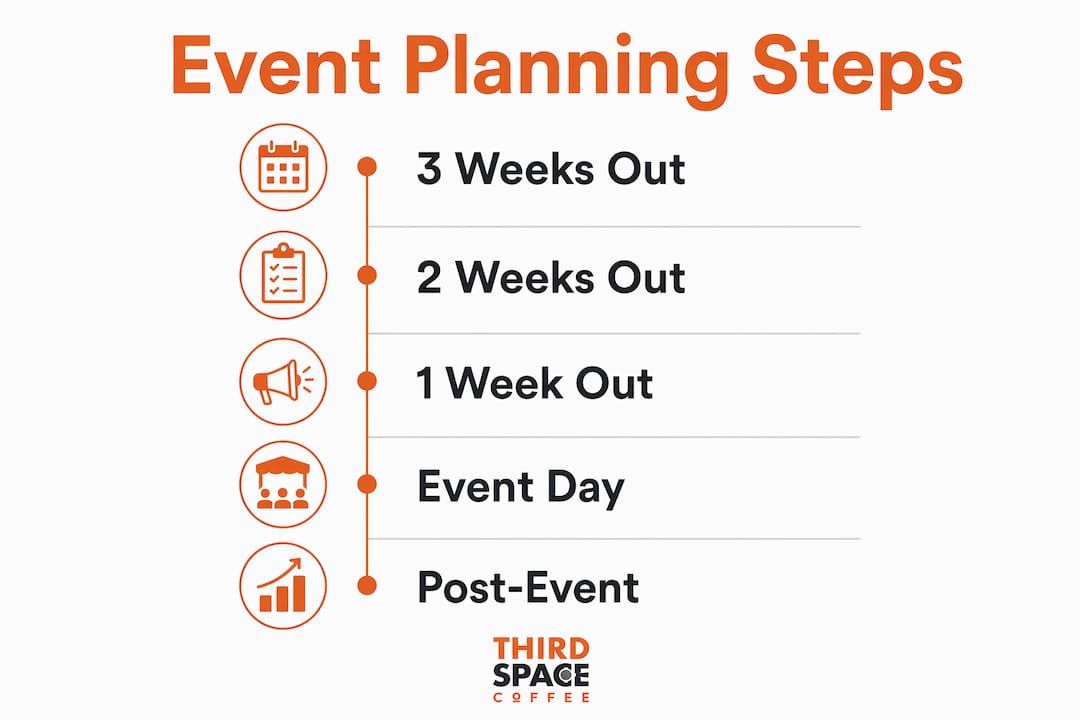
For a coffee-shop gathering of 20–80 people, three weeks is workable if you move fast. Here's a practical week-by-week breakdown:
| Week | Key actions |
|---|---|
| 3 weeks out | Confirm venue, set date, publish save-the-date on social and email |
| 2 weeks out | Open RSVP link, post event details, contact local partners |
| 1 week out | Send reminder email, finalize headcount, share run-of-show with staff |
| 2–3 days out | Confirm catering order, test AV, print signage |
| Day of | Setup 90 min early, tech check, greet early arrivals |
Promotion for small-business events works best when it starts several weeks out and follows up within days after with thank-you notes or a feedback request.
What does a realistic budget look like?
Budget by category from the start. Industry frameworks suggest allocating roughly 30–40% to venue, 20–25% to catering, and 10–15% to contingency for last-minute needs. For a 40-person networking night at a coffee shop, common budget items include venue rental fees, coffee and light food costs per person, signage and printed materials, and contingency funds to cover unexpected expenses.

Permits and insurance are worth a line item too. See the legal section below for specifics.
What venue details matter most in a coffee shop?
Layout drives everything. Removing one bulky piece of furniture can significantly increase usable mingling space, and thinking in zones — food, conversation, activity — prevents bottlenecks at the coffee bar. When evaluating a coffee-shop venue, confirm:
- Capacity: seated vs. standing (Thirdspacecoffee accommodates up to 150)
- AV and power: verify speaker placement, microphone availability, and power access before the event date
- Noise: ask about adjacent street noise and whether the shop has a sound system you can plug into
- Seating flexibility: can tables be rearranged for your format (classroom, rounds, standing)?
Coffee shops carry a natural community vibe that hotel ballrooms simply don't replicate, and the built-in beverage service removes one vendor from your list entirely.
What should your run-of-show look like?
A run-of-show is a minute-by-minute script that keeps energy on track. Here's a sample for a 90-minute evening networking event:
| Time | What happens | Who owns it |
|---|---|---|
| — | Doors open, coffee service begins | Venue staff |
| — | Open networking, background music | Host circulates |
| — | Welcome remarks, purpose statement | Host |
| — | Featured speaker or panel (15 min) | Speaker |
| — | Structured networking (2-min intros) | Facilitator |
| — | Q&A or open floor | Host moderates |
| — | Closing remarks, next steps, CTA | Host |
| — | Cleanup begins | Host + venue staff |
Priya Parker calls this "generous authority" — you set the structure so guests can relax into it. Assign every time block an owner so nothing falls through.
How do you promote a coffee-shop event locally?
Digital and local outreach together outperform either alone. A practical mix:
- Instagram and Facebook: post 3 weeks out, story reminders at 1 week and 48 hours
- Email list: one announcement, one reminder 3 days before
- Eventbrite or a free Google Form: for RSVP tracking and headcount
- Colorado Springs Chamber of Commerce calendar: free community listing
- Partner cross-promotion: ask one or two local businesses to share your event in exchange for a mention
Guest engagement tactics like a pre-event question in your RSVP form ("What's your biggest challenge right now?") give you conversation starters and help you tailor the agenda.
Day-of logistics checklist
Arrive 90 minutes before doors open. Run through this in order:
- Confirm table layout matches your zone plan
- Test microphone, laptop connection, and slide display
- Place printed signage at entrance and registration table
- Set up name tags and a sign-in sheet or QR code check-in
- Brief venue staff on service timing (when to start coffee, when to clear)
- Confirm emergency exits are clear and accessible
- Do a sound check at the back of the room, not just the front
Pro Tip: Run your tech check with the exact device you'll use during the event. Borrowed laptops and unfamiliar adapters are the number-one cause of delayed starts.
How do you measure success and improve next time?
Treat every event as a prototype: collect data, then iterate. Within 48 hours, send a short Google Form asking three questions: What worked? What would you change? Would you attend again? Track attendance against your RSVP count, note your actual spend vs. budget, and log any promotion channels that drove the most sign-ups. That data makes your next event faster and cheaper to plan.
What permits and legal requirements apply?
Hosting an event in a food and beverage venue in Colorado Springs involves a few specific considerations. If you're serving alcohol beyond what the venue's existing license covers, you may need a special events permit from the Colorado Liquor Enforcement Division. For events with paid admission, confirm whether a temporary sales tax license applies to your ticket revenue. General liability insurance is standard practice for private events; many venues require a certificate of insurance naming them as an additional insured. Check with El Paso County and the City of Colorado Springs directly for current permit requirements, as thresholds and fees change. This article is general information, not legal advice — confirm your specific situation with a licensed professional or the relevant city office.
How do you coordinate with coffee shop staff?
Staff coordination is where most first-time organizers drop the ball. Schedule a 15-minute pre-event walkthrough with the venue's point of contact at least one week before the event. Agree on:
- Service windows: when coffee and food come out, and when the bar closes
- Signal system: a simple hand signal or text so you can request more drinks mid-event without interrupting the program
- Cleanup roles: who breaks down tables, who handles trash, and whether you or the venue handles leftover food
Coordinating AV and staffing hand-offs up front prevents the awkward mid-event scramble where the host is chasing down a power strip while guests stand around.
What's your contingency plan when things go wrong?
Three problems hit most small events: tech failure, low turnout, and overcapacity. Have a plan for each before the day arrives.
Tech failure: bring a backup slide deck on a USB drive, know the venue's Wi-Fi password, and have a printed agenda so the program can continue without a screen.
Low turnout: design the agenda to work for 10 people as well as 40. Smaller rooms feel more intimate, not empty, when the format is conversation-based rather than lecture-style.
Overcapacity: if RSVPs spike past your venue limit, set up a waitlist immediately and communicate clearly. Thirdspacecoffee's 150-person capacity gives you real headroom for most small-business gatherings, but confirm the fire code limit for your specific room configuration.
How do you book Thirdspacecoffee for your event?
Booking the venue is straightforward. Here's the process:
- Check availability: contact Thirdspacecoffee through the website contact form or by phone to request your preferred date and a tentative hold.
- Site visit: request a walkthrough to confirm layout, AV setup, and catering options before signing anything.
- Review policies: ask about deposit requirements, cancellation terms, permitted external vendors (e.g., a photographer or outside speaker), and whether a beverage minimum applies.
- Confirm in writing: get the rental agreement, deposit amount, and any included services documented before you announce the event publicly.
- Finalize catering: Thirdspacecoffee's in-house coffee and food menu covers most small-event needs; confirm your per-person order at least 72 hours out.
Booking windows vary by season, so the earlier you reach out, the more date flexibility you'll have. For Colorado Springs community events and local business meetups, coffee shop rentals offer a cost-effective alternative to hotel meeting rooms with none of the sterile atmosphere.
Thirdspacecoffee is ready when you are

Thirdspacecoffee gives Colorado Springs event organizers something most venues can't: a space that already feels like a community, with in-house roasted specialty drinks and a flexible layout that scales from a 10-person strategy session to a 150-guest networking night. You're not renting a blank room and sourcing every vendor separately. The coffee, the ambience, and the staff coordination come with the space.
Typical event packages cover hourly rental, beverage service, basic AV, and setup/cleanup support. Whether you need a 2-hour morning meetup, an evening networking session, or a half-day workshop, the team can work with your format and headcount. Reach out through the Thirdspacecoffee website to check availability, request a site visit, or get a quote for your date.
Pro Tip: Apply Priya Parker's "generous authority" principle from the moment guests arrive: greet everyone by name, state the purpose of the gathering in your opening remarks, and make at least two specific introductions between guests who don't know each other. That one habit changes the room.
Key Takeaways
Hosting a successful small-business event in a Colorado Springs coffee shop comes down to a clear purpose, a written run-of-show, and early venue coordination.
| Point | Details |
|---|---|
| Start promotion 3 weeks out | Announce on social and email at week 3; send a reminder 3 days before the event. |
| Budget by category | Allocate roughly 30–40% to venue, 20–25% to catering, and 10–15% as contingency. |
| Optimize layout in zones | Removing one bulky piece of furniture can significantly increase usable mingling space. |
| Treat each event as a prototype | Collect post-event data on spend, attendance, and promotion to improve the next one. |
| Book Thirdspacecoffee early | Thirdspacecoffee holds a substantial number of guests, accommodating various event sizes with in-house coffee, catering, and AV support. |