 ultimate-guide
How to Brew Better Coffee at Home: A 2026 Guide
Table of Contents
- Start With Fresh Beans and the Right Grind
- Nail the Coffee to Water Ratio
- Use a Coffee Grind Size Chart to Match Your Brewer
- Control Water Temperature and Quality
- Master Steeping Time, Bloom, and Agitation
- Choose the Right Brewing Method for Your Routine
- Know the Side Effects of Too Much Coffee
- Conclusion
- Frequently Asked Questions
Last Updated: September 16, 2026
Start With Fresh Beans and the Right Grind
The single biggest upgrade to your morning cup isn't a new machine. It's fresher beans and a consistent grind. Coffee is an agricultural product, and like any produce, it fades with time. Learning how to brew better coffee at home starts here, before water ever touches grounds. At Third Space Coffee, we roast in-house for exactly this reason: freshness you can taste.
Freshly roasted beans matter because of degassing. After roasting, beans release carbon dioxide for days. Brew too soon and that gas fights your water, producing uneven, sour cups. Most roasters rest beans for a few days before shipping for this reason.
Grind size is the second lever. A burr grinder crushes beans to a uniform particle size, while a blade grinder smashes them into a mix of dust and boulders. That inconsistency means some grounds over-extract and others under-extract in the same brew.
A common mistake is buying pre-ground coffee for a pour-over setup. It's convenient, but the grind rarely matches your brewer, and stale grounds lose aroma fast.
Nail the Coffee to Water Ratio
The coffee-to-water ratio is the measurement that most reliably fixes a bad cup. Start with 1 gram of coffee to 15-17 grams of water by weight. That's roughly 60 grams of coffee per liter of water.
Why weight instead of scoops? A tablespoon of coarse grounds and a tablespoon of fine grounds weigh differently. A scale removes that guesswork entirely, and precision here is what separates a good cup from a great one.
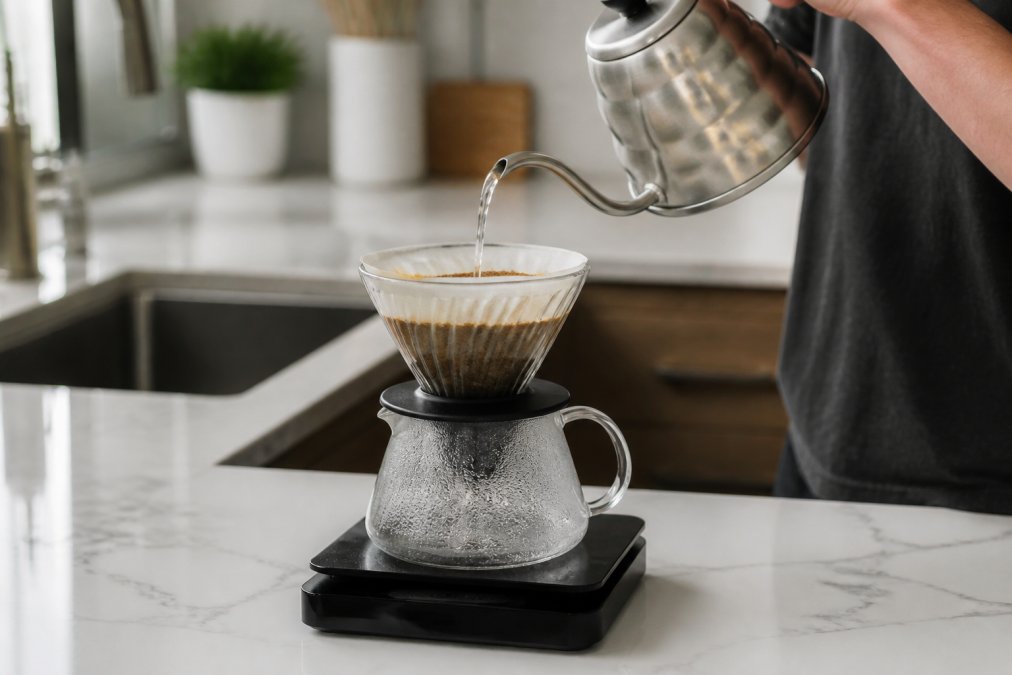
Using a Scale for Consistency
Weigh both your coffee and your water. A basic kitchen scale accurate to 0.1 grams is enough. Tare the scale with your brewer on it, add grounds, then track water as you pour.
For a single 12-ounce cup, that means about 22 grams of coffee and 350 grams of water. Adjust the ratio, not the technique, when a cup tastes too weak or too strong.
Use a Coffee Grind Size Chart to Match Your Brewer
A coffee grind size chart connects your equipment to your grind. Match the two and extraction evens out.
| Brewer | Grind Size | Brew Time | Best For |
|---|---|---|---|
| French press | Coarse | 4 minutes | Full body, immersion brewing |
| Drip machine | Medium | 5 minutes | Hands-off daily brewing |
| Pour-over | Medium-fine | 3 minutes | Clarity, tasting notes |
| AeroPress | Fine | 2 minutes | Fast, versatile single cups |
| Espresso | Very fine | 25-30 seconds | Concentrated shots |
The principle is simple: longer contact time needs coarser grounds, shorter contact time needs finer grounds. Get this wrong and no amount of good technique will save the cup.
Control Water Temperature and Quality
Water is roughly 98% of your cup, yet it's the variable most home brewers never touch. Temperature and mineral content shape flavor as much as the beans do, and unlike beans, water is cheap to fix.
Temperature: Aim for the Slurry, Not the Kettle
Target a slurry temperature (the water-plus-grounds mixture, not the kettle reading) between 195°F and 205°F. Boiling water scalds grounds and pulls out bitterness and ash; water below about 195°F under-extracts and leaves the cup sour and hollow.
A few practical notes:
- Kettle off-boil: After a full boil, wait 30-45 seconds before pouring. That lands most kettles in range at sea level.
- Altitude matters: Water boils lower as elevation rises. At 5,000 feet, boiling is about 203°F, already inside the target band, so don't wait as long.
- Preheat your brewer: A cold dripper or mug steals 5-10°F from the slurry on contact. Rinse the filter and vessel with hot water first.
- Immersion vs. pour-over: A French press loses heat fast; wrap it or use a preheated carafe. A pour-over loses heat with every pour, so keep the kettle on a warmer between pours.
Water Chemistry: The Lever Almost Nobody Pulls
Filtered water removes chlorine and off-flavors, but filtration alone doesn't make good brew water. What matters is the mineral profile, specifically three things:
1. Magnesium and calcium (hardness). These minerals bind to coffee compounds and carry flavor into the cup. Too little and coffee tastes flat and papery; too much and it tastes chalky and dull. Most practitioners find a total hardness around 50-175 ppm (as CaCO₃) is a workable home range.
2. Alkalinity (bicarbonate buffer). This is the sleeper variable. High alkalinity neutralizes coffee's natural acids, muting brightness and flattening tasting notes. Low alkalinity lets acidity shine but can push a light roast into sour territory. A common target is roughly 40-70 ppm alkalinity for balanced extraction.
3. TDS (total dissolved solids). This is the total mineral load. Distilled or reverse-osmosis water sits near 0 ppm and brews flat, lifeless coffee because there's nothing to extract into. A reasonable brew-water TDS is roughly 75-250 ppm.
What to Actually Do
- Start with filtered tap water. A simple carbon filter (pitcher or under-sink) strips chlorine and most off-flavors while leaving beneficial minerals intact. This is the right middle ground for most homes.
- Don't use distilled or straight RO water. It brews flat coffee. If RO is your only option, you need to remineralize.
- If your tap is very hard or very soft, consider building water from scratch: a gallon of distilled water plus a small measured addition of a brewing mineral concentrate (magnesium sulfate, calcium chloride, and a pinch of baking soda for alkalinity). Pre-made brewing-water packets and concentrates exist for exactly this.
- Taste-test the difference. Brew the same beans with tap, filtered, and remineralized water back to back. The gap is usually obvious and immediate.
For most people, filtered tap water heated just off a boil is plenty. If you want to go deeper, a TDS meter (about $15-25) and a GH/KH test kit for aquariums let you measure your water and adjust with data instead of guesswork, the same tools advanced home brewers use.
Master Steeping Time, Bloom, and Agitation
Bloom, steeping time, and agitation control how evenly water reaches your grounds, but the reason they matter is extraction, and extraction is measurable. Once you understand the numbers, you stop guessing.
The Bloom: Why 30 Seconds Changes Everything
The bloom is a quick pre-wet: pour just enough water (roughly 2x the weight of your grounds) to saturate them, then wait 30-45 seconds. Fresh beans release trapped carbon dioxide during this window, visible as bubbling and swelling.
Steeping Time by Method
Steeping time depends on your brewer and grind:
- French press (immersion): ~4 minutes, then press slowly and decant immediately to stop extraction.
- Pour-over (percolation): total brew time ~2:30-3:30, including the bloom.
- AeroPress: 1:30-2:30 depending on recipe; longer for finer grinds.
- Drip machine: 4-6 minutes total cycle; if yours runs faster, the grind is likely too coarse.
Agitation: The Underrated Dial
Agitation, a gentle stir or swirl, helps water contact every particle and evens out extraction.
Going Prosumer: Measuring Extraction Yield and TDS
The target ranges most practitioners use:
How to measure it at home:
A common pattern is to start with taste, then use a refractometer only when a cup is confusing, too bitter and too sour, or inconsistent bag to bag. That's when the data earns its keep.
Choose the Right Brewing Method for Your Routine
The best brewing method is the one you'll actually use every morning.
Know the Side Effects of Too Much Coffee
The side effects of too much coffee are real, and knowing your limit matters as much as dialing in your brew.
Conclusion
Brewing better coffee at home comes down to a handful of controllable variables: fresh beans, a consistent grind, a measured ratio, and water that's hot enough but not boiling.
Frequently Asked Questions
What is the most effective way to brew coffee at home?
The most effective approach combines fresh beans, a burr grinder, filtered water at 195-205°F, and a consistent coffee to water ratio by weight. Start with a 1:15 to 1:17 ratio, adjust grind size to match your brewer, and keep your equipment clean. Small changes in grind and ratio make the biggest difference in the cup, so change one variable at a time and taste the results.
How does water temperature affect coffee extraction?
Water temperature controls how quickly compounds dissolve from the grounds. Water between 195°F and 205°F extracts sweetness, acidity, and body evenly. Water that is too hot pulls out bitter compounds and creates a harsh cup. Water that is too cool under-extracts, leaving the coffee sour and thin. If you do not have a temperature-controlled kettle, boil water and let it sit for about 30 seconds before pouring.
What are the side effects of too much coffee?
Drinking more than about four 8-ounce cups per day can cause jitteriness, insomnia, rapid heartbeat, upset stomach, and anxiety. Caffeine also raises blood pressure temporarily and can interfere with sleep if consumed in the afternoon. Most healthy adults can handle 400 mg of caffeine daily, roughly four cups of brewed coffee. If you notice these side effects, cut back gradually or switch to decaf in the afternoon.
Why is a burr grinder essential for better coffee?
A burr grinder crushes beans between two abrasive surfaces, producing particles that are uniform in size. Blade grinders chop unevenly, leaving fine dust and coarse chunks that extract at different rates, which makes the cup taste both bitter and sour at once. Uniform grind size gives you predictable extraction, so you can dial in your coffee to water ratio and grind setting with repeatable results.