 ultimate-guide
Coffee Bean Origin: Why Flavor Notes Change
Last Updated: November 4, 2026
Quick Summary
Coffee bean origin affects flavor notes because every cherry grows inside a specific combination of climate, altitude, soil, and plant genetics, and that combination changes how the bean develops its sugars and acids. Origin sets a range of possibilities, while processing, roasting, and brewing decide where inside that range your cup actually lands.
- A wide day-to-night temperature swing slows cherry maturation, giving denser beans with more concentrated sugars and acids.
- Washed coffee has the fruit stripped off before drying, producing clean, bright cups where origin character shows clearly.
- Light roasts preserve acidity, floral notes, and fruit, so start light to medium to taste where a coffee grew.
- For a side-by-side tasting, buy two origins at the same roast level and brew them identically.
- Cupping removes brew-method variables and gives the clearest read on origin character.
Table of Contents
- How Coffee Bean Origin Shapes Flavor Notes
- Coffee Terroir Explained: Climate, Soil, and Microclimate
- How Altitude Affects Coffee Flavor
- Coffee Processing Methods: Washed, Natural, and Honey
- Genetics and Cultivar: How Variety Interacts with Terroir
- Roast Profiles and Regional Flavor Profiles
- How to Taste and Verify Origin Notes at Home
- Taste the Difference in Your Next Cup at Third Space Coffee
- Frequently Asked Questions
How Coffee Bean Origin Shapes Flavor Notes
Coffee bean origin affects flavor notes because every cherry grows inside a specific combination of climate, altitude, soil, and plant genetics, and that combination changes how the bean develops its sugars and acids. This guide breaks down the forces behind those differences and, more importantly, how to taste them in your own cup.
Here is the part most guides skip: origin does not write flavor directly. It sets a range of possibilities, and processing, roasting, and brewing decide where inside that range your cup actually lands.
The 80/20 Rule of Coffee Flavor
Think of flavor as a chain with four links: genetics, environment, processing, and roast. Origin covers the first two. A washed Ethiopian and a washed Brazilian can share a processing method and a medium roast and still taste nothing alike, because the raw material differs before either step begins.
That is the 80/20 of coffee: origin and processing do most of the work. Roast adjusts the edges. Brewing decides how much of the range you actually taste.
Coffee Terroir Explained: Climate, Soil, and Microclimate
Coffee terroir explained simply is the total growing environment of a farm: temperature, rainfall, sunlight, soil chemistry, slope, and the small-scale weather patterns of one hillside. Two farms a mile apart can produce measurably different beans.
Climate and Growing Conditions
Coffee grows best in a band around the equator with warm days and cool nights. A wide day-to-night temperature swing slows cherry maturation, and slower maturation generally means denser beans with more concentrated sugars and acids.
Rainfall timing shapes the harvest too. A pronounced dry season pushes the tree to flower all at once, which gives pickers a more uniform crop. Constant rain spreads flowering out, so cherries ripen unevenly and lots get blended across ripeness stages.
Soil Composition and Nutrients
Volcanic soils, common across much of Central America and East Africa, drain well and hold minerals that feed the plant. Well-drained soil keeps roots healthy; waterlogged soil stresses the tree and shows up as flat, muddy flavor.
Soil alone rarely explains a flavor note. It works alongside altitude, shade, and variety. Treat "volcanic soil equals chocolate" as a rough clue, not a rule.
How Altitude Affects Coffee Flavor
How altitude affects coffee flavor comes down to temperature: higher farms are cooler, cherries ripen slower, and denser beans typically carry brighter acidity, more aromatic complexity, and finer texture. Low-grown coffee ripens fast and often tastes softer and simpler.
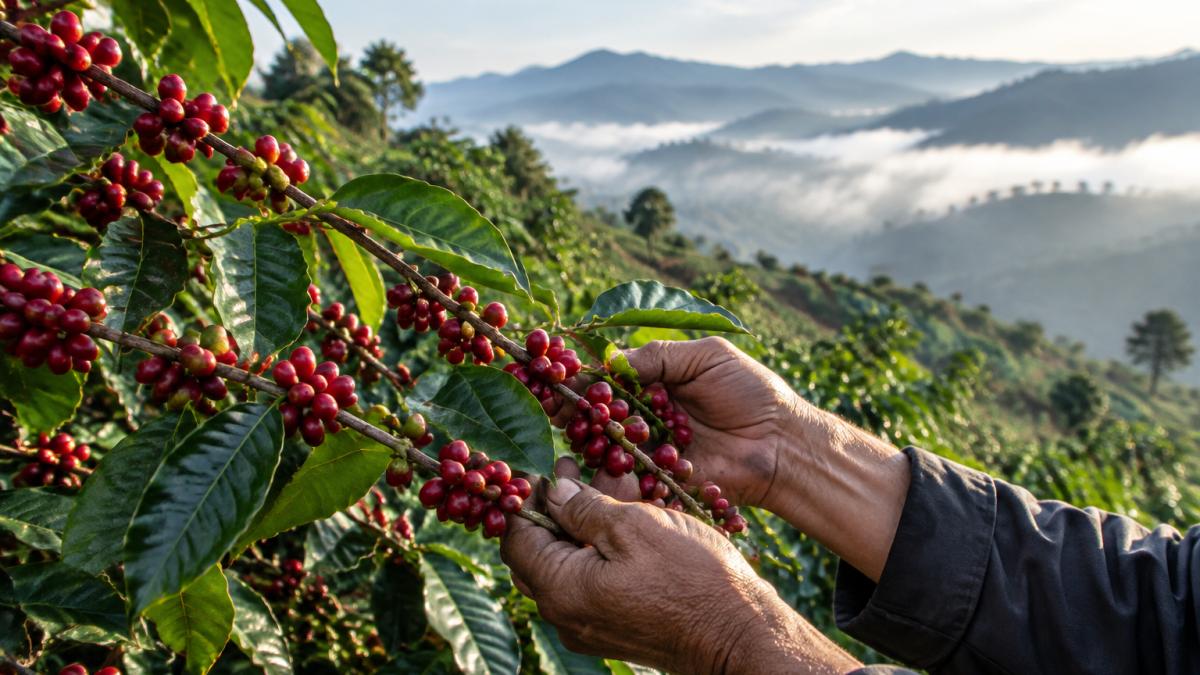
Elevation is not destiny, though. A well-managed low farm can beat a neglected high one, and altitude labels on bags describe the farm, not a guarantee in the cup.
Coffee Processing Methods: Washed, Natural, and Honey
Coffee processing methods decide how much fruit character stays with the seed. Washed coffee has the fruit stripped off before drying, producing clean, bright cups where acidity and origin character show clearly. Natural coffee dries inside the whole cherry, adding fruity, wine-like, sometimes fermented notes. Honey processing leaves part of the mucilage on the bean, landing between the two.
- Washed: clarity, structure, transparent acidity
- Natural: fruit-forward sweetness, heavier body, bigger aromatics
- Honey: rounded sweetness with moderate fruit
Processing can amplify or bury origin. A natural process can push a mild bean toward berry notes it would never show washed. When you compare origins, compare like with like: washed to washed, natural to natural.
Genetics and Cultivar: How Variety Interacts with Terroir
Coffee variety, or cultivar, is the plant's genetic identity, and it sets the ceiling on what a farm can produce. Bourbon and Typica tend to show sweetness and clarity. Gesha is famous for floral, tea-like aromatics. SL28 is tied to the blackcurrant character of Kenyan coffee.
Genetics and terroir work as a pair. Plant Gesha at low elevation with heavy rain and you get a pleasant but unremarkable cup. Plant a sturdy, high-yield hybrid on a prized hillside and it may never reach the aromatic heights of a fussier heirloom variety.
Species matters at the base level. Arabica carries most of the acidity and complexity drinkers prize. Robusta brings body, bitterness, and higher caffeine, which is why it dominates blends and espresso in some markets.
Roast Profiles and Regional Flavor Profiles
Roast profile decides how much origin survives the roaster. Light roasts preserve acidity, floral notes, and fruit; medium roasts balance sweetness and body; dark roasts build chocolate and caramel while flattening delicate origin character. If you want to taste where a coffee grew, start light to medium.
Regional patterns are useful starting points, not guarantees. The table below uses consistent criteria, acidity, body, sweetness, aroma, and common notes, so you can compare origins on the same terms rather than reading broad descriptions in isolation.
| Region | Acidity | Body | Sweetness | Aroma | Common Notes |
|---|---|---|---|---|---|
| East Africa (Ethiopia, Kenya) | High | Light to medium | Medium to high | Floral, citrus, berry | Jasmine, bergamot, blackcurrant, stone fruit |
| Central America (Guatemala, Costa Rica) | Medium | Medium | Medium to high | Cocoa, soft fruit | Chocolate, caramel, orange, nut |
| South America (Brazil, Colombia) | Low to medium | Medium to full | High | Nutty, caramel | Almond, caramel, milk chocolate, red apple |
| Southeast Asia (Sumatra, Java) | Low | Full | Low to medium | Earthy, spicy | Cedar, tobacco, dark chocolate, baking spice |
Read the table as a set of tendencies, not a fingerprint. Two coffees from the same country can land at opposite ends of these columns. A washed Kenyan lot from a high-altitude estate and a natural-processed Ethiopian heirloom can both show high acidity yet share almost no aroma. That is why the criteria matter more than the country label: they give you a vocabulary for comparing what is actually in the cup.
Within-region variation is the part most origin guides skip. A single country can contain dozens of microclimates, and producer-level decisions, cultivar choice, shade management, pick ripeness, fermentation length, shift flavor as much as geography does. A common pattern is for coffees from the same washing station, same variety, and same harvest to diverge noticeably between lots because of fermentation timing or drying conditions. Treat country-level notes as a starting hypothesis, then let the cup correct it.
Freshness sits on top of all of this. Roasted coffee sheds its most volatile aromatics within weeks, so a stale bag of a brilliant origin tastes like cardboard. For a deeper look at why timing matters, read why fresh roasted coffee tastes better.
How to Taste and Verify Origin Notes at Home
You can check origin claims with a simple side-by-side tasting. Buy two coffees from different origins at the same roast level, brew them identically, and compare. Keep water temperature consistent, since small changes shift extraction and can mask origin character; this guide to measuring coffee water temperature accurately helps you hold that variable steady.
- Grind both coffees to the same setting.
- Use the same dose and water ratio for each.
- Taste both warm, then again as they cool. Aromatics open up as coffee cools.
- Write down three notes per cup before comparing.
- Repeat the next day to rule out one-off brewing errors.
For a more rigorous check, borrow the cupping protocol used across the industry. Weigh a consistent dose, a common ratio is about 8.25 grams of coffee per 5 fluid ounces of water, grind medium-coarse, pour water just off the boil, let the crust form for about four minutes, then break the crust and skim. Slurp from a spoon so the coffee aerates across your palate. Cupping removes brew-method variables and gives the clearest read on origin character, which is why roasters and buyers use it to compare lots.
Brewing variables can bury or amplify origin. Under-extraction reads sour and thin; over-extraction reads bitter and ashy, and both drown out the delicate notes you are trying to find. Grind, water ratio, and water chemistry all shift what reaches the cup. If your tap water is very hard or very soft, the same beans can taste flatter or sharper than they would at the roastery. Hold those variables steady and origin differences become far easier to detect.
Two honest limits apply. First, tasting notes are subjective sensory analogies, not ingredients: one drinker's blackcurrant is another's generic berry, and your reference library of smells shapes what you can name. Second, origin is not the only source of variation. Processing, roast, and even the taster's mood and recent meals influence perception. That is why a single cup is weak evidence and repeated, controlled comparisons are strong evidence. To build your vocabulary, our guide to tasting notes in specialty coffee walks through how to name what you taste.
Watch out: comparing a natural-processed coffee against a washed one will tell you more about processing than about origin, so match processing methods before you draw conclusions about where a bean grew.
Taste the Difference in Your Next Cup at Third Space Coffee
Origin is the starting point of flavor, not the finished story. The clearest way to learn that is to drink coffee roasted close to home, where freshness keeps the origin character intact instead of letting it fade in a warehouse.
At Third Space Coffee, we roast our beans in-house. Grab a bag of our whole bean coffee and brew the comparison yourself, or stop in and order a cup. We are proud to be voted Best Coffee Shop in Colorado Springs, and we would love to be your third space.
Frequently Asked Questions
How do coffee beans get their flavor notes?
Flavor notes develop from a combination of coffee bean origin, variety, growing conditions, processing, and roasting. The plant absorbs minerals from soil, responds to altitude and climate, and develops sugars and acids that roasters then highlight. Processing methods like washed or natural fermentation add another layer. Roasting unlocks these compounds, and brewing variables like water temperature and grind size determine what you actually taste in the cup.
Which coffee origin has the best flavor?
There is no single best origin because flavor preference is personal. African coffees often show bright citrus and floral notes, Latin American beans tend toward chocolate and nuttiness, and Indonesian coffees are earthy and full-bodied. The best choice depends on whether you want acidity, sweetness, or body. Tasting across origins using consistent criteria is the only reliable way to find what suits your palate.
Does the processing method change the flavor notes of coffee?
Processing methods have a major impact. Washed processing removes the fruit quickly, producing clean, bright, and acidic cups that highlight terroir. Natural processing dries the cherry around the bean, adding fruity, wine-like, and sweet notes. Honey processing sits between the two, balancing sweetness and clarity. Two beans from the same farm can taste dramatically different based on processing alone.
How does altitude affect the flavor of coffee beans?
Higher altitudes slow cherry maturation, allowing sugars and acids to develop more fully. Beans grown above 1,200 meters typically have higher density, more complexity, and brighter acidity. Lower-altitude coffees ripen faster and tend to be milder and less acidic. Altitude alone does not guarantee quality, but it is one of the strongest environmental signals for how a coffee will taste.
The next step is simple: pick two origins, brew them the same way, and taste them side by side. That one exercise will teach you more about coffee bean origin than any label ever will. Get started with Third Space Coffee and taste the difference fresh, in-house roasted beans make in your next cup.