
TL;DR:
- Building a home coffee bar improves daily coffee quality and simplifies routines.
- Essential equipment includes a burr grinder, brewer, scale, milk frother, kettle, and water filter.
- Proper organization, water quality, and maintenance are key to consistent, flavorful coffee at home.
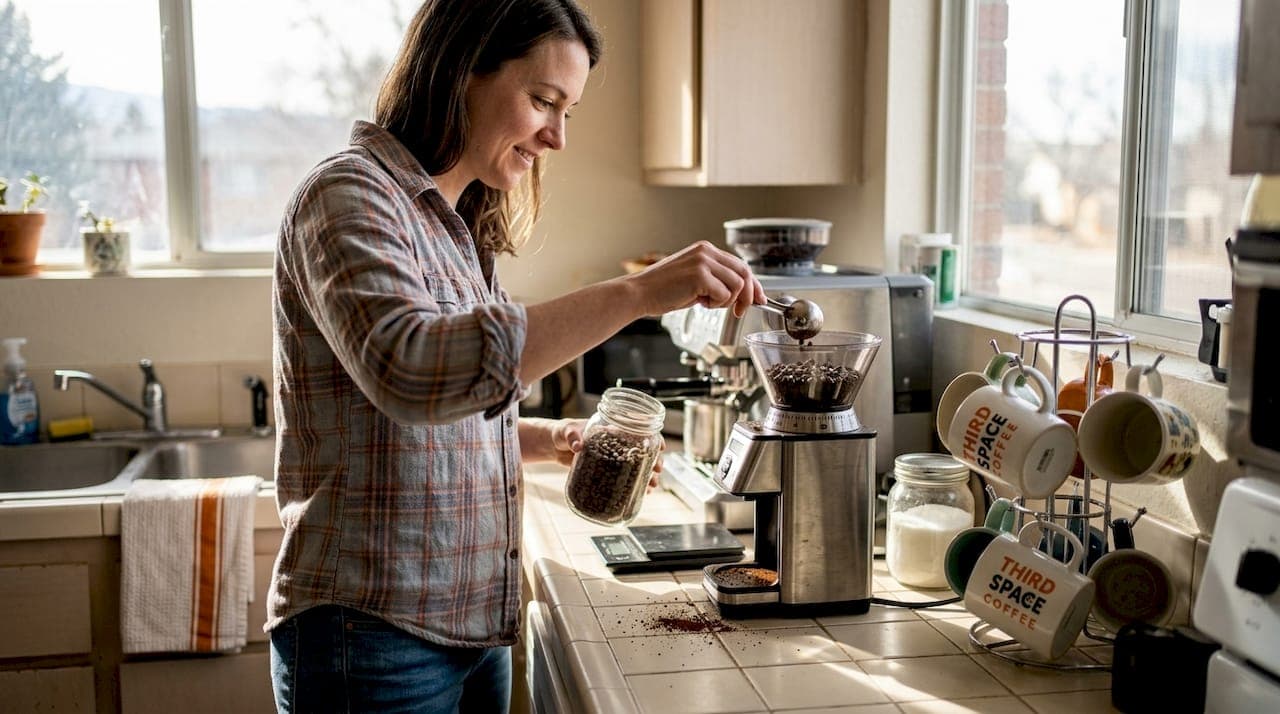
Your morning routine deserves better than a cluttered counter, a blade grinder from five years ago, and beans that lost their freshness two weeks back. A lot of Colorado Springs coffee lovers feel this frustration without realizing the fix is closer than they think. Building a home coffee bar is not about buying every gadget on the market. It is about putting the right pieces in the right places so every cup tastes intentional. This guide walks you through the exact equipment you need, how to arrange it, why water quality matters more than most people expect, and how to make your setup shine when guests come over.
Table of Contents
- Gather your home coffee bar essentials
- Design an efficient coffee bar layout
- Perfect water quality and coffee maintenance
- Organize for style, simplicity, and entertaining guests
- The truth about home coffee bar perfection
- Take your coffee experience further with Third Space Coffee
- Frequently asked questions
Key Takeaways
| Point | Details |
|---|---|
| Burr grinder matters most | Choosing a quality burr grinder elevates your coffee more than any other tool. |
| Water transforms flavor | Using the right water dramatically improves coffee taste and protects equipment. |
| Layout boosts workflow | Arranging your equipment in brewing order saves time and effort each morning. |
| Organize for hosting | A tidy setup and guest options turn your bar into a social hub with zero stress. |
Gather your home coffee bar essentials
Now that you're dreaming of your perfect coffee corner, let's start with the essentials you'll need. Think of this phase like stocking a kitchen for the first time. You want a solid foundation before adding the fun extras.
At the core of any great home setup, you need a burr grinder, a brewer or espresso machine, a digital scale, a milk frother or steam wand, and a temperature-controlled kettle. Essential equipment also includes a water filter, since tap water quality varies widely across Colorado Springs neighborhoods. These six items are non-negotiable if you want consistent, flavorful coffee every day.
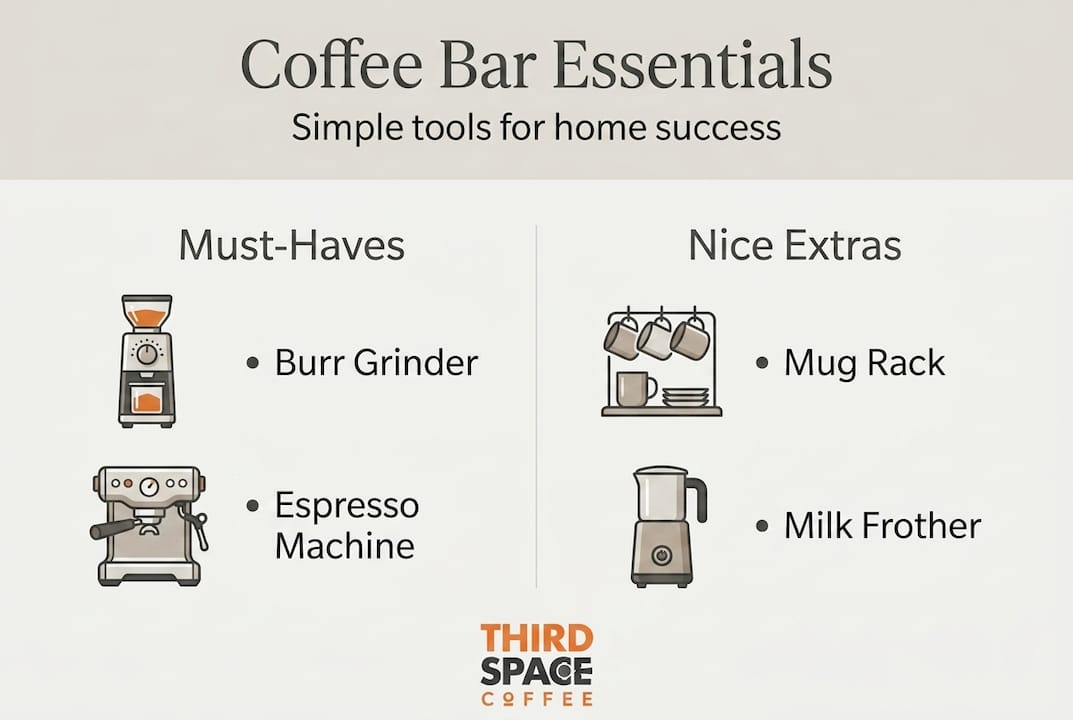
Must-have equipment at a glance:
| Equipment | Why it matters |
|---|---|
| Burr grinder | Even particle size for better extraction |
| Espresso machine or drip brewer | Your main brewing engine |
| Digital scale | Precision dosing (18g in, 36g out for espresso) |
| Milk frother or steam wand | Lattes, cappuccinos, flat whites |
| Temperature-controlled kettle | Consistent water temp for pour-overs |
| Water filter | Removes chlorine and sediment |
Once you have these covered, optional add-ons make the bar more fun and functional. A mug rack keeps cups within reach. Airtight canisters protect your buy whole beans from going stale. Flavored syrups, a latte art pitcher, and a tamper mat round out the experience without overwhelming your budget.
Here is where most beginners go wrong: they spend heavily on an espresso machine and cut corners on the grinder. The grinder is actually the most important purchase. Burr grinders crush beans to a consistent size, while blade grinders chop unevenly, leading to bitter or sour shots. If you want to go deeper on grind quality and roast profiles, the home coffee roasting guide from Third Space Coffee breaks it down clearly.
Pro Tip: Invest in the best burr grinder your budget allows before upgrading your machine. A great grind with a mid-range espresso machine beats a mediocre grind with an expensive one every single time.
For those exploring coffee barista terms for the first time, words like "extraction," "tamping," and "bloom" will start making sense once your equipment is in front of you. Starting with quality drip coffee options is also a great low-pressure entry point if espresso feels like too much right away.
Design an efficient coffee bar layout
Once you have your tools, arranging them smartly makes every cup smoother and faster. Think of the layout like a production line. Each step flows into the next without backtracking.
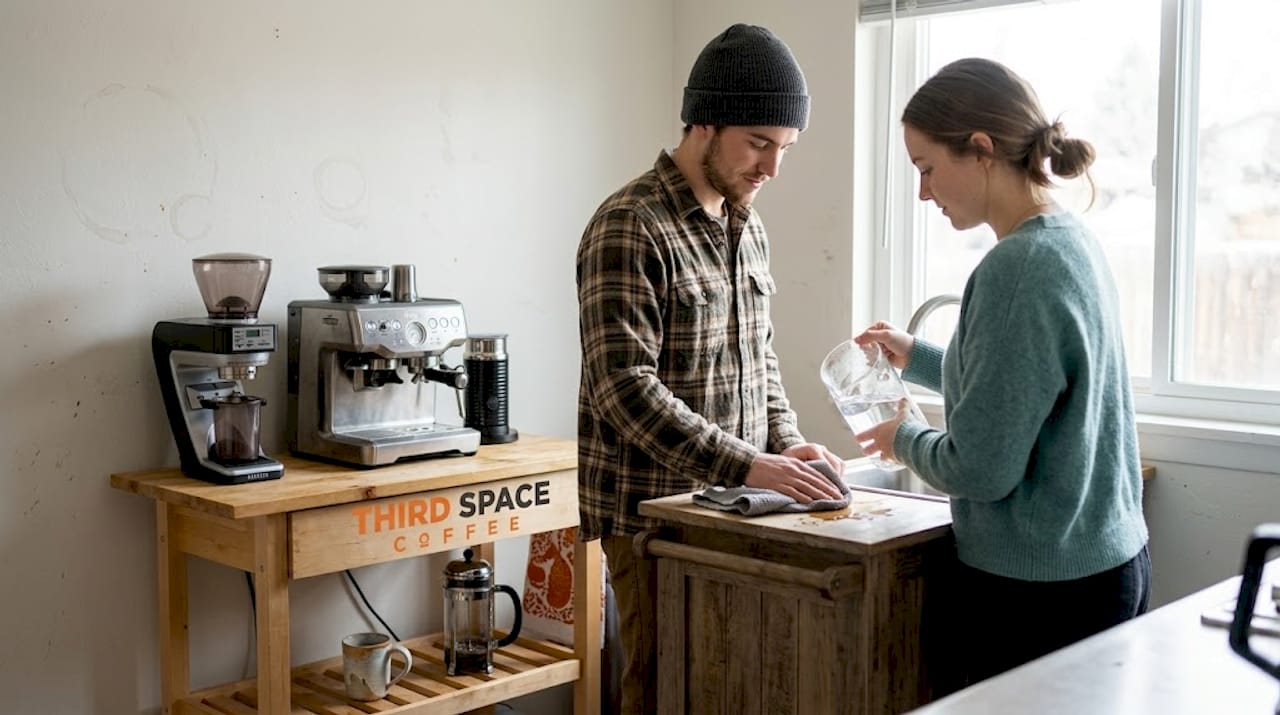
Arrange equipment in brewing sequence: grinder next to the brewer or espresso machine, then the milk frother, and finally an assembly area for cups and add-ins. This mirrors what you see behind the counter at specialty cafes and can reduce unnecessary movement by more than half.
Linear layout vs. scattered setup:
| Layout type | Movement required | Ease of use | Consistency |
|---|---|---|---|
| Linear (left to right) | Minimal | High | High |
| Scattered or haphazard | Frequent back-and-forth | Low | Low |
| Cart-based (small spaces) | Moderate | Medium | Medium |
Here is how to physically build your station, step by step:
- Place the grinder at the far left (or right, depending on your dominant hand).
- Position the espresso machine or drip brewer directly next to it.
- Set the milk frother and pitcher just past the brewer.
- Create an assembly zone at the end for cups, lids, syrups, and spoons.
- Keep the scale on the counter near the grinder for consistent dosing.
- Store mugs at eye level or on a rack just above the assembly zone.
For smaller Colorado Springs homes or apartments, a rolling cart is a smart solution. It keeps everything grouped and can be tucked away after morning use. Floating shelves above the counter add vertical storage without eating into your prep space. Make sure equipment has room to breathe, especially machines with back vents.
Pro Tip: Leave at least a 4-inch gap between each machine and the wall behind it. Without ventilation, espresso machines and grinders overheat, which shortens their life and can affect flavor consistency.
If you want to understand the language behind what you're doing, brewing terminology explained is a helpful resource for matching your physical setup to the concepts that drive great coffee.
Perfect water quality and coffee maintenance
An efficient layout is only as good as the ingredients. Especially your water, which makes up most of what's in your cup. Most people overlook this entirely, and it shows in the flavor.
Water accounts for over 90 percent of your brewed coffee. The Specialty Coffee Association recommends using filtered water with a TDS (total dissolved solids) of 75 to 150 ppm for best results. Too low, and your water strips flavor. Too high, and minerals overpower the coffee's natural notes and damage your machine over time.
Comparing water types for home brewing:
| Water type | TDS range | Flavor impact | Machine safety |
|---|---|---|---|
| Tap (unfiltered) | 150-400+ ppm | Inconsistent | Risk of scale |
| Filtered tap | 75-200 ppm | Good | Moderate protection |
| Reverse osmosis (RO) | Under 10 ppm | Flat, dull | Too aggressive |
| RO with remineralization | 75-150 ppm | Excellent | Best protection |
Colorado Springs tap water tends to be moderately hard. Testing your water with an inexpensive TDS meter is the simplest first step. If your reading comes in above 200 ppm, a good filter pitcher or inline filter will help. If it is very high, RO with a remineralization cartridge, like the Third Wave Water Espresso profile, is the gold standard for espresso machines.
For machine care, a few key habits protect your investment:
- Backflush your espresso machine weekly if it has a three-way valve.
- Wipe steam wands immediately after every use to prevent milk buildup.
- Run a cleaning tablet through the group head every two weeks.
- Descale every 2 to 4 months to keep scale from clogging internal components and ruining flavor.
For espresso specifically, aim for an extraction of 25 to 30 seconds at 9 bars of pressure and a water temperature between 195 and 205 degrees Fahrenheit. This is the sweet spot that pulls out sweetness, body, and acidity in balance. If you enjoy an Americano flavor notes profile, dialing in this extraction window makes a dramatic difference. For a deeper look at how water affects taste at the molecular level, this water and taste deep dive is worth bookmarking.
Organize for style, simplicity, and entertaining guests
With your water and equipment locked in, an organized bar makes daily brewing and hosting friends a breeze. Organization is not just about looks. It is about removing friction so you actually use your setup every single day.
Use risers and turntables to create vertical layers on your counter. Label airtight containers for beans, syrups, and sugar. Hang a mug rack under a cabinet or on the wall. Group like items together and use a bar mat to catch drips and keep surfaces clean.
Essential organization tips for your home coffee bar:
- Use tiered risers to display mugs and syrups without clutter.
- Store beans in airtight, opaque canisters away from direct sunlight.
- Keep a small tray for spoons, stirrers, and portafilters so they never get lost.
- Hang hooks or a rail for towels and tongs near the assembly zone.
- Label everything clearly, especially if guests will be self-serving.
For hosting, the goal is a self-serve flow that does not require you to play barista all night. Here is how to set it up:
- Place cups and mugs at the very start of the station so guests know where to begin.
- Position the brewer or pour-over setup next in line.
- Set out a labeled selection of beans or pods, including decaf or single-origin options.
- Add a small basket of alternative beverages for guests like teas or cocoa.
- Place syrups, milks (including oat and almond), and sugar at the end.
- Add a small handwritten menu card so guests know their choices at a glance.
"Seasonal decor and simple risers personalize a coffee bar without adding clutter. A small plant, a chalkboard label, or a candle next to the station makes guests feel like they walked into a cafe."
For entertaining, a rolling cart is especially useful. It lets you move the entire station to the living room or patio without dismantling anything. Keep it stocked the night before so you are not scrambling in the morning.
The truth about home coffee bar perfection
Here is what most guides skip over: your home coffee bar does not need to look like a Pinterest post to work well. In fact, chasing an aesthetic before you have the workflow figured out is the fastest way to end up with an expensive setup you barely use.
At Third Space Coffee, we see this all the time. Someone buys a sleek espresso machine to match their kitchen decor, but they never learned to dial in the grind. The machine becomes a countertop sculpture. Meanwhile, someone else has a modest burr grinder, a simple drip brewer, and filtered water, and they are making better coffee every single morning.
Workflow and water quality will always matter more than matching mugs or a color-coordinated station. Experiment freely. Make bad cups. Adjust one variable at a time and keep notes on what works. Your palate is the only judge that matters.
"The best coffee bar is the one you use every day."
Upgrade in stages. Start with the grinder and water. Add the brewer. Layer in the extras once you know what you actually want. And if you want to take it even further, learning roasting at home tips can transform how you think about freshness and flavor from the very beginning of the process.
Take your coffee experience further with Third Space Coffee
You have the blueprint. Now feed your bar with the good stuff.

At Third Space Coffee, we roast our beans in-house right here in Colorado Springs, so what you get is genuinely fresh. Whether you are building your bar from scratch or dialing in an existing setup, our fresh whole beans give you a quality foundation that no grocery store shelf can match. If you want inspiration for what your home bar could produce, browse our specialty drinks and reverse-engineer your favorites. Order online for pickup or stop in to talk coffee with people who genuinely love it. Your best cup is still ahead of you.
Frequently asked questions
What is the most important piece of equipment for a home coffee bar?
A good burr grinder is the single biggest upgrade for coffee flavor and consistency. Burr grinders offer precision grinding at 10 to 20 microns per step, which blade grinders simply cannot match.
How do I optimize water for coffee in Colorado Springs?
Use filtered water with a TDS of 75 to 150 ppm, or RO with remineralization if your tap water tests very hard, since this combination prevents scale buildup better than basic filters.
What's the best way to organize a coffee bar in a small kitchen?
Use a rolling cart, floating shelves, and group items by brewing sequence for space efficiency. Small spaces benefit from a 4-inch wall gap behind machines to prevent overheating and protect your equipment long-term.
How often should I descale my espresso machine?
Descale your machine every 2 to 4 months for optimal performance and flavor. Consistent descaling paired with quality water is the single best habit for extending your machine's life.