

An effective team offsite agenda maps every session to a measurable outcome, blocks time in 60/30/10 chunks (decisions, relationships, updates), and closes with a decision log sent within 48 hours. Pick your template based on your primary goal: a single-day agenda for a focused work sprint, a two-day agenda for alignment plus prioritization, or a three-day agenda when you need context-building, deep work, and formal commitments. Copy the matching template below and start filling in your specific sessions today.
TL;DR:
- Choose a primary focus—alignment, connection, or output—and set clear, measurable outcomes for each session to ensure measurable results.
- Schedule high-stakes decision sessions in the morning when energy is at its peak and include time for unprogrammed follow-up.
- Build in 10% of the day for informal relationship activities and include unstructured time to prevent burnout and facilitate spontaneous follow-up.
- Send detailed pre-event communications, confirm logistics well in advance, and assign roles for each session to maintain control and clarity.
- After the offsite, document decisions, assign owners, and schedule follow-up checks within two weeks to maintain momentum and track progress.
Table of Contents
- What Makes a Team Offsite Agenda Work
- Time-Blocked Team Offsite Agenda Templates You Can Copy
- Choosing Session Formats That Actually Produce Decisions
- Pacing Your Offsite So Energy Doesn't Crash by 2 PM
- Planning Timeline and Pre-Event Communications Checklist
- Running the Day Without Losing Control of the Clock
- Turning Offsite Outputs Into Tracked Work After You Leave
- A Café Offsite in Practice: Booking and Running It at Third Space Coffee
- Three Lessons From Watching Offsites Succeed and Fail
- Book Third Space Coffee for Your Next Small-Team Offsite
- Sources
What Makes a Team Offsite Agenda Work
The agenda fails the moment a session doesn't map to something you can measure. That's the single biggest planning mistake, and it's avoidable if you nail down purpose before you touch a calendar.
Start by picking one primary focus for the entire offsite. Most offsites fall into three buckets: strategic alignment (deciding what to do next quarter), team connection (rebuilding trust after a rough stretch or a wave of new hires), or creative output (generating and prioritizing new ideas). Trying to do all three in one agenda usually means you do none of them well. Effective offsite planning starts with a single clear objective and 2 to 3 measurable outcomes, and every session on the agenda has to justify its slot against that objective.
Once you know the focus, write outcomes using a simple format: who does what, by when. Not "align on strategy" but "leadership team agrees on top 3 Q3 initiatives and names an owner for each by end of day two." That phrasing does two things a vague goal can't: it tells you exactly what a successful session produces, and it tells you when you've failed, which is just as useful during planning.
A quick two-by-two helps you pick the right format once you know your goal. Cross your primary focus (alignment, connection, or output) against your setting (structured meeting room vs. open/social space):
- Alignment + structured setting: plenary presentations, decision workshops, prioritization exercises
- Alignment + open setting: fireside chats, leadership Q&A over coffee
- Connection + structured setting: structured pairing exercises, retrospectives
- Connection + open setting: shared meals, walks, unstructured social blocks
- Output + structured setting: sprint-style breakouts, design critiques
- Output + open setting: unconference sessions, open pitch hours
Before you finalize anything, run a short stakeholder intake with whoever's sponsoring the offsite (your VP, your CEO, HR). Ask four questions: What decision needs to get made that hasn't been possible remotely? What does success look like on the Monday after we're back? Who absolutely needs to be in the room for the high-stakes sessions? And what's the one thing that would make this a waste of everyone's time? That last question tends to surface the real risk nobody wants to say out loud.
Time-Blocked Team Offsite Agenda Templates You Can Copy
Here are three fully annotated templates built around the length of your offsite. Each one names the facilitator's role and the output attendees should walk away with, not just a topic.
One-day offsite template
A single day works when your goal is narrow: one big decision, one prioritization exercise, or a focused reconnection after a stretch of remote work.
| Time Block | Session | Output | Facilitator Role |
|---|---|---|---|
| 9:00–9:30 AM | Kickoff and framing | Shared understanding of the day's one goal | Team lead sets context, no slides |
| 9:30–10:30 AM | Core working session (highest stakes) | Draft decision or prioritized list | Named facilitator runs structured format |
| 10:30–10:45 AM | Break | Recovery | None needed |
| 10:45 AM–12:15 PM | Second working block or breakouts | Refined output from morning session | Facilitator + breakout leads |
| 12:30–1:30 PM | Lunch | Informal connection | None |
| 1:30–2:30 PM | Synthesis session | Final decisions documented | Facilitator captures in shared doc live |
| 2:30–3:00 PM | Close and next steps | Named owners and dates for each decision | Team lead reads back the decision log |
Two-day offsite template
Day one builds shared context and alignment. Day two turns that alignment into prioritized, committed action. This structure anchors day one in alignment and day two in prioritization and commitments, and every session should be output-defined in its title, not just its content.
- Day 1 morning: Kickoff, state-of-the-business review, alignment discussion. Output: shared understanding of current state.
- Day 1 afternoon: Breakout sessions on specific problem areas. Output: 2 to 3 documented options per breakout.
- Day 1 evening: Group dinner or informal social. No agenda, no note-taking.
- Day 2 morning: Prioritization workshop using dot voting or a similar method. Output: ranked list of initiatives.
- Day 2 afternoon: Commitment session. Output: owners and deadlines assigned for the top 3 to 5 items.
- Day 2 late afternoon: Close, decision log review, travel.
Three-day offsite template
Three days give you room for a pattern that consistently works: Day 1 for context and relationship building, Day 2 for high-stakes work in the morning with breakouts in the afternoon, and Day 3 to commit, assign owners, and close.
- Day 1 (arrival): Travel, light welcome session, team dinner. Prep required from attendees: pre-read under 30 minutes, sent one week out.
- Day 2 (peak work): Morning is your highest-stakes session block. Afternoon splits into breakouts tied to specific outcomes. Evening is unstructured or a planned social activity.
- Day 3 (commit and close): Morning synthesizes breakout outputs into final decisions. Midday locks in owners and dates. Early afternoon close, travel home.
Every block above names an output because that's what prevents the agenda from turning into a string of meetings nobody remembers. A session titled "Discuss Q3 roadmap" invites rambling. A session titled "Prioritize Q3 initiatives, deliver top 3 priorities and assigned owners" forces accountability into the room before anyone sits down.
Choosing Session Formats That Actually Produce Decisions
Picking the right format matters more than picking the right icebreaker. A session's format determines whether you get a decision, a list of options, or just a good conversation, and all three have their place if you choose deliberately.
Here's a rough guide for matching format to goal:
- World café: rotating small-group conversations, best for gathering input on a broad topic before narrowing it down.
- Fishbowl: a small group discusses while others observe and rotate in, useful for surfacing disagreement on a sensitive topic without it turning into a shouting match.
- 1-2-4-All: individuals think alone, pair up, form groups of four, then report to the full room. This is the fastest way to get everyone's input on a question without the loudest voice dominating.
- Dot voting: participants place a limited number of votes on options posted around the room, ideal for prioritization when you have more good ideas than time.
- Unconference block: participants pitch and vote on session topics in real time. It raises buy-in because people choose the content themselves rather than sitting through a pre-set agenda.
Before you lock any session into the agenda, run it through a three-item checklist: What decision or output does this session need to produce? What format best produces that output? Who is facilitating, and are they different from the person whose idea is being debated?
That last point matters more than most agendas account for. Structured facilitation techniques, like silent brainstorming before group discussion or requiring each small group to nominate a spokesperson who didn't originate the idea, reliably surface quieter voices and produce better decisions than open-floor discussion.
Pro Tip: Write a two-sentence facilitator script for every session, even the ones you're running yourself. "We have 45 minutes to land on our top 3 priorities. I'll ask each of you to write your top pick silently, then we'll dot-vote as a group." Reading that out loud at the start of a session prevents the slow, awkward drift into unstructured chat.
When should you bring in an outside facilitator instead of running it yourself? Bring in external help when the topic involves conflict between people in the room, when you personally have a stake in the outcome, or when the group is large enough (over 30 people) that one internal facilitator can't manage breakouts and a plenary. For smaller teams working through routine prioritization, an internal owner who's prepped a script works fine.
Pacing Your Offsite So Energy Doesn't Crash by 2 PM
Cognitive energy follows a predictable arc across a day, and ignoring it is how good agendas turn into 3 PM slogs where nobody's really listening anymore. Put your highest-stakes strategic session in the morning peak-energy window, and reserve the post-lunch slot for lighter work or social activities.

A useful rule of thumb for allocating time across a full offsite day is 60/30/10: roughly 60% decision-making work, 30% relationship-building activities, and 10% status updates or informational content. If your team just went through a reorg or a stretch of high turnover, flip that ratio toward relationship time, maybe 40/50/10, because trust has to get rebuilt before people will speak candidly in a decision-making session anyway.
Two scheduling habits protect the agenda from burning people out:
- Build in a genuine energizer between heavy sessions, something physical or social, not another slide deck disguised as a break.
- Leave a 90-minute unprogrammed window on the main work day. This is often where the best follow-up ideas start, and it gives people room to process what just happened in the last session instead of walking straight into the next one.
The World Health Organization recognizes burnout as an occupational phenomenon, and a packed offsite agenda is a fast way to induce a mild version of it over 48 hours. High-quality offsites cap structured content around six hours a day, not eight or nine. If your draft agenda has back-to-back sessions from 8 AM to 6 PM with no white space, you've overprogrammed it.
Here's a sample micro-schedule showing the peak-and-recovery pattern in practice:
- 9:00 AM: Highest-stakes strategic session (peak energy)
- 10:30 AM: Short break
- 10:45 AM: Second working session, moderate intensity
- 12:15 PM: Lunch
- 1:15 PM: Light breakout or creative session
- 2:30 PM: Energizer (15 minutes, physical or game-based)
- 2:45 PM: 90-minute unprogrammed window
- 4:15 PM: Synthesis and close
Planning Timeline and Pre-Event Communications Checklist
Most offsite chaos traces back to logistics decided too late. A reliable timeline runs from roughly eight weeks out down to the 48 hours before arrival.
- 8 weeks out: Confirm date, venue, and headcount. Send a save-the-date. Assign a single coordinator to own travel booking, since centralizing travel through one person avoids the fragmented, error-prone mess of everyone booking their own flights.
- 3 weeks out: Send the intake form covering travel details, dietary restrictions, and accessibility needs. Finalize the agenda draft and share it with session facilitators so they have time to prep.
- 48 hours out: Send final logistics, the confirmed agenda, and any pre-read material. Confirm AV and room setup with the venue directly.
Your intake form should collect: arrival and departure times, dietary restrictions and allergies, accessibility accommodations, and emergency contact information. Build in arrival buffers of at least an hour before the first session starts. Someone always gets stuck in traffic or a delayed flight.
On the technology side, confirm before the day: microphone and speaker setup for plenary sessions, a reliable WiFi connection with the password posted visibly, screen or projector for facilitators, and whiteboard or flip-chart supplies for breakouts. If you're sending a pre-read, keep it under 30 minutes to consume. Anything longer gets skimmed on the plane or skipped entirely.
A typical pre-event message cadence looks like this:
- 8 weeks out: Save-the-date with dates and location
- 3 weeks out: Full logistics email with intake form link and draft agenda
- 1 week out: Reminder with pre-read material and packing/dress guidance
- 48 hours out: Final agenda, room assignments, and a single point of contact for day-of questions
Running the Day Without Losing Control of the Clock
A written run of show with named roles is what separates a smooth offsite from one where the facilitator is scrambling to figure out who's supposed to be talking next. Assign, in writing, who opens each day, who facilitates each breakout, and who owns the close.
Transitions between sessions are where agendas quietly lose time. A short script helps: "We're moving from breakouts back to the full group. Please wrap your current conversation in the next 60 seconds and head back to the main room." Repeating a consistent transition phrase throughout the day trains the room to respond to it faster by session three or four.
A few common problems come up often enough to plan for in advance:
- Late arrivals: Build a 10 to 15 minute buffer into the first session so latecomers don't derail the opening, and have a one-line recap ready to loop them in quietly.
- Low participation in a breakout: Switch to a 1-2-4-All format on the spot. Individual reflection time almost always unlocks input from people who go quiet in open discussion.
- AV failure: Have a low-tech backup, printed handouts or a whiteboard, for any session that depends on a screen.
- Running long: Give the facilitator explicit permission in advance to cut a session short and move unfinished discussion to a parking-list doc rather than letting it eat into the next block.
Keep a live decision log open throughout the day, whether that's a shared doc projected on a screen or a dedicated notetaker typing in real time. Every decision gets an owner and a date attached the moment it's made, not reconstructed from memory afterward. That habit alone prevents the most common post-offsite complaint: nobody remembers who agreed to what.
Turning Offsite Outputs Into Tracked Work After You Leave
The offsite isn't done when everyone flies home. It's done when decisions turn into tracked tasks with owners who actually follow through, and that requires a clear closeout process before anyone leaves the room.
At minimum, close every offsite with three deliverables: a documented list of decisions made, an owner assigned to each one, and a due date. Sending that summary within 48 hours keeps the momentum from the room instead of letting it evaporate once people are back in their normal routines.
Send a short survey within a week of returning, while the experience is still fresh. Ask three things: Did the offsite achieve its stated goal? Which session was most valuable? What would you cut next time? Keep it under five questions, because a long survey after a long offsite gets ignored.
To convert decisions into tracked work: move every item from the decision log into whatever project management tool your team already uses, assign the same owner named in the log, and schedule a first progress check two weeks out. That two-week check-in is where a lot of offsite momentum quietly dies if nobody schedules it in advance.
A few numbers worth including in your post-event report to sponsors: number of decisions made, percentage of attendees who completed the survey, and time-to-first-check-in. Industry data on offsite frequency shows high-performing companies run about 2.8 offsites per year compared to 2.4 for underperformers, with many programs now dedicating a substantial portion of total offsite time to social programming rather than pure work sessions. That shift reflects a broader recognition that connection time isn't wasted time, it's part of what makes the work sessions land.
A Café Offsite in Practice: Booking and Running It at Third Space Coffee
Small teams don't always need a conference center. A café setting can run a genuinely productive one-day or half-day offsite if the space fits your headcount and the venue understands what you're trying to accomplish.
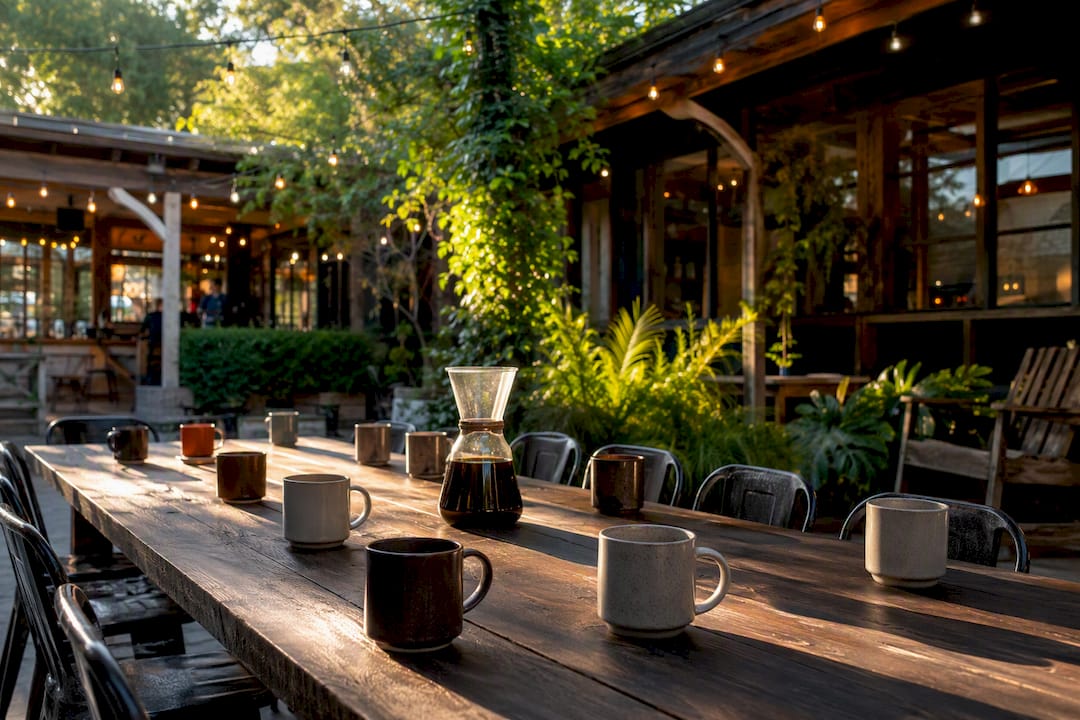
Third Space Coffee, located in Colorado Springs, offers private event space that accommodates gatherings up to 150 guests, along with a smaller meeting room suited to compact team sessions. For a team offsite, that flexibility matters: a 12-person leadership retreat and a 60-person all-hands don't need the same room.
Before booking a café-style venue for an offsite, walk through this checklist:
- Noise levels: Ask whether the space can be reserved during off-peak hours to reduce background noise during working sessions.
- Seating flexibility: Confirm tables can be rearranged for breakouts versus a single plenary setup.
- Power access: Count outlets against your headcount if attendees are bringing laptops.
- WiFi reliability: Ask for the network name and password in advance, and test it during a walkthrough if possible.
- Booking minimums: Confirm any minimum spend or catering requirements tied to the room rental.
A sample half-day run at a café venue might open with coffee and light breakfast as people arrive, move into a 90-minute core working session, break for a working lunch catered on-site, then close with a shorter afternoon synthesis session before people head out. A full-day version adds a second working block after lunch and an afternoon energizer, following the same peak-and-recovery pacing covered earlier in this guide.
Booking a space that already understands coffee-forward, informal gatherings tends to smooth over a lot of the friction a corporate venue introduces, and it's worth checking a multi-use venue checklist before you commit to any space, café or otherwise.
Three Lessons From Watching Offsites Succeed and Fail
The most common mistake I see is an agenda with no stated output. A block labeled "Discuss product roadmap" tells the facilitator nothing about what a good outcome looks like, and it shows in the room. People wander, the conversation loops, and the group leaves with vague enthusiasm instead of a decision. The fix costs nothing: rename every session block with its output attached, and if you can't write that output in one sentence, the session probably isn't ready for the agenda yet.
The second mistake is scheduling the highest-stakes conversation for 4 PM because it felt easier to leave for later. By then, the room has spent its best thinking on lower-priority items. Put your hardest decision in the first 90 minutes of the day, every time.
The technique I'd recommend most is the 90-minute unprogrammed window. It sounds like wasted time until you watch what happens in it: side conversations that resolve tension a formal session never would have touched, and the informal follow-ups that end up mattering more than the scheduled agenda item next to it.
Pick your primary outcome this week, choose the matching template above, and send a save-the-date. The agenda gets easier to write once the goal is locked.
— Tanya
Book Third Space Coffee for Your Next Small-Team Offsite
If you're planning a compact offsite, somewhere between a leadership huddle and a 50-person all-hands, Third Space Coffee gives you a working café environment instead of a sterile conference room, with catering built into the same booking instead of a separate vendor to coordinate.

The venue suits small-to-midsize teams best: leadership retreats, quarterly planning sessions, or team-connection days where a relaxed, coffee-forward setting actually helps the conversation rather than working against it. It's a better fit for a focused half-day or full-day agenda than a multi-day retreat requiring overnight accommodations, since Third Space Coffee operates as a single Colorado Springs location rather than a lodging venue.
To check availability, reach out through the Third Space Coffee site with your target date, expected headcount, and whether you need the full event space or the smaller meeting room. Have your agenda draft ready, even a rough one, since it helps the team confirm the right room setup and catering order, whether that's drip coffee for a working session or a round of cappuccinos to kick off the morning.
Sources
- How to plan a team offsite step by step (Cvent)
- Offsite
- The Team Offsite Agenda Nobody Writes (Workshop Weaver)
- Burn-out an occupational phenomenon (WHO)