
TL;DR:
- A community coffee shop centers its mission on fostering social inclusion, neighborhood connection, and trust. Unlike commercial cafes, they prioritize deliberate programming, affordable pricing, and staff engagement to build lasting community ties. Supporting these spaces involves consistent participation, direct purchases, and engaging with local events to strengthen neighborhood bonds.
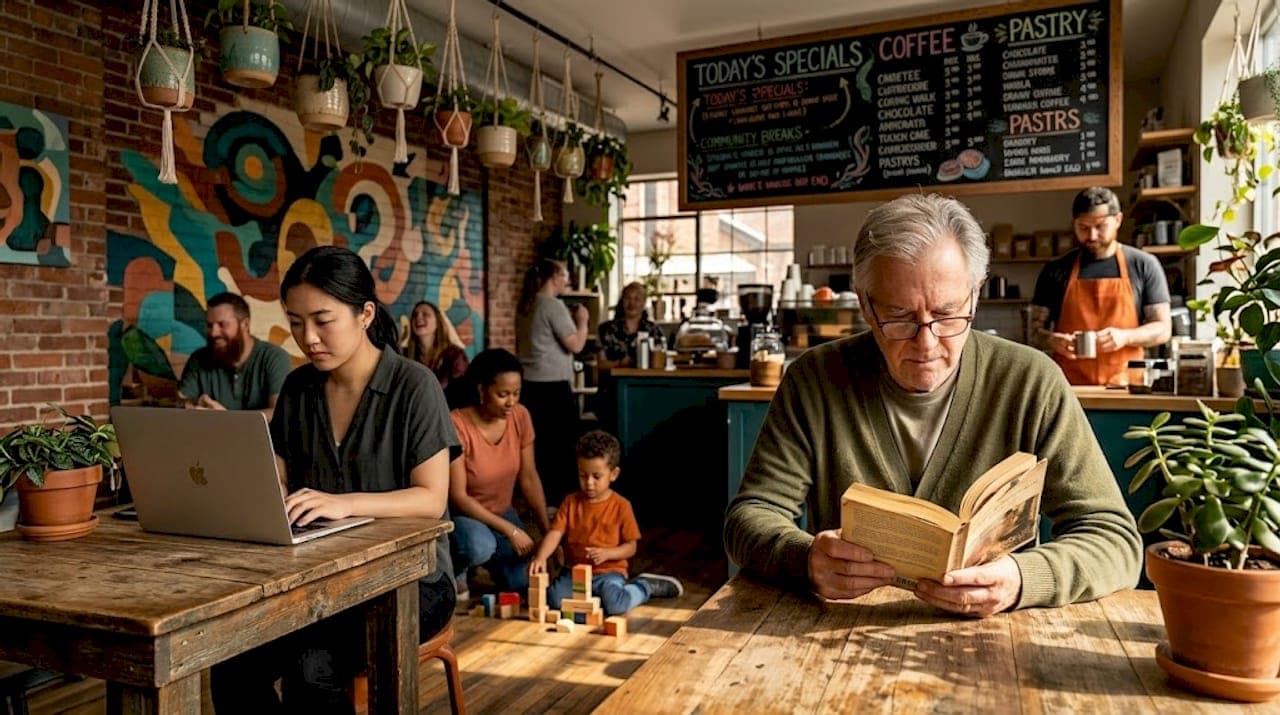
Not every coffee shop is a community coffee shop. That distinction matters more than most people realize. Understanding what is a community coffee shop means looking past the espresso machine and recognizing a deliberate social mission operating underneath. These spaces exist not simply to sell coffee but to serve as gathering points where neighbors become familiar, isolation shrinks, and local identity strengthens. If you have ever walked into a café and felt like a stranger in a transaction, versus one where you felt genuinely welcomed, you already know the difference. This article breaks down exactly what separates these two worlds.
Table of Contents
- Key takeaways
- What is a community coffee shop, exactly
- The social roles and benefits of community coffee shops
- Community vs. commercial coffee shops
- How design and hospitality build real connections
- How to start or support a community coffee shop
- My take on what community coffee shops actually require
- Experience community coffee culture at Thirdspacecoffee
- FAQ
Key takeaways
| Point | Details |
|---|---|
| Social mission is the core | Community coffee shops prioritize inclusion and connection over profit, unlike standard commercial cafes. |
| Third place function | These shops serve as neutral social hubs outside home and work, building trust and familiarity over time. |
| Business model differences | Pay-what-you-can pricing and volunteer-driven operations are common community coffee shop features not found in typical cafes. |
| Design and hospitality matter | Intentional interior choices and staff behavior create the welcoming atmosphere that defines these spaces. |
| Support goes both ways | Patrons can actively strengthen community coffee shops by attending events, buying local, and participating in programs. |
What is a community coffee shop, exactly
The community coffee shop definition starts with purpose. A community coffee shop is a café that places social mission at the center of its operations, designing everything from pricing to programming around inclusion, connection, and neighborhood wellbeing. This is categorically different from a commercial café, where the mission is profit and coffee is the product.
The concept draws heavily from sociologist Ray Oldenburg's idea of the third place: an informal gathering space that is neither home nor work. Third places are where casual social contact happens, where trust builds quietly over repeated interactions, and where people develop a sense of belonging to something larger than their household. Community coffee shops are perhaps the most accessible form of this concept alive today.
What makes a coffee shop community-oriented at the structural level often shows up in its business model. Many operate as social enterprises or not-for-profits, applying practices uncommon in commercial cafes:
- Pay-what-you-can pricing, where customers contribute what they are able, removing financial barriers to participation
- Volunteer integration, where community members staff or support operations, building ownership and shared investment
- Skill-building programs, such as barista training for at-risk youth or job readiness workshops held on-site
- Inclusive programming, from language exchange meetups to mental health drop-in hours
"Inclusion, belonging, and connection require conscious nurturing through business practices and culture. They cannot be left to chance." — Aren't all cafes community cafes?
This quote captures something critical. The community coffee shop definition is not about atmosphere alone. It is about deliberate choices made at every level of the operation.
The social roles and benefits of community coffee shops
The importance of community coffee shops becomes clearest when you look at what disappears without them. Social isolation is a documented public health concern, and repeated, low-pressure social contact is one of the most effective antidotes to it. Community coffee shops provide exactly that kind of contact. You do not need an agenda or a friend group to walk in. You just need to show up.
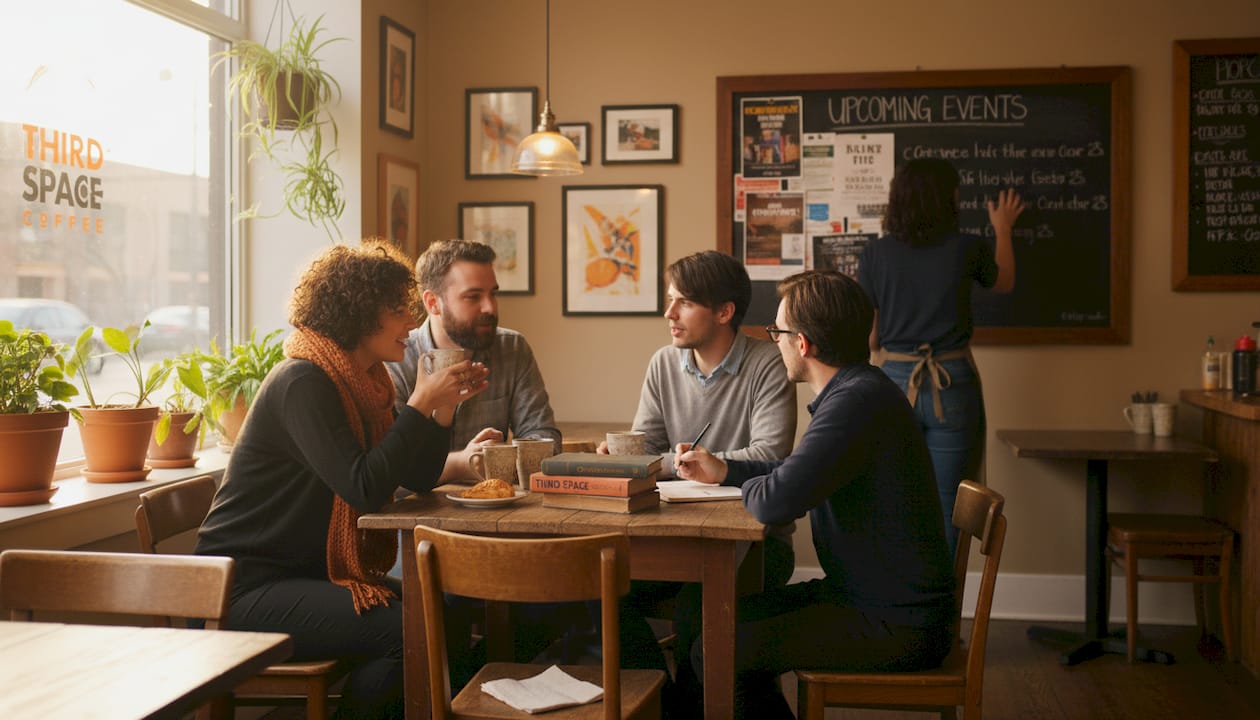
Research on third places and social capital shows that these informal gathering spaces build something called "weak ties." Weak ties are the connections you have with people outside your close circle: your barista, the regular who always sits by the window, the couple who comes in every Saturday. These relationships feel minor, but they are actually powerful predictors of psychological stability and community resilience.
The benefits of community coffee shops extend beyond individual wellbeing into neighborhood health. When people recognize each other, they look out for each other. A block where neighbors are strangers is fundamentally different from one where people have casually shared space over coffee. Community coffee shops manufacture those moments of recognition at scale.
Pro Tip: If you want to feel the difference quickly, commit to visiting the same community-oriented café at the same time each week for a month. By week three, you will notice familiar faces, easy conversation, and a subtle but real sense of belonging that no commercial chain can replicate.
Recurring events like book clubs, open mic nights, and themed meetups create what researchers call "neighborhood muscle memory." Cadence-based programming turns occasional visitors into regulars and regulars into advocates. This is community engagement for coffee shops done right: not a one-off event but a consistent rhythm that people can anchor their weeks around.
There is also a generational dimension here. Hybrid third places that blend retail, study, and social functions are increasingly attractive to younger generations who want spaces offering both deep-focus zones and easy socialization. Gen Z in particular gravitates toward what researchers call "soft wellness," spaces that support mental and social health without being explicitly therapeutic. Community coffee shops fit this need perfectly.
Community vs. commercial coffee shops
Understanding the community coffee shop definition gets sharper when you compare it directly to what a standard commercial café offers. The differences are not subtle.
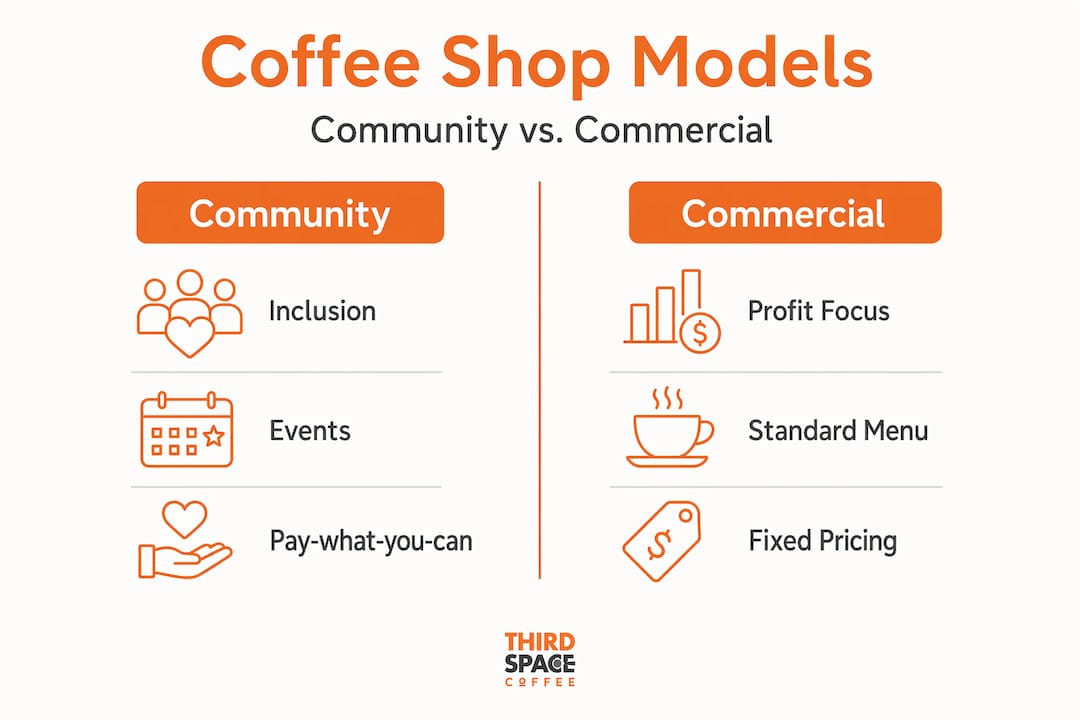
| Feature | Community coffee shop | Commercial coffee shop |
|---|---|---|
| Primary mission | Social impact and inclusion | Revenue and brand growth |
| Pricing model | Pay-what-you-can or subsidized | Fixed market-rate pricing |
| Staffing | Mix of paid staff and volunteers | Fully employed, profit-focused workforce |
| Programming | Regular community events and skill-building | Minimal or no programming |
| Profits | Reinvested into community programs | Returned to owners or shareholders |
| Customer relationship | Ongoing, relationship-driven | Transactional |
The gap in accessibility and community benefit between these two models is significant. Pay-what-you-can pricing is rarely found in standard commercial cafes because it conflicts with margin targets. Community-focused cafes accept narrower margins in exchange for broader neighborhood reach.
That said, the spectrum is not perfectly binary. Many local coffee shops, including places like Thirdspacecoffee in Colorado Springs, operate as hybrids. They maintain commercial viability through quality products and event space rental while simultaneously prioritizing local engagement, relationship-building, and genuine hospitality. This hybrid model is arguably where the most sustainable version of the community coffee shop concept lives.
How design and hospitality build real connections
The physical space of a community coffee shop is not decoration. It is infrastructure for human connection. Hospitality in a café functions as a kind of performance where baristas act as hosts, furniture arrangement shapes conversation, and even the music volume signals who is welcome. Every design choice either opens the door wider or narrows it.
Coffee shop decor that supports community typically includes communal tables that encourage strangers to sit together, bulletin boards where local events get posted, flexible seating arrangements that work for both solo visitors and groups, and visual art from local creators that signals neighborhood investment. None of this happens by accident.
The staff role in a community coffee shop is also different from a commercial café. Rather than processing orders efficiently, community-focused baristas are trained to:
- Remember regulars by name and order, creating a sense of being known
- Introduce unfamiliar customers to regulars with shared interests
- Model the warmth and ease that sets the social tone for the whole room
- Facilitate event programming and act as connectors within the community
Pro Tip: When you visit a community coffee shop, make a point of chatting with the staff briefly. They are often the most connected people in the room and can introduce you to events, people, and resources you would not find on your own.
Research on café hospitality and atmosphere shows that design choices and serving rituals directly impact perceived coffee quality and overall experience. People do not just taste the coffee. They taste the environment around it. A welcoming space genuinely makes the coffee taste better, which means investing in atmosphere is not a soft choice but a practical one.
How to start or support a community coffee shop
Whether you are looking to open a community-focused café or simply want to show up for one in your neighborhood, the approach matters. Here is how to think about both.
- Define the social mission first. Before selecting equipment or a lease, identify which community need you are addressing. Is it social isolation among seniors? Economic inclusion for low-income residents? Youth development? The mission shapes every subsequent decision.
- Build local partnerships early. Connect with nonprofits, schools, faith communities, and neighborhood associations before opening. These relationships generate programming, referrals, and trust that no marketing budget can buy.
- Choose a business model that aligns with your mission. A social enterprise structure or not-for-profit designation affects your tax status, funding eligibility, and public perception. Operational cost challenges in food and labor make this decision consequential early.
- Integrate volunteers meaningfully. Volunteers are not just free labor. They are stakeholders. Give them real responsibility and they will become your strongest advocates.
- Program with cadence. One event does not build community. A recurring weekly or monthly event does. Start with one consistent program and build from there.
For patrons, supporting a local coffee shop community looks like attending events, buying directly rather than through third-party delivery apps, leaving reviews, and bringing friends. Recurring community events thrive on steady participation, not just occasional attendance.
My take on what community coffee shops actually require
I have spent enough time observing what makes certain coffee shops feel transformative and others feel like glorified waiting rooms to say this clearly: intentionality is everything. The shops that genuinely build community did not stumble into it. Someone made a deliberate choice to prioritize belonging over efficiency, and then made that same choice again in every subsequent decision.
The most common misconception I encounter is that any local coffee shop with a friendly vibe qualifies as a community coffee shop. It does not. Warmth is nice. Mission is different. A truly community-oriented café asks itself regularly: who is not able to walk through our door, and what are we doing about that? That question separates the genuine article from the aesthetically appealing approximation.
I also think the hybrid model is the most honest one for long-term survival. A café that cannot pay its staff sustainably cannot serve its community sustainably. The shops I find most admirable are the ones that refuse to choose between quality and accessibility. They invest in both, often by hosting events that generate revenue while simultaneously deepening community ties. That is the model worth betting on.
— Tanya
Experience community coffee culture at Thirdspacecoffee
If you have been thinking about what a community coffee shop actually looks like in practice, Thirdspacecoffee in Colorado Springs is worth experiencing directly. The shop combines in-house roasted specialty coffee with a genuine commitment to local gathering, offering everything from event space rental to curated coffee products you can enjoy at home.

You can explore their specialty drinks crafted from freshly roasted whole beans, or pick up whole bean coffee to bring the community café experience into your kitchen. Online orders are available for quick front-of-store pickup, making it easy to support local without the wait. Whether you are a regular or visiting for the first time, Thirdspacecoffee is built around the idea that great coffee and genuine connection belong in the same room.
FAQ
What is the community coffee shop definition?
A community coffee shop is a café that places social inclusion and neighborhood connection at the center of its business model, often operating as a social enterprise or not-for-profit with pricing and programming designed to serve the broader community, not just paying customers.
How do community coffee shops differ from regular cafes?
Community coffee shops prioritize social impact over profit, often using pay-what-you-can pricing, volunteer staff, and recurring community events, while standard commercial cafes focus primarily on revenue and customer transactions.
What makes a coffee shop truly community-oriented?
Intentional design is the key factor. A community-oriented coffee shop makes deliberate choices around pricing, staffing, programming, and interior layout to lower barriers to access and build repeated, trust-based social contact among neighbors.
What are the main benefits of community coffee shops?
The benefits of community coffee shops include reduced social isolation, stronger neighborhood ties through weak social connections, increased local resilience, and accessible gathering space that serves people regardless of income or background.
How can I support my local coffee shop community?
Attend recurring events consistently, purchase directly from the shop rather than through third-party apps, bring people who have not visited before, and leave honest reviews that help the shop attract new regulars and event bookings.