 listicle
City Brew Alternatives for Remote Workers
Table of Contents
- Why Remote Workers Need Alternatives to City Brew
- Best Coworking Spaces for Remote Workers in Colorado Springs
- How to Find Quiet Places to Work Remotely
- Coffee Shop Etiquette for Remote Workers
- Third Space Coffee: A Purpose-Built Alternative
- Evaluating Your Remote Work Workspace Needs
- Frequently Asked Questions
Last Updated: August 7, 2026
Why Remote Workers Need Alternatives to City Brew
Remote workers face a real problem: finding a productive workspace outside the home that doesn't feel transactional. City Brew serves coffee, but it's designed primarily as a grab-and-go operation. For someone working a full day, the environment doesn't support sustained focus, the seating isn't built for comfort, and the implicit message is clear: buy your drink and move along.
This is where alternatives for remote workers become essential. A true workspace for digital nomads and telecommuters needs reliable Wi-Fi, adequate power outlets, seating that won't destroy your back after four hours, and a culture that welcomes people who aren't cycling through in 15 minutes. The difference between a coffee shop and a third space is the difference between a transaction and a destination.
At Third Space Coffee, we understand this distinction. We've built our Colorado Springs location specifically for people who need to work, not just grab coffee. Your remote work environment shapes your productivity, your ability to take video calls, and whether you can maintain focus through deep work sessions. The right space removes friction. The wrong one creates it.
Most remote workers don't realize how much their workspace choice affects their output. A noisy environment fragments attention. Poor ergonomics lead to pain that compounds over weeks. Unreliable connectivity kills momentum mid-task. When you're evaluating alternatives for remote workers, you're really evaluating whether a space respects your time and supports your actual work.
Best Coworking Spaces for Remote Workers in Colorado Springs
Coworking spaces represent the most intentional option for remote workers seeking a professional environment with built-in infrastructure. Unlike coffee shops, dedicated coworking facilities are designed from the ground up to support productivity: high-speed internet, ergonomic furniture, quiet zones for deep work, and meeting rooms for client calls.
Colorado Springs has several coworking options, each with different trade-offs. Some emphasize community and networking. Others prioritize quiet focus areas. The best choice depends on whether you need constant connection with other professionals or whether you're primarily seeking a distraction-free workspace with reliable power and connectivity.
When evaluating coworking spaces for remote workers, look for these specifics: bandwidth that handles video conferencing without lag, outlets at every desk, a range of seating options (some people need standing desks, others need lounge seating for calls), and clear quiet hours or designated focus zones. Many coworking spaces charge membership tiers, daily passes, monthly memberships, or hot-desking arrangements where you don't have an assigned seat.
The infrastructure matters more than the aesthetic. A beautiful space with weak Wi-Fi is worse than an ordinary space with flawless connectivity. Ask about their uptime guarantees and whether they have backup internet. Test the network yourself before committing to a membership. Download a large file. Run a video call. Check the signal strength in different areas of the space.

Community is a secondary benefit, not the primary one. If you're extroverted and want daily interaction with other professionals, coworking spaces deliver that. If you're introverted or focused on solo work, a space that respects quiet hours becomes more important than one that hosts constant networking events. Some coworking spaces host events every week; others maintain a library-like atmosphere. Know which environment suits your work style before signing up.
Pricing varies significantly. Some spaces charge per day (typically $15-40), while others offer monthly memberships ($200-500). The cost-benefit calculation depends on your frequency. If you're working from a coworking space three days a week, a monthly membership often makes sense. If you're there once or twice weekly, day passes keep you flexible.
How to Find Quiet Places to Work Remotely
Quiet zones are harder to find than you'd think, especially in urban areas where ambient noise is constant. The challenge isn't just finding a quiet place to work remotely, it's finding one that remains quiet during the hours you actually need to focus.
Start by identifying the noise patterns of potential spaces. Visit at different times. A coffee shop that's peaceful at 9 a.m. might be loud by 11 a.m. when the lunch crowd arrives. Libraries offer quiet, but their hours are fixed and you can't order food. Parks are free and peaceful, but weather-dependent and lack power outlets.
The best quiet places to work remotely share common characteristics: they have designated quiet zones (not just ambient quiet, but enforced norms), they're not designed as social gathering spaces, and they attract people who are there to focus rather than socialize. This eliminates most traditional coffee shops, which thrive on conversation and foot traffic.
Noise isn't just a distraction, it's a cognitive load. Research on open office environments shows that background noise, even at levels people report as "not bothering them," degrades focus and increases errors. If you're doing work that requires concentration (writing, coding, analysis, design), you need actual quiet, not just a space where you can tolerate noise.
Libraries remain the gold standard for quiet, though they come with limitations: fixed hours, no food or beverages, and sometimes restrictive policies on phone calls. Some libraries have designated quiet floors and areas for remote work. Some allow phone calls in specific zones. Before relying on a library, verify their current policies, they vary widely by branch.
Private office rentals offer another option. Some businesses rent out unused office space by the hour or day. You get a genuine office environment, phone-call capability, and true quiet. The trade-off is cost and less community. This works well if you have specific meetings or deep work that requires absolute focus.
Coffee Shop Etiquette for Remote Workers
Working remotely from a coffee shop requires understanding the unspoken contract between you and the business. You're occupying a table, using their utilities, and potentially taking up space that could be used for a customer ordering a drink. The business tolerates this because coffee shops benefit from the atmosphere of activity and work, but there are limits.
The fundamental rule: you're a customer, not a member. Buy something when you arrive. Order another drink or food after two hours. Don't camp for six hours on a single $4 coffee. This isn't just courtesy, it's the difference between being welcome and being tolerated.
Laptop etiquette matters. Use headphones for calls and video meetings. Don't hold loud conference calls in a shared space. If you need to take a call, step outside or find a private area. Many coffee shops have back seating or patios specifically for this. Position your screen so you're not broadcasting your work to everyone around you (particularly important if you handle sensitive information).
Noise discipline is essential. Keep your keyboard volume reasonable. Don't blast music through your laptop speakers. If you're on a call, speak at normal volume, not loud enough for the whole shop to hear. The person on the other end of your call doesn't need to hear the espresso machine in the background, mute yourself when you're not speaking.
The seating arrangement matters. Don't spread out across multiple tables. Don't leave your laptop unattended for extended periods. Don't treat the space like a personal office, keep your workspace contained to one table. Be aware of whether you're blocking access to the bathroom, the counter, or high-traffic areas.
Respect the rhythm of the space. During peak hours (morning rush, lunch, evening), coffee shops prioritize turnover. If it's busy, don't settle in for a four-hour work session. During off-peak hours (mid-afternoon, late evening), the pressure to move along decreases. Timing matters.
Third Space Coffee: A Purpose-Built Alternative
Third Space Coffee exists specifically for this scenario. Unlike a traditional coffee shop designed around quick transactions, or a coworking space that requires membership and monthly fees, Third Space Coffee is built as a true third space, a place between home and office where remote workers can actually work.
The difference shows in the infrastructure. We've installed power outlets throughout the space so you're not hunting for a charging spot or sitting on the floor near a wall outlet. The seating is chosen for comfort during extended work sessions, not just for quick coffee consumption. The Wi-Fi is reliable and fast enough for video calls and large file transfers. The noise level is managed, we're not a silent library, but we're not a social hub either. It's a space designed for focus.
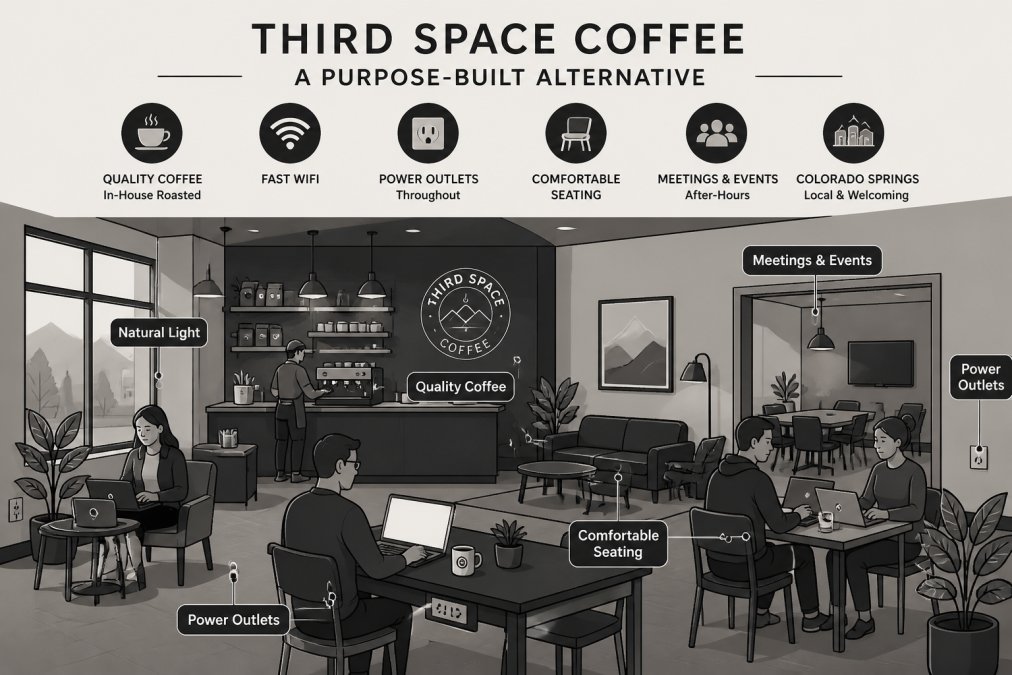
Our in-house roasted beans matter here too. When you're spending several hours in a space, the quality of what you're drinking compounds. We roast our own coffee, which means fresher beans than most shops receive from wholesale roasters. The flavor is better, but more importantly, you're supporting local roasting rather than buying from a chain that sources from multiple suppliers.
The meeting room rental option is critical for remote workers who occasionally need to host client calls or team meetings. You can't take a video call with a client from a coffee shop, the noise and informality undermine your professionalism. Third Space Coffee offers flexible meeting room rental that lets you book space for specific hours, not just monthly memberships. This solves the problem of the remote worker who needs a professional setting occasionally, not constantly.
Beyond the physical space, Third Space Coffee functions as a community hub. You're working among other professionals and remote workers, not isolated at home. This matters psychologically. The ambient presence of other focused people creates accountability. You're less likely to drift into social media when you're surrounded by people doing real work. It's the third space concept: not home, not office, but a genuine alternative that serves both productivity and connection.
Evaluating Your Remote Work Workspace Needs
Before choosing an alternative for remote workers, be honest about what you actually need. Different people have different requirements, and picking the wrong workspace wastes time and money.
Start with the technical requirements. Do you need reliable video conferencing capability? This eliminates most coffee shops and requires either a dedicated coworking space or a purpose-built alternative like Third Space Coffee. Are you doing work that requires deep focus without interruption? This requires a quiet environment, not a social one. Are you on the phone constantly? You need a space that permits calls without disturbing others.
Next, evaluate the time commitment. How many hours per week are you actually working from this space? If it's two days per week, a daily pass system makes sense. If it's five days per week, a membership becomes cost-effective. If it's irregular, sometimes three days, sometimes zero, you need flexibility that monthly memberships don't provide.
Consider the community aspect honestly. Are you working remotely because you want to avoid office politics, or because you want flexibility while maintaining professional connection? These lead to different choices. Someone avoiding office drama might prefer a quiet, anonymous coworking space. Someone seeking professional community might prioritize a space that hosts events and encourages networking.
Ergonomics matter more than most remote workers admit until they experience back pain. Coffee shop chairs aren't designed for six-hour work sessions. If you're working more than four hours daily from a remote location, you need proper seating. This means coworking spaces or purpose-built alternatives that invest in furniture. Standing desks, adjustable chairs, and proper desk height aren't luxuries, they're necessities for sustained productivity.
The data security question is often overlooked. If you handle sensitive information, you need a private workspace where you're not broadcasting your screen to people sitting nearby. You need a reliable VPN connection (most coffee shop Wi-Fi is unencrypted). You need the ability to take calls without worrying about who's listening. This requirement alone eliminates most coffee shops and points toward private office space or membership-based coworking.
Budget is the final constraint. Daily passes at coworking spaces typically range from $15-40. Monthly memberships typically cost $100-500. Purpose-built alternatives like Third Space Coffee offer both day-pass flexibility and membership options. Home office setup costs nothing but may hurt productivity. Calculate your actual monthly spend and compare it to the productivity gains. If a $300 monthly membership increases your output enough to generate an extra $500 in income, the math is clear.
| Workspace Type | Best For | Cost Range | Commitment | Noise Level |
|---|---|---|---|---|
| Coffee Shop | Occasional work, social environment | $5-15/day | None | High |
| Coworking Space | Full-time remote workers, networking | $100-500/month | Monthly | Medium |
| Library | Deep focus, quiet work | Free-$10/day | None | Very Low |
| Third Space Coffee | Remote workers needing flexibility | Day passes + membership options | Flexible | Low-Medium |
| Private Office Rental | Confidential work, client meetings | $20-1000+/hour or day | Hourly/Daily/Monthly | Low |
Frequently Asked Questions
What makes a coffee shop ideal for remote work?
A productive remote work environment requires reliable high-speed internet, available power outlets at multiple seating locations, minimal ambient noise or designated quiet zones, comfortable seating with proper ergonomics, and a welcoming atmosphere that doesn't pressure you to leave after an hour. Third Space Coffee offers all these elements, with in-house roasted coffee and flexible seating that accommodates all-day work sessions without interruption.
Are public libraries good alternatives to coffee shops for remote work?
Public libraries provide quiet zones, free Wi-Fi, and power outlets, making them excellent alternatives for focused deep work. However, they typically have limited food and beverage options, strict noise policies, and restricted hours. Coffee shops and coworking spaces offer more flexibility, social atmosphere, and amenities like quality refreshments. The best choice depends on whether you prioritize absolute silence or a balanced work-life environment with community connection.
How do I find quiet places to work remotely in my city?
Start by identifying locations with dedicated quiet zones or noise policies: libraries, dedicated coworking spaces with quiet areas, and specialty coffee shops that cater to remote workers. Visit during off-peak hours (mid-morning or early afternoon), ask about seating away from entry points and espresso machines, and check online reviews mentioning ambient noise levels. Third Space Coffee and similar community-focused venues often designate specific areas for focused work, separate from social gathering spaces.
What are the benefits of working from a coworking space vs. a coffee shop?
Coworking spaces offer professional infrastructure (meeting rooms, high-speed bandwidth, printing services), networking opportunities with other professionals, and consistent availability without worrying about peak hours. Coffee shops provide lower cost, social atmosphere, and flexibility. Hybrid solutions like Third Space Coffee combine coffee shop warmth with professional amenities like meeting room rentals, offering remote workers the best of both without the full coworking membership commitment.
Remote workers in Colorado Springs have moved beyond the binary choice of home or coffee shop. Third Space Coffee represents a third option: a space designed specifically for your needs. It's built for focus, equipped for calls, furnished for comfort, and rooted in community. Whether you need it daily or occasionally, the flexibility is there. Visit Third Space Coffee and experience the difference a purpose-built workspace makes in your productivity and your workday.
This article was written using GrandRanker