 how-to
How to Calculate Cost Per Cup of Home Coffee
Table of Contents
- Why Calculate Your Coffee Cost Per Cup
- Define Your Cup Size and Coffee Dose
- Understanding Coffee-to-Water Ratio and Grams Per Cup
- How Many Cups of Coffee Per Pound of Beans
- Building Your Cost Per Cup Coffee Calculator
- Cost of Making Coffee at Home vs Buying from a Café
- Account for Real-World Variables and Waste
- Frequently Asked Questions
Last Updated: October 21, 2026
Why Calculate Your Coffee Cost Per Cup
Understanding how to calculate cost per cup of home coffee matters more than most people realize. When you brew daily, small costs compound into significant annual expenses. Calculating your cost per cup of home coffee helps you make informed decisions about your coffee habit and potentially discover savings you didn't know existed.
Many remote workers and students spend $5-7 per café visit. That's 10-15 times more than home brewing typically costs. But without doing the math, the real difference stays hidden.
When you know your actual cost per cup, you can compare fairly with café prices and decide where your money goes best.
Learning how to calculate cost per cup of home coffee is straightforward. You need three pieces of information: your bag price, the weight in grams, and how much coffee you use per cup. From there, basic division gives you the answer.
Define Your Cup Size and Coffee Dose
A cup size is your starting point. The standard definition in the coffee world is 8 fluid ounces of brewed coffee. This is important because coffee dose (the amount of ground coffee you use) depends on your cup size.
Most home brewers use between 15-18 grams of ground coffee per 8-ounce cup. Some prefer stronger coffee at 20 grams. Others like it lighter at 12-14 grams. Your personal taste determines where you land.
Here's why this matters for your calculation:
- Lighter brew (12 grams per cup): Uses less coffee, lowers cost per cup, but some find it weak
- Standard brew (15-17 grams per cup): Most common ratio, balances taste and cost
- Strong brew (20+ grams per cup): Uses more coffee, higher cost per cup, richer flavor
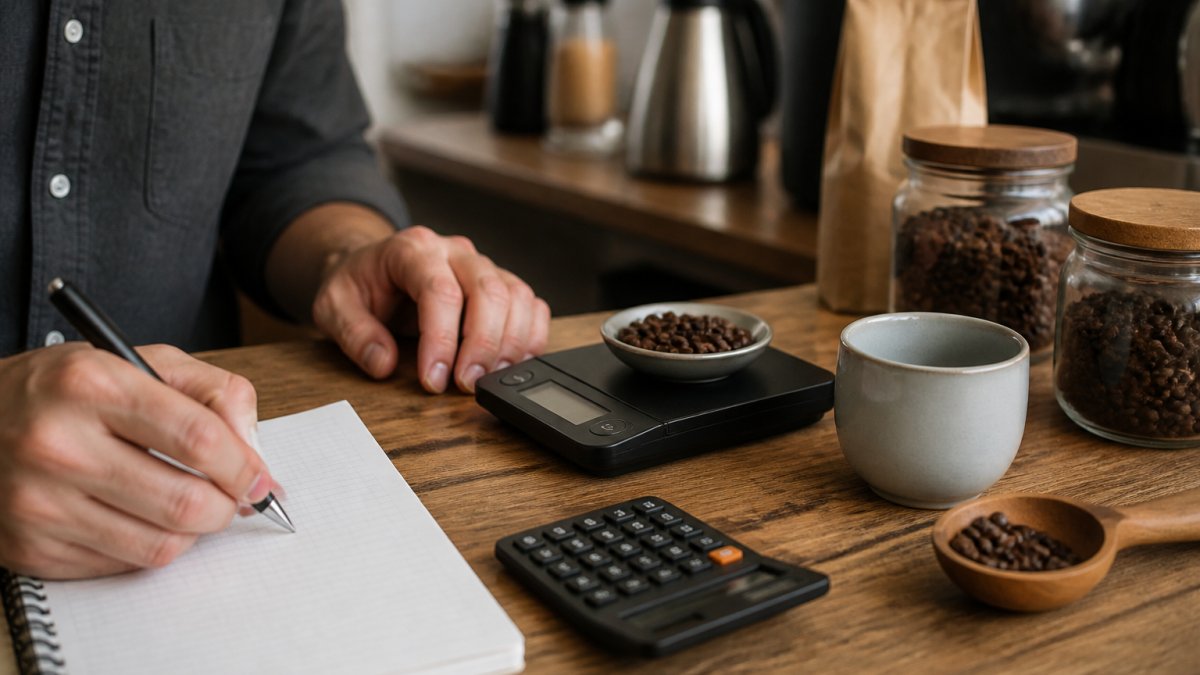
If you don't own a kitchen scale, this is your first investment. A basic digital scale costs under $15 and measures grams accurately. Guessing by eyeballing coffee grounds introduces error into your calculation.
Measure your actual dose for three days. Use the same brewing method each time. This gives you a realistic average rather than a theoretical number.
Understanding Coffee-to-Water Ratio and Grams Per Cup
The coffee-to-water ratio is the relationship between dry ground coffee and water. It determines both taste and your cost per cup calculation.
The golden ratio in specialty coffee is 1:16. This means 1 gram of coffee to 16 grams of water. For an 8-ounce cup (about 240 milliliters or 240 grams of water), this works out to roughly 15 grams of ground coffee.
Here's how ratios affect your costs:
- 1:14 ratio (stronger): 17 grams coffee per 8 oz cup. Higher cost, bolder taste.
- 1:16 ratio (standard): 15 grams coffee per 8 oz cup. Balanced cost and flavor.
- 1:18 ratio (lighter): 13 grams coffee per 8 oz cup. Lower cost, milder taste.
You can convert ounces to grams easily. One fluid ounce of water weighs approximately 30 grams. So 8 fluid ounces equals about 240 grams.
Most home brewers don't measure water weight. Instead, they measure by volume using cups or their brewer's markings. That's fine for consistency. What matters is knowing your typical dose in grams.
How Many Cups of Coffee Per Pound of Beans
A pound of coffee beans weighs 453.6 grams. This is your total supply for calculating how many cups you can brew.
Here's the math:
453.6 grams per pound ÷ 15 grams per cup = 30 cups per pound
This assumes your standard dose is 15 grams. If you use 17 grams per cup, you get 26 cups per pound. At 13 grams per cup, you get 34 cups per pound.
The number of cups per pound directly affects your cost per cup calculation. A $15 bag that yields 30 cups costs $0.50 per cup. The same bag yielding only 26 cups costs $0.58 per cup.
This is where brewing method matters. French press, pour-over, espresso, and automatic drip brewers use different doses. Espresso uses much more coffee per serving (about 18-20 grams for a 2-ounce shot). Automatic drip uses less per serving than manual pour-over.
Know your brewing method's typical dose. This locks in your cups-per-pound number, which becomes a constant in your cost calculation.
Building Your Cost Per Cup Coffee Calculator
The actual calculation is simple division, but the most common errors come from unit mismatches and from skipping a step.
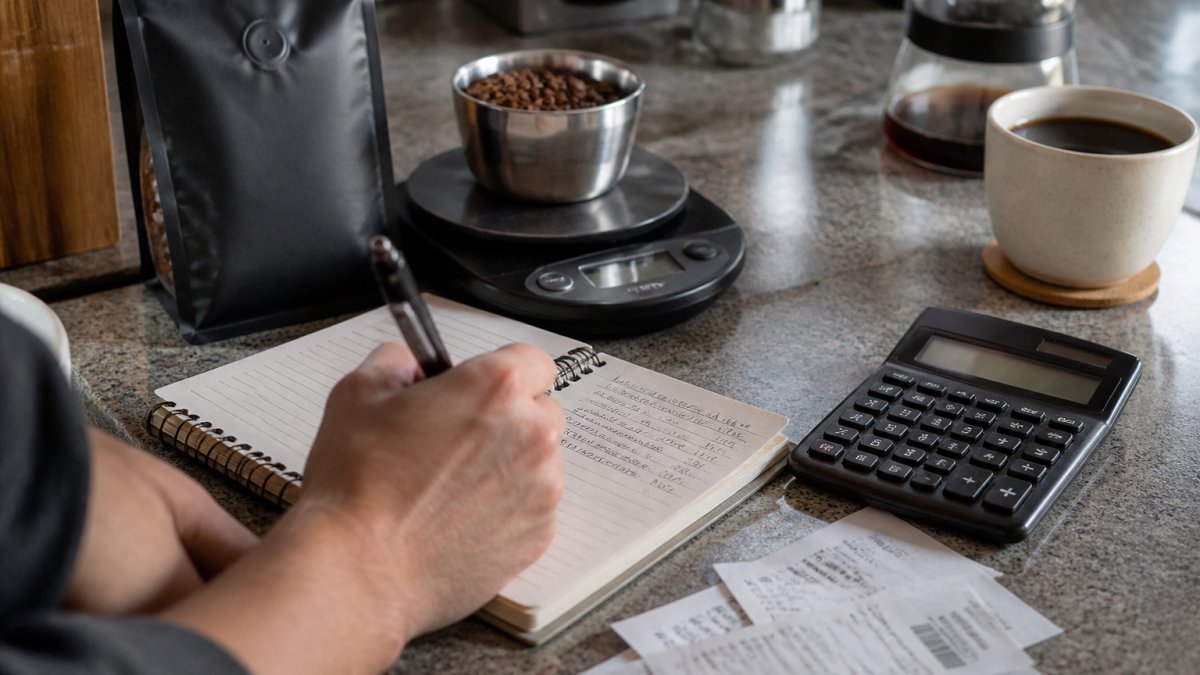
The formula
Cost Per Cup = Bag Price ÷ Cups Per Bag
Cups Per Bag = Bag Weight in Grams ÷ Dose in Grams Per Cup
That is the whole method. The rest is unit handling and bookkeeping.
Step-by-step worked example
Let's calculate the cost per cup for a 12-ounce bag priced at $14, using a 15-gram dose per 8-ounce cup.
- Convert bag weight to grams. There are 28.35 grams per ounce, so 12 ounces × 28.35 = 340.2 grams. Round to 340 grams.
- Divide bag weight by dose. 340 grams ÷ 15 grams per cup = 22.7 cups. Round down to 22 full cups because you cannot brew a partial cup from the last few grams.
- Divide bag price by cups. $14 ÷ 22 = $0.636 per cup. Round to $0.64.
Now the same method for a 1-pound bag priced at $22:
- One pound is 453.6 grams.
- 453.6 ÷ 15 = 30.2 cups, or 30 full cups.
- $22 ÷ 30 = $0.733 per cup, or $0.73.
In this example the larger bag costs more per cup. That happens when the per-ounce price is higher for the larger format, which is common in specialty coffee.
A reusable worksheet
Set up a spreadsheet with these columns and one row per bag:
- Date purchased
- Coffee name and origin
- Bag weight (ounces)
- Bag weight (grams), formula: ounces × 28.35
- Bag price (USD)
- Dose per cup (grams)
- Cups per bag, formula: grams ÷ dose, rounded down
- Cost per cup, formula: price ÷ cups per bag
- Notes (brew method, roast date)
If you prefer to work in ounces for dose, convert once: 0.53 ounces is about 15 grams.
Unit-handling tips
- Enter bag weight in ounces and let the spreadsheet convert to grams. This avoids the most common error, which is mixing ounces and grams in the same formula.
- Round cups per bag down, not up. The last partial dose is usually too small to brew a full cup.
- Keep dose consistent for the comparison. If you change dose between bags, the cost-per-cup numbers are not comparable.
- Use the same cup size definition throughout. An 8-ounce cup and a 12-ounce mug will produce different cups-per-bag numbers from the same dose.
Update the sheet monthly. Over time you will see which coffees offer the best value for your brewing style, and you will have a record you can check against your actual consumption.
Cost of Making Coffee at Home vs Buying from a Café
Home-brewed coffee typically costs between $0.40-$0.80 per cup. Café coffee costs between $4-$7 per cup.
That's a 5-10 times difference.
But this comparison needs context. The café price includes labor, rent, utilities, equipment, and margin. You're not just buying coffee; you're buying the space, the expertise, and the experience.
Here's a more complete home cost breakdown:
- Ground coffee: $0.50-$0.80 per cup
- Filters (if applicable): $0.05-$0.10 per cup
- Water: negligible
- Milk or cream (if used): $0.20-$0.40 per cup
- Sweetener (if used): $0.05-$0.15 per cup
- Total home cost: $0.80-$1.65 per cup
A café latte with milk and flavor shot costs $6-$8. Your home version costs $1.20-$1.80.
The daily savings add up fast. Brewing at home five days a week saves you $20-$30 weekly compared to café visits. Over a year, that's $1,000-$1,500.
But café coffee offers something home brewing doesn't: consistency, expertise, and community. Third Space Coffee exists because people value those things. The calculation helps you decide how much to spend on each.
Account for Real-World Variables and Waste
The calculation above assumes perfect efficiency. Real life introduces variables that affect your actual cost, and the difference between a calculated cost and a real cost is often 10-20%.
Dialing in and discarded coffee
Dialing in is the process of adjusting grind size and dose until the coffee tastes right.
If you buy one bag per month and discard 3 doses each time, you lose about 36 doses per year.
Stale beans
Whole beans stay fresh for about 2-4 weeks after the roast date. Ground coffee stays fresh for about 1-2 weeks.
Equipment depreciation
Equipment is a one-time cost that spreads across many cups. The method is to divide the equipment cost by the number of cups you expect to brew over its useful life.
- A $200 pour-over setup (kettle, dripper, carafe, scale) used for 10,000 cups adds $0.02 per cup.
- A $3,000 espresso machine used for 50,000 cups adds $0.06 per cup.
- A $150 grinder used for 15,000 cups adds $0.01 per cup.
Add maintenance to the same calculation. If you spend $50 per year on descaling, filters, and replacement parts, and you brew 500 cups per year, that is $0.10 per cup.
Variable dose
Some mornings you use 14 grams, others 16 grams. Your actual average may differ from your target.
A practical adjustment
Here is how to combine these into one number:
- Calculate your base cost per cup from the formula.
- Add equipment cost per cup (equipment cost ÷ expected cups).
- Add maintenance cost per cup (annual maintenance ÷ annual cups).
- Add a waste allowance for dialing in and stale beans. A common approach is to add 5-10% to the base coffee cost, or to add the annual waste dollar amount to your annual total.
Using the earlier example, a $0.64 base cost plus $0.02 equipment plus $0.10 maintenance plus a 10% waste allowance gives about $0.82 per cup.
Frequently Asked Questions
How do you calculate the cost per cup of coffee at home?
Divide the total cost of your coffee beans by the number of cups they produce. First, determine how many cups one pound of beans yields (typically 16-20 cups depending on brew strength). Then divide the bag price by that number. For example, if a one-pound bag costs $12 and makes 18 cups, your cost per cup is about $0.67. Add consumables like filters or milk if relevant to your brewing method.
How many cups of coffee per pound of beans can you actually brew?
One pound of coffee beans typically yields 16-20 cups of brewed coffee, depending on your coffee-to-water ratio and cup size. A standard ratio is 1:16 (one part coffee to 16 parts water), which means one pound of beans (about 454 grams) brews approximately 16-18 cups. Stronger brews use more grounds and yield fewer cups; weaker brews stretch one pound further. Always weigh your beans and water for consistency.
Is it cheaper to make coffee at home or buy it from a café?
Home-brewed coffee typically costs $0.50-$1.50 per cup, while café coffee averages $4-$6 per cup. Even accounting for equipment, filters, and milk, brewing at home saves 70-80% per cup. A daily café habit costs roughly $1,200-$1,800 per year; home brewing costs $180-$550 annually. The savings multiply quickly for regular coffee drinkers, especially those who brew multiple cups daily.
What costs should you include in a home coffee cost calculator?
Include bean cost, filters (if applicable), and milk or add-ins. Optional but realistic costs: equipment depreciation (divide total brewer cost by expected lifespan in cups), grinder wear, and water. Skip these only if calculating baseline bean cost. For a full picture, track waste from dialing in your grinder or failed brews, which can add 5-10% to your actual per-cup cost. Most home brewers find bean cost dominates the total.