 listicle
What Are the Best Coffee Bean Storage Containers?
Last Updated: October 29, 2026
Quick Summary
The best coffee bean storage containers are airtight, opaque canisters that block oxygen, light, moisture, and heat, kept at room temperature. For coffee bean storage, the Fellow Atmos Vacuum Canister is our best overall pick because its vacuum lid actively removes oxygen, while the OXO Steel Pop Container is the best budget option at $23.
- Whole bean coffee stays fresh for roughly two to four weeks after the roast date.
- A one-way valve releases carbon dioxide while keeping oxygen out during the first week.
- The Airscape plunger lid comes in 32-ounce and 64-ounce sizes priced at $37.50 and $44.00.
- Leave roughly 10 to 15 percent of canister volume empty so the lid seals fully.
- Freeze long-term portions in airtight bags and freeze once rather than thawing and refreezing.
Table of Contents
- Quick Comparison: Best Coffee Bean Storage Containers
- What Is the Best Way to Store Coffee Beans?
- How Long Do Coffee Beans Stay Fresh?
- Coffee Storage Container Glass vs Stainless Steel
- Why a Coffee Bean Storage Container With One-Way Valve Matters
- Top Picks: Reviews and Who Each Container Is For
- Choosing Capacity, Cleaning, and Long-Term Care
- Stock Your Canister With Freshly Roasted Beans From Third Space Coffee
- Frequently Asked Questions
Quick Comparison: Best Coffee Bean Storage Containers
The best coffee bean storage containers keep oxygen, light, moisture, and heat away from your beans between brews. Here is our quick comparison, followed by the reasoning behind each pick.
| Container | Best For | Seal Type | Material | Price |
|---|---|---|---|---|
| Fellow Atmos Vacuum Canister | Best overall | Vacuum pump lid | Stainless steel | Varies by size |
| OXO Steel Coffee Pop Container With Scoop | Best budget pick | Pop-up button seal | Steel | $23 |
| Airscape Coffee Bean Canister | Best for bulk buyers | Air-displacement plunger | Stainless steel | $37.50 (32 oz) / $44.00 (64 oz) |
| MiiR Airlock Coffee Canister | Best portable option | Accordion seal | Stainless steel | Varies by size |
| Coffee Gator Canister | Best value | One-way valve lid | Stainless steel | $18.69 |
| Ankomn Turn-N-Seal / Everlock | Best everyday use | Twist lock | Plastic and glass options | Varies by model |
What Is the Best Way to Store Coffee Beans?
The best way to store coffee beans is in an airtight, opaque container kept at room temperature, away from light, heat, and moisture. To understand why preserving freshness actually improves the taste of your coffee, see why fresh roasted coffee tastes better. If you want the deeper case for buying whole bean in the first place, our guide on the benefits of buying whole bean coffee explains why the extra grind step pays off.
The Four Enemies: Oxygen, Light, Moisture, and Heat
Every storage decision comes down to four things. Oxygen oxidizes the oils that carry aroma. Light breaks those oils down faster. Moisture invites staleness and, in the worst case, mold. Heat accelerates all three. A good coffee canister blocks all four; a decorative jar on a sunny windowsill blocks none. The fridge exposes beans to moisture and odors every time the door opens, which is worse than leaving them in the bag.
How Long Do Coffee Beans Stay Fresh?
Whole bean coffee stays fresh for roughly two to four weeks after the roast date, and noticeably longer in the freezer. Most coffee drinkers find quality drops sharply after the first month, even in a sealed container. Ground coffee fades much faster, often within a week.
Roast Date, Opening Date, and Realistic Timelines
The roast date on the bag matters more than any "best by" stamp. Beans rest for a few days after roasting while they degas, then hit their peak. Once you open the bag, oxygen gets in, and every scoop lets more in. If you are unsure whether your current bag is still good, our guide on how to tell if coffee beans are fresh walks through the sensory checks.
Coffee Storage Container Glass vs Stainless Steel
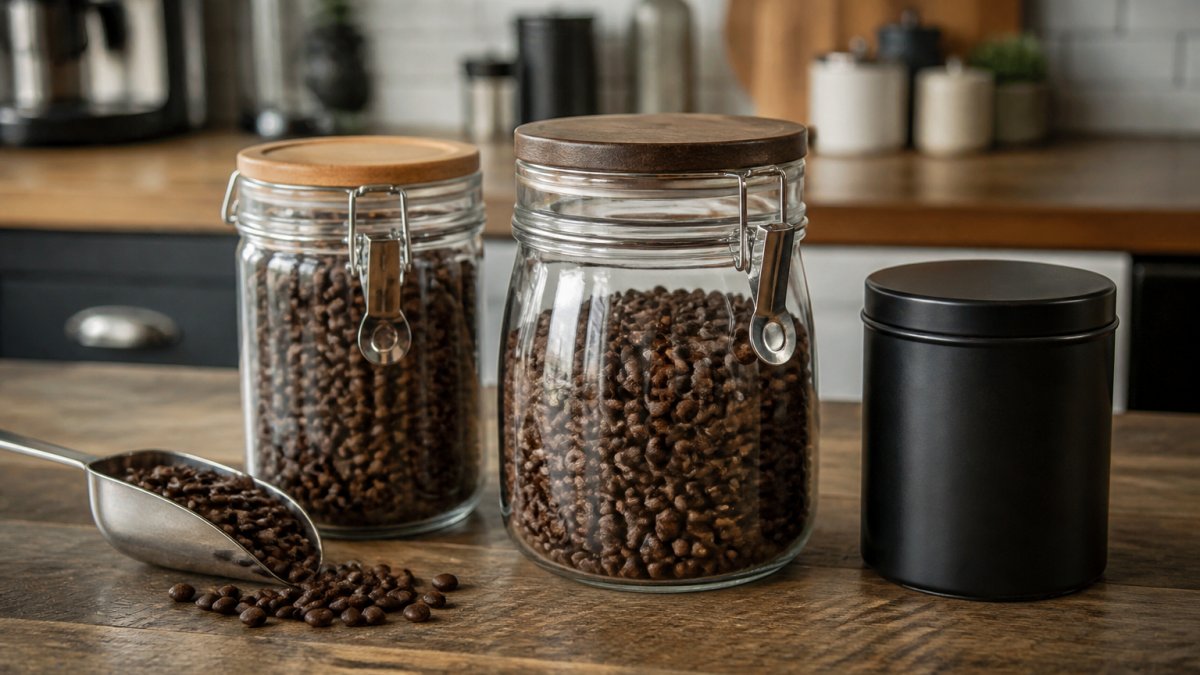
Glass and stainless steel both store coffee well, but they solve different problems. Glass is non-porous, easy to clean, and lets you see how much is left, though it must be opaque or kept in a dark cabinet to block light. Stainless steel blocks light completely and resists dents, but you cannot see the fill level without opening the lid.
Why a Coffee Bean Storage Container With One-Way Valve Matters
A coffee bean storage container with one-way valve releases carbon dioxide while keeping oxygen out. The valve lets CO₂ escape without letting air back in, which protects flavor during the first week when beans are most active.
Not every good canister has one. Vacuum designs like the Fellow Atmos remove air mechanically instead, and air-displacement lids like the Airscape press the oxygen out from above.
What Each Storage Mechanism Can and Cannot Do
Most canister marketing implies every sealed lid delivers the same result.
One-way valve (passive degassing). A silicone or membrane valve opens under slight internal pressure to vent CO₂ and closes to block room air.
Vacuum pump (active air removal). A built-in or handheld pump pulls air out until an indicator shows a seal.
Air-displacement plunger. A lid with a plunger presses down onto the beans, pushing headspace air out through a small vent as it descends.
Reading Freshness Claims Without a Lab
No canister can restore freshness that is already gone, and none of these mechanisms is a substitute for a recent roast date. Judge a container by what it controls: a valve controls pressure, a vacuum controls headspace oxygen, a plunger controls headspace volume, and a gasket controls ingress. When a product page claims to "keep coffee fresh for months," ask which of those four it actually does, and whether the claim is backed by a repeatable test or only by marketing copy.
Top Picks: Reviews and Who Each Container Is For
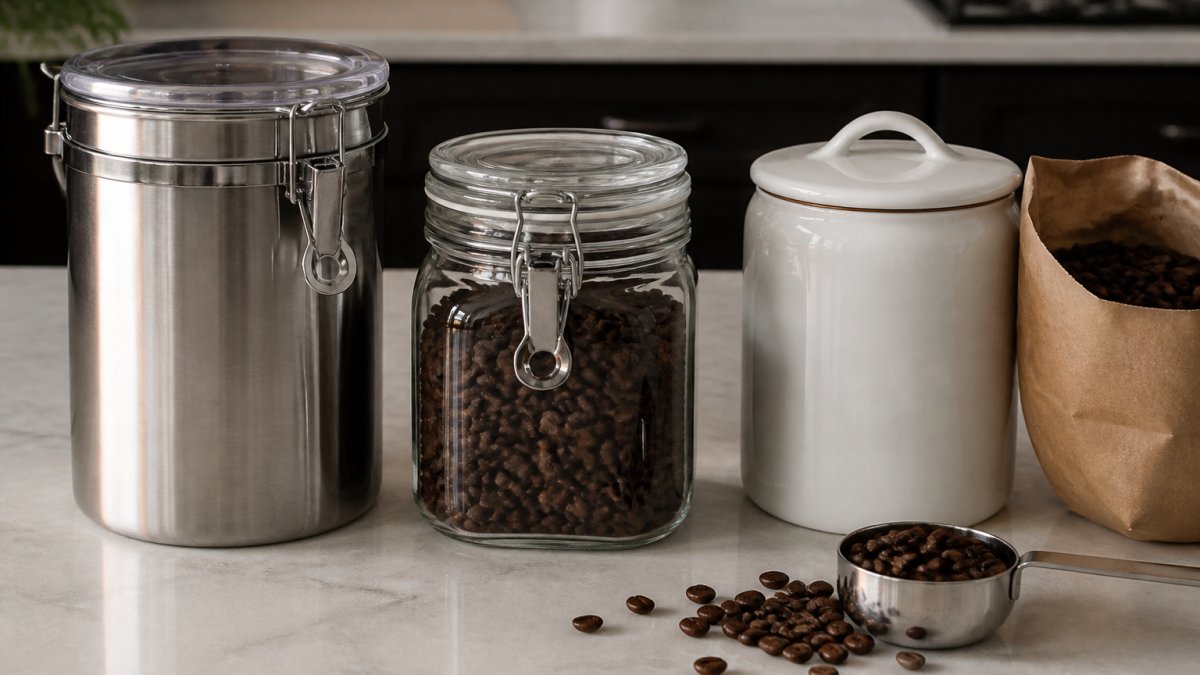
We grouped these by how people actually buy and brew coffee. None is perfect for everyone, and we say so where it matters.
Fellow Atmos Vacuum Canister: Best Overall
The Fellow Atmos earns the top spot because its vacuum lid actively pulls air out rather than just sealing it off. It has been named a top canister in multiple independent reviews, including The Spruce Eats coffee storage testing, which speaks to consistency across testers.
Best for: anyone who opens the bag daily and wants the strongest defense against oxygen. Skip if: you want zero fiddling with lids before your first cup.
OXO Steel Coffee Pop Container With Scoop: Best Budget Pick
The OXO Steel Pop Container is a budget-friendly option. A button on the lid creates a seal with one press, and the included scoop means fewer excuses to leave the bag open. The steel body keeps light out.
Best for: budget-conscious buyers who want a solid everyday canister. Skip if: you buy in bulk and need months of protection.
Airscape Coffee Bean Canister: Best for Bulk Buyers
The Airscape uses a plunger lid that presses down onto the beans, pushing air out of the headspace. It comes in 32-ounce and 64-ounce sizes, listed at $37.50 and $44.00 respectively by Seattle Coffee Gear's Airscape listing, which makes the larger size the better per-ounce buy.
Best for: households that buy two pounds at a time. Skip if: you only keep a week's worth of beans on hand, since the plunger has little to press against.
MiiR Airlock Coffee Canister: Best Portable Option
MiiR's canister pairs a heavy-duty stainless-steel body with an accordion seal that compresses as you close it. The tradeoff is capacity, which suits travel portions rather than a full bag.
Best for: commuters, campers, and anyone who carries beans to the office. Skip if: you need to store a full pound at home.
Coffee Gator Canister and Ankomn Turn-N-Seal / Everlock: Best Value and Everyday Use
The Coffee Gator is a lower-cost option with a medium size. It includes a one-way valve and a date dial on the lid to help track the roast date. The Ankomn Turn-N-Seal and Everlock models use a twist-lock lid that compresses a gasket for a firm seal, Neither Ankomn model publishes much specification detail, so buy from a retailer with a clear return policy.
Best for: first-time canister buyers who want a valve and a low price. Skip if: you want documented capacity specs before ordering.
Choosing Capacity, Cleaning, and Long-Term Care
Sizing and maintenance decide whether a canister lasts a decade or gets shoved in a drawer by spring. Buy for your consumption rate, not the biggest bag on the shelf.
Sizing by Purchase Size and Consumption Rate
Match capacity to how fast you drink. A single daily brewer using about 18 grams per cup goes through roughly a pound in two to three weeks, which suits a one-pound canister.
A more reliable method is to work backward from your bag and your brew routine:
- Count your dose. A standard drip or pour-over dose runs about 15 to 18 grams; a double espresso basket holds roughly 18 to 20 grams. Multiply daily cups by dose to get daily grams.
- Convert the bag. A one-pound bag is about 454 grams; a 12-ounce bag is about 340 grams; a 2.2-pound (1 kg) bag is about 1,000 grams.
- Divide to get days per bag. At 18 grams per cup and two cups a day (36 grams), a one-pound bag lasts about 12 to 13 days. At one cup a day, it lasts about 25 days.
Headspace matters more than most buyers expect. A plunger-style lid needs room to travel, and a vacuum lid needs a clean sealing surface, so filling to the rim defeats both.
Freezing, Seal Replacement, and Maintenance
Freezing works for long-term storage if you do it right: portion beans into airtight bags, squeeze out the air, and freeze once rather than thawing and refreezing. Wash canisters with warm soapy water and dry them fully before refilling, since residual moisture undoes everything the seal does. Silicone gaskets wear out; if the lid stops gripping, check the gasket before replacing the whole container.
A few maintenance habits extend the life of any canister:
- Dry fully before refilling. Moisture trapped under a gasket is the most common cause of musty odors. Let parts air-dry completely, or wipe gaskets dry with a clean cloth.
- Inspect gaskets quarterly. Look for flattening, cracks, or a shiny compressed edge. A gasket that no longer springs back is not sealing, even if the lid still closes.
- Avoid dishwashers for valve and pump lids. Heat and detergent can warp silicone and degrade pump seals. Hand-wash those parts and wash the body per the manufacturer's instructions.
Stock Your Canister With Freshly Roasted Beans From Third Space Coffee
A great container can only protect what you put in it, and the freshest beans give it the most to work with. We roast in-house, so the beans you take home carry a roast date you can trust rather than a vague shelf life. If you have been waiting to try them, our whole bean coffee is now available by the bag.
Frequently Asked Questions
What is the best container for storing coffee beans?
An opaque, airtight container with a tight seal is the best choice. Stainless steel and ceramic block light, while a silicone or accordion seal limits air exposure. Vacuum designs like the Fellow Atmos and air-displacement lids like the Airscape remove oxygen before sealing. Avoid clear glass unless it lives in a dark cabinet. Whatever you choose, buy whole beans and store them at room temperature, away from the stove, and use them within a few weeks of the roast date.
Is it better to store coffee beans in glass or stainless steel?
Stainless steel wins on light blocking, which is why it is the safer default for countertop storage. Glass is non-reactive and easy to clean, but it lets light through, so it belongs in a cupboard, not beside a sunny window. The coffee storage container glass vs stainless steel decision comes down to placement: if the canister sits out, pick opaque steel; if it stays dark, glass works fine. Seal quality matters more than either material.
How long do coffee beans stay fresh in an airtight container?
Whole beans hold peak flavor for about two to four weeks after the roast date, and an airtight container protects that window. After opening, expect good results for roughly two to four weeks, with quality declining gradually after that. Ground coffee stales much faster, often within a week or two. Write the roast date on the canister, keep it sealed between uses, and finish the bag before buying the next one.
Should coffee beans be stored in the refrigerator or freezer?
Skip the refrigerator: it is humid and cycles temperature every time the door opens. The freezer works for long-term storage if you seal beans in an airtight container with minimal headspace and let them come to room temperature before grinding. Only freeze what you will not finish within a few weeks, and never refreeze thawed beans. For daily use, a countertop canister kept away from heat and light is simpler and just as effective.
Do I need a coffee bean storage container with a one-way valve?
A one-way valve helps because freshly roasted beans release carbon dioxide, and a sealed container without a vent can build pressure. The valve lets that CO2 escape while limiting oxygen coming in, which supports flavor and aroma. Many vacuum and air-displacement canisters handle this differently by removing air before sealing. If you buy beans within days of roasting, a valve or vacuum design is worth having; for beans already a week or two old, a tight seal matters most.
The real challenge is not finding a container; it is starting with beans fresh enough to be worth protecting. At Third Space Coffee, we roast in-house so every bag carries a date you can check, and our space gives you a place to enjoy the result. Stop by for a bag of our freshly roasted beans, or ask us about flexible meeting room options for your next team gathering. Get started with Third Space Coffee and taste what fresh roasting does for your daily brew.