
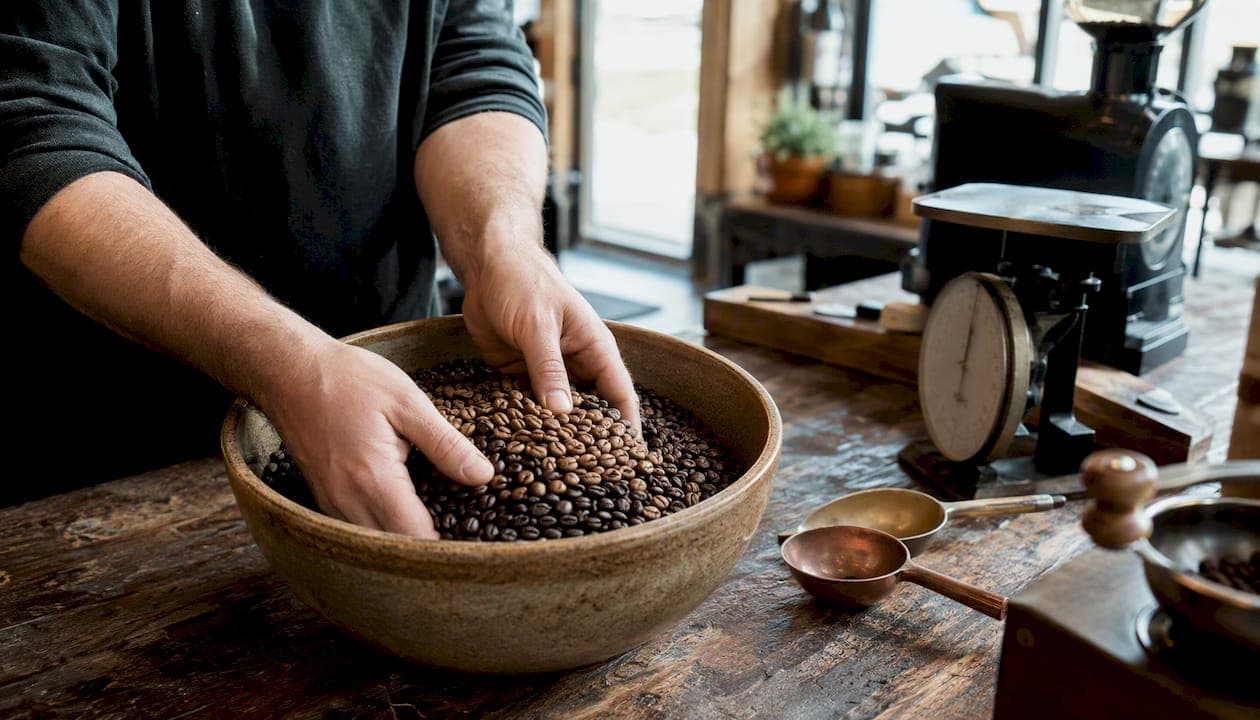
A "coffee build" usually means one of three things: designing a custom coffee blend from scratch, assembling a brew recipe with specific ratios and temperatures, or the unrelated developer/gaming tool. Pick your meaning below and go straight to the matching steps.
- Building a custom blend? Start with a 70:30 ratio of two single-origin beans, brew a small test cup, and adjust from there. The blend-building section walks you through it.
- Looking for a brew recipe? The recipes table gives you exact grams, temperatures, and times for pour-over, French press, espresso, and cold brew.
- Playing Project Zomboid or using an npm tool? Skip to the gaming/dev section near the bottom.
Consumer Reports tasting data confirms that price alone does not predict blend quality, which means a $12 bag of whole beans you blend yourself can outperform a $30 retail blend if you dial in the ratio. Thirdspacecoffee roasts in-house in Colorado Springs and runs hands-on workshops where you can taste the difference directly.
Table of Contents
- How do you build your own coffee blend from scratch?
- Where can you learn to build coffee blends?
- Did you mean the gaming or developer version of "coffee build"?
- Key Takeaways
- Why small-batch testing beats buying a "perfect" blend
- Thirdspacecoffee: taste the difference in Colorado Springs
- Useful sources and further reading
How do you build your own coffee blend from scratch?
Custom blending, the craft term for what most people call a "coffee build," starts with a goal. Before you buy a single bean, decide what you want in the cup: rich body, bright acidity, chocolate sweetness, or a clean finish. That decision drives every choice that follows.
Three starter blend templates (200 g total)
| Blend goal | Component A | Component B | Starting ratio |
|---|---|---|---|
| Balanced everyday | Brazilian natural (medium) | Colombian washed (medium) | 70:30 |
| Chocolate-forward | Sumatra wet-hulled (medium-dark) | Brazilian natural (medium) | 70:30 |
| Bright and fruit-forward | Ethiopian natural (light-medium) | Kenyan washed (light-medium) | 50:50 |
Work with a 200 g sample batch. That is small enough to waste nothing if it fails, large enough to brew three or four test cups.
Test and adjust
Brew your test batch using the same method every time — pour-over works well because it highlights individual flavors clearly. Take notes on body, sweetness, acidity, and finish. If the cup is too sharp, shift 10% more weight toward the body anchor. Too flat? Add more of the brightness contributor.
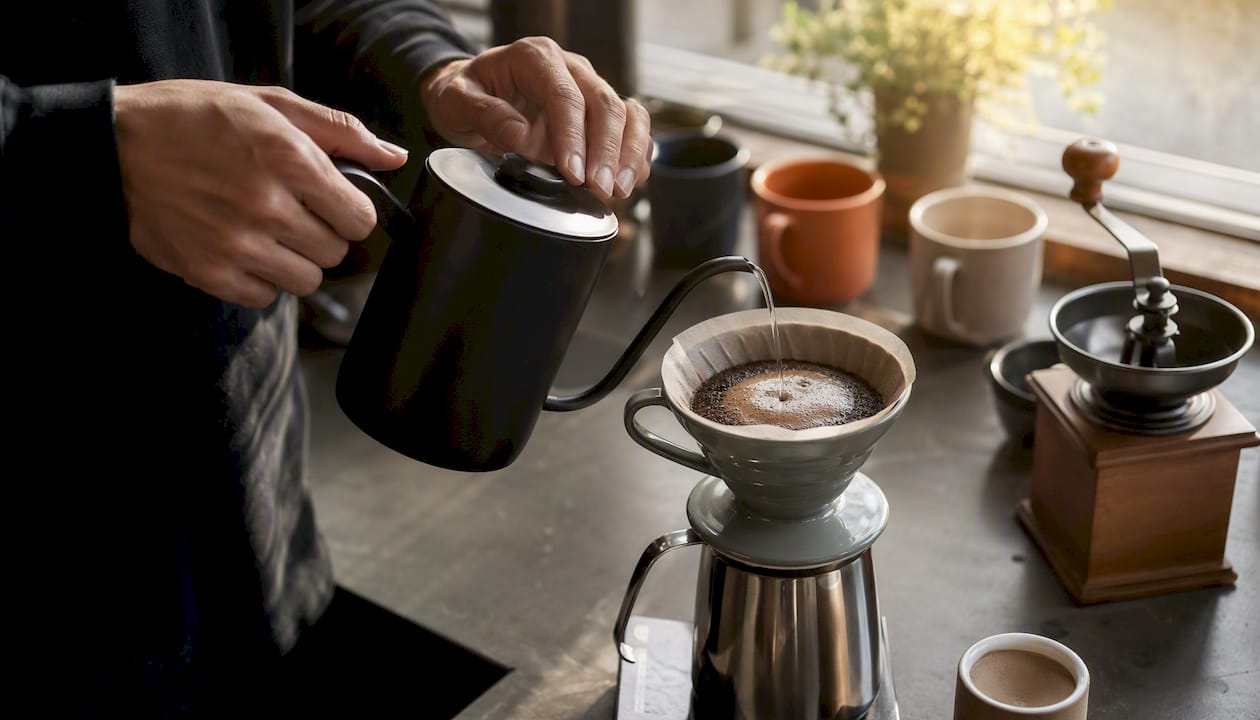
Roast level shapes every flavor variable in a blend. A darker roast on one component will dominate the cup even at a 30% share, so adjust ratios when you change roast levels, not just origins.
Pro Tip: Let roasted beans rest 5–10 days off-roast before blending test batches. CO₂ off-gassing in the first few days after roasting skews extraction and makes tasting notes unreliable.
Brew recipes and target ratios
| Method | Ratio (g coffee : g water) | Temperature | Brew time |
|---|---|---|---|
| Pour-over (V60) | — | 200°F (93°C) | 3–4 min |
| French press | 1:15 | 200°F (93°C) | 4 min |
| Drip machine | — | — | 5–6 min |
| Espresso | 1:2 (dose:yield) | 200°F (93°C) | 30 sec |
| Cold brew | — | Cold/room temp | 12 hrs |
Grind notes: Pour-over needs medium-fine, close to table salt. French press uses coarse, like breadcrumbs. Espresso requires fine, almost powdery. Cold brew goes coarsest of all. For espresso, tamp with roughly 30 lbs of pressure and distribute evenly before pulling the shot.
Pour-over bloom: Pour twice the weight of coffee in water (e.g., 30 g water for 15 g coffee) and wait 30–45 seconds before continuing. This releases CO₂ and opens up extraction.
Espresso runs at a much higher concentration than pour-over. Serious Eats' espresso testing notes that medium-to-dark roasts produce the classic espresso profile, while light-to-medium roasts offer more complexity for those willing to experiment with grind and dose.
Where can you learn to build coffee blends?
Hands-on learning accelerates the process more than any video or article. Here is what to look for and where to find it.
What to look for in a class
- Hands-on roasting or component selection (not just pre-ground samples)
- Small class size (under 12 people) so you get real feedback on your palate
- Instructor with Q Grader credentials or verifiable roasting experience
- Roast-date transparency on all beans used in class
- A take-home sample of your blend
For a practical look at how a community workshop flows from roast overview to cupping, Thirdspacecoffee's workshop guide covers the full sequence.
Local vs. online
An in-person class beats an online course for one specific reason: you cannot taste a YouTube video. If you are in Colorado Springs, Thirdspacecoffee offers in-person access to in-house roasted beans, specialty drinks, and a community space built for exactly this kind of exploration. For sourcing context, understanding local coffee sourcing and why it matters gives you a sharper eye for what goes into a quality blend.
Did you mean the gaming or developer version of "coffee build"?
Two completely different things share this search term.
Project Zomboid (Build 42 and later)
In Project Zomboid, making coffee requires a heat source (campfire, stove, or generator-powered appliance), a pot or mug, water, and a coffee ingredient item. The exact recipe varies by build version. For Build 42-specific fixes and updated crafting trees, the r/projectzomboid subreddit and the official Project Zomboid forums are the most reliable sources. Community members post patch-specific notes within days of each update.
The npm developer tool
coffee-build is a separate npm/GitHub package used to compile CoffeeScript across multiple packages in a monorepo. It has nothing to do with coffee the beverage. If you landed here looking for that tool, search GitHub for coffee-build directly or check the npm registry for the current version and documentation.
Key Takeaways
Building a custom coffee blend starts with a clear flavor goal, a 200 g test batch, and a consistent brew method to evaluate each iteration before scaling up.
| Point | Details |
|---|---|
| Pick your meaning first | "Coffee build" means a custom blend, a brew recipe, or a gaming/dev tool — go to the matching section. |
| Start with a 200 g test batch | Use a 70:30 ratio of two single-origin beans and brew pour-over to evaluate flavor clearly. |
| Use the 15‑15‑15 rule | Green beans last ~15 months; roasted whole beans peak at ~15 days; grind ~15 minutes before brewing. |
| DIY saves money at volume | Whole-bean specialty coffee costs roughly $0.30–$0.50 per cup versus $4–$6 for a café espresso drink. |
| Thirdspacecoffee for hands-on learning | Thirdspacecoffee in Colorado Springs roasts in-house and offers local access to whole-bean retail and community events. |
Why small-batch testing beats buying a "perfect" blend
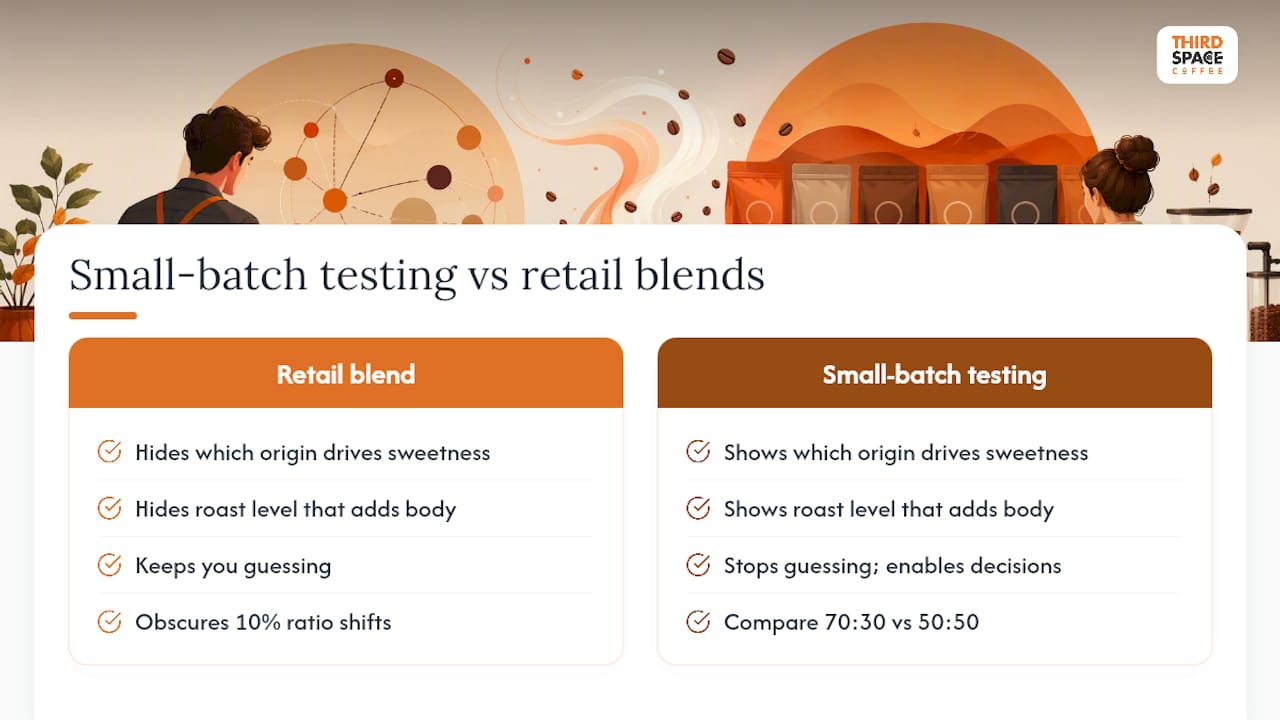
The conventional advice is to find a great retail blend and stick with it. That works fine if you never want to understand what you are tasting. The problem is that a pre-built blend hides its components. You drink the result without ever learning which origin drives the sweetness, which roast level adds the body, or what happens when you shift the ratio by 10%.
Small-batch testing forces you to pay attention. When you brew a 70:30 Brazilian-Colombian blend and then a 50:50 of the same beans, the difference is immediate and instructive. You stop guessing and start making decisions. That is the actual skill that workshops teach, and it transfers to every cup you make afterward.
The GCP RegenCoffee Guidance frames regenerative sourcing as outcome-focused, and the same logic applies to blending: measure what matters, adjust based on results, and build toward a specific goal rather than a vague preference. A paired-plot study in Embu County, Kenya found that eco-friendly farming practices reduced Coffee Berry Disease by 89% and Coffee Leaf Rust by 93% compared to conventional plots. That kind of farm-level resilience matters when you are sourcing beans for a blend you want to replicate consistently.
The gap between knowing what you like and knowing why you like it is exactly what a hands-on workshop closes. Thirdspacecoffee's in-house roasting and community space exist for that reason.
Thirdspacecoffee: taste the difference in Colorado Springs
Thirdspacecoffee roasts its beans in-house in Colorado Springs, which means every bag on the shelf has a known roast date and a traceable origin. That matters for blend work because you are not guessing at freshness.
For hobbyists who want to move beyond home experiments, Thirdspacecoffee's community space hosts events and workshops where you can taste multiple origins side by side, ask questions about roast development, and leave with a bag of whole-bean coffee you actually helped select. Event planners and small groups can also book the space for private tastings or meetings. Online ordering with front-of-store pickup makes it easy to grab fresh beans without waiting. Browse the specialty drinks menu to taste what a well-dialed espresso blend looks like before you build your own.
Useful sources and further reading
- The 7 Best Espresso Beans of 2026, Tested & Reviewed
- Eco-friendly coffee farming paired-plot study (Embu County, Kenya)
- GCP RegenCoffee Guidance 2025
- The best coffee blends to buy in 2026: Consumer Reports
- On Bean Freshness and Storage – Blackout Coffee Co
- Build Your Own Electric Coffee Maker: A Step-by-Step Guide
- Home | Third Space Coffee Colorado Springs, CO