

Roasting is the single process that transforms a green, grassy-smelling seed into the aromatic, complex beverage you recognize as coffee, a process central to understanding the role of food in hospitality. Heat applied to green beans over a typical roasting duration within a range of high temperatures triggers a cascade of chemical reactions that generate the acids, sugars, bitter compounds, and volatile aromatics defining every cup. The role of roasting in flavor is not subtle: it determines whether your coffee tastes bright and fruity, balanced and sweet, or dark and smoky. No other step in the production chain, short of the quality of the green bean itself, has more influence on what ends up in your cup.
Roasting shapes these key flavor attributes directly:
- Acidity: Bright, citrus-like acidity peaks in light roasts and decreases as roast color darkens
- Bitterness: Increases steadily with roast development, driven by melanoidins and degraded chlorogenic acids
- Sweetness: Peaks in medium roasts; burns off in dark roasts as sugars carbonize
- Aroma complexity: Hundreds of volatile compounds form during roasting, with medium roasts producing the most desirable balance
- Body: Darker roasts tend to feel heavier in the mouth as cell structure breaks down and solubility increases
What chemical reactions actually drive coffee flavor?
Three reactions do most of the work: the Maillard reaction, caramelization, and Strecker degradation. Each fires at a different stage of the roast, and together they account for the over 1,000 volatile compounds responsible for coffee's aroma and taste.
The Maillard reaction starts around 150 °C and runs through the browning phase. It is a reaction between amino acids and reducing sugars that produces melanoidins (the brown pigments) and hundreds of flavor compounds ranging from toasty and nutty to fruity and floral. A shorter Maillard phase tends to favor sweetness; a longer one pushes the profile toward bitterness as volatile compounds gradually burn off. Scott Rao, one of the most cited voices in specialty roasting, puts it plainly: green coffee starts with hundreds of flavor chemicals, and roasted coffee has many more generated during roasting, but in the process you create millions and destroy millions.
Caramelization runs alongside the Maillard reaction. It involves sucrose alone, the dominant sugar in green coffee, breaking down into brown compounds that contribute caramel and sweet notes. Push it too far and those sugars become acrid. The line between caramel sweetness and burnt bitterness is a matter of degrees and seconds.
Strecker degradation is a subset of the Maillard reaction in which amino acids react with carbonyl compounds to produce aroma-active aldehydes. These aldehydes contribute specific notes like malty, chocolate, and floral depending on which amino acids are present in the bean.
The roast unfolds in three stages:
- Drying phase: Free moisture exits the bean; no significant flavor reactions yet
- Browning phase: Maillard and caramelization reactions begin; color develops; aroma compounds form
- Development phase (post-first crack): The most critical stage for flavor complexity; volatile compounds are created, refined, and, if heat is excessive, destroyed
Pro Tip: Watch your roast color during the browning phase. The transition from yellow to tan to light brown is when the Maillard reaction accelerates fastest. A few seconds of inattention here can shift the entire flavor profile.
How do light, medium, and dark roasts taste differently?
Roast color is the strongest predictor of flavor, outperforming roasting time in multi-study sensory research. Darker colors correlate with increased bitterness and decreased acidity, sweetness, and fruitiness. That single finding explains most of what you taste when you compare a light Ethiopian to a dark French roast.
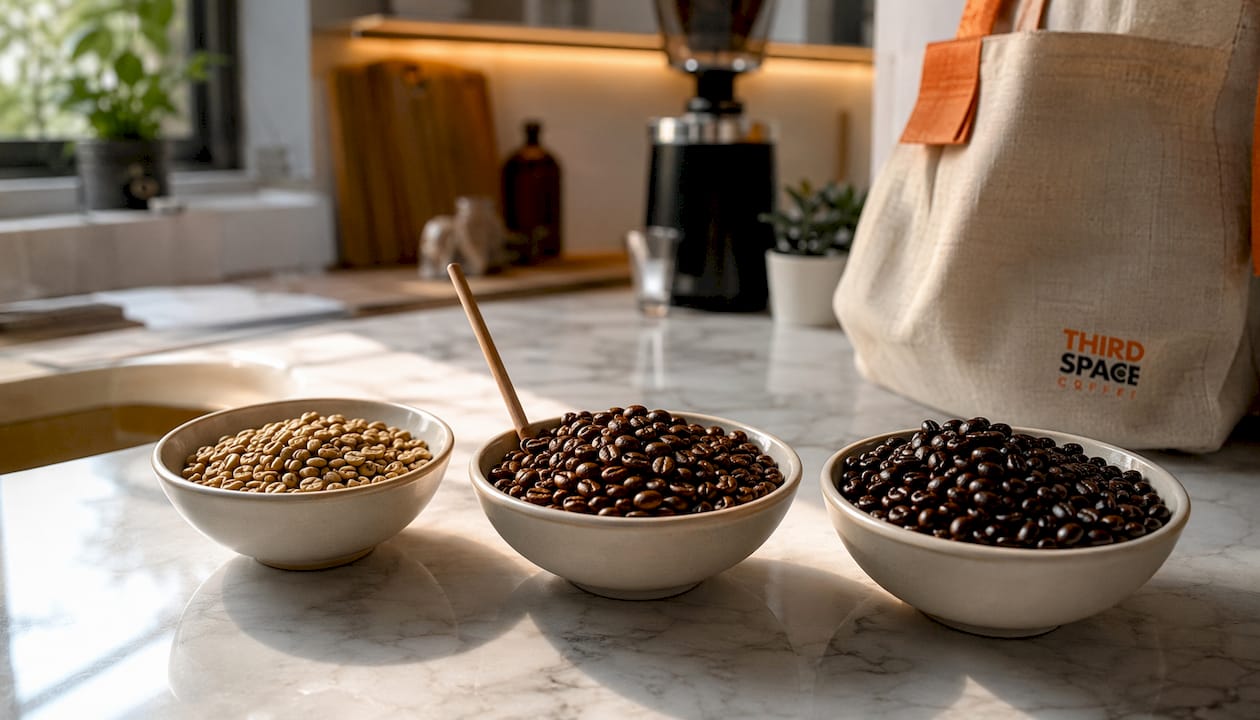
Light roasts preserve the bean's origin character. Acidity is high and bright, often citrus or stone fruit. Floral and tea-like aromas dominate. Sweetness is delicate rather than rich. The Maillard reaction has not progressed far enough to generate heavy caramel or chocolate compounds, so what you taste is largely the terroir of the bean itself.
Medium roasts hit the sweet spot for most specialty coffee drinkers. The SCA scale designates RL55 as the optimal balance for specialty coffee, where pleasant aromas including sweet notes, toasted hazelnut, and caramel are most prominent. Acidity softens, sweetness deepens, and the roasting reactions add complexity without overwhelming the origin notes.
Dark roasts push past that balance point. Bitterness climbs as melanoidins accumulate and chlorogenic acids degrade into bitter fragments. Sweetness drops sharply as sugars carbonize. Pyrazines, the compounds responsible for roasted, nutty, and coffee-forward odors, dominate the aroma profile. At the extreme end, RL25 and darker, the Maillard reaction decomposes acids and burns sugars, generating compounds with undesirable, sulfurous, and burnt characteristics.
| Flavor Attribute | Light Roast | Medium Roast | Dark Roast |
|---|---|---|---|
| Acidity | High, bright | Moderate | Low |
| Bitterness | Low | Moderate | High |
| Sweetness | Delicate | Rich, caramel | Low, burnt |
| Fruitiness | Prominent | Moderate | Minimal |
| Aroma complexity | Floral, origin-driven | Balanced, hazelnut, caramel | Roasted, smoky, pyrazine-heavy |
| Body | Light | Medium | Full |
For coffee enthusiasts exploring roasting's influence on flavor profiles, the practical takeaway is this: if you want to taste the bean's origin, go light. If you want the roast itself to be the flavor, go dark. Medium is where both conversations happen at once.
- Light roasts work best for single-origin pour-overs where origin character is the point
- Medium roasts suit most brewing methods and audiences
- Dark roasts are better matched to espresso and milk-based drinks where bitterness integrates with fat
How do roasting time and temperature control the final flavor?
Temperature and time are the two levers a roaster controls, and they interact in ways that are not always intuitive. The typical roasting window lasts several minutes with bean temperatures reaching high heat levels, but within that range, the specific trajectory matters as much as the endpoints.
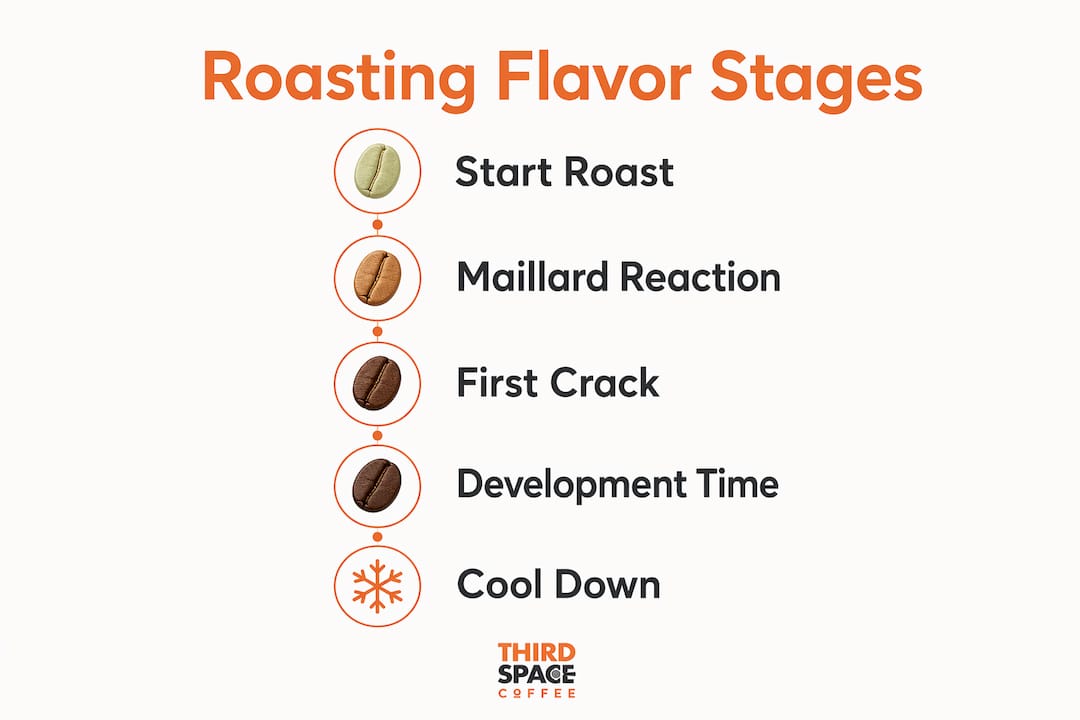
Development time after first crack is the most consequential variable. Research drawing on eight sensory studies confirms that development time influences flavor more than time to first crack. Too short a development time produces underdeveloped, "baked" flavors: flat, papery, reminiscent of dry cereal or cardboard. Too long, and volatile aroma compounds burn off, leaving a bitter, hollow cup regardless of how good the green coffee was.
Rate of rise (ROR) describes how quickly the bean temperature increases at each point in the roast. The general principle, confirmed by specialty roasters and supported by research, is that bean temperature should always be increasing, but the rate of that increase should slow over time. When ROR spikes during development time, the result is excessive heat exposure that destroys delicate flavor compounds. A flat or stalling ROR during development, even for just one minute, can destroy sweetness and create flat flavors.
Temperature effects on aroma compounds are also measurable. Roasting at 210 °C generates higher pyrazine levels than lower-temperature roasting, while also reducing umami and sourness attributes. Pyrazines are the dominant odor-active compounds in darker roasts, contributing the roasted, nutty, and bitter notes that define that profile.
Cooling method after the roast is often overlooked, but it affects flavor preservation directly. Rapid cooling, typically with forced air, halts chemical reactions quickly and helps lock in sweetness. Slow cooling allows residual heat to continue driving reactions, which can push the profile darker than intended and reduce the brightness of volatile aromatics.
- Faster roasts at higher temperatures produce more pyrazines and roasted notes
- Slower roasts at lower temperatures preserve more origin character and acidity
- Extended development time increases bitterness and reduces sweetness
- Rapid post-roast cooling preserves volatile aromatics and sweetness
Pro Tip: If your medium roast tastes flat and lacks sweetness, check your rate of rise during development. A stalling or flat ROR in those final minutes is the most common cause of baked flavor, and it is fixable by adjusting heat application before first crack rather than after.
What does recent research reveal about roasting and flavor?
The science of roasting has gotten considerably more precise in the last few years, and the findings are useful for anyone serious about flavor development.
The most important finding from multi-study sensory research is that roast color predicts flavor more reliably than roasting time. Across eight studies, darker roast color consistently correlated with higher bitterness and lower acidity, sweetness, and fruitiness. Time still matters, but if you want to predict what a coffee will taste like, color is the more dependable guide.
Pyrazines and furans are the two dominant aroma compound classes generated during roasting. Pyrazine levels increase with roast temperature, contributing nutty, roasted, and coffee-forward odors. Furans contribute caramel and sweet aromas and are more prominent at lighter roast levels. The balance between these two classes is essentially the chemical signature of a roast profile.
Research highlight: Medium roast at SCA RL55 produces the most desirable concentration of key aroma-active compounds, including ethenyl pyrazine, 2-ethyl-6-methylpyrazine, and 4-hydroxy-2,5-dimethyl-3(2H)-furanone, characterized by sweet, toasted hazelnut, and caramel notes. At RL25 (very dark), these compounds are replaced by furfuryl formate and 4-methylthiazole, associated with burnt and sulfurous odors.
Development time's effect on flavor complexity is now well-documented. Under the same roast color, varying development time still produces measurable sensory differences, particularly in sweetness and acidity. This means two coffees with identical color readings can taste noticeably different if their development times diverge. For roasters, this is the argument for logging and repeating precise roast curves rather than relying on color alone.
2026 industry roasting guidelines reinforce what research has been showing: controlling the roast curve through development, managing ROR, and targeting specific color readings by SCA standards are the most reliable paths to consistent, high-quality flavor. Expert roasters at operations like Thirdspacecoffee apply these principles to tailor roast profiles to specific origins, matching heat application to the density and moisture content of each green coffee lot.
- Roast color is the strongest single predictor of sensory flavor attributes
- Development time independently affects sweetness and acidity even when color is held constant
- Pyrazines dominate aroma at higher roast temperatures; furans dominate at lighter levels
- Very dark roasts (RL25 and below) generate compounds associated with undesirable and potentially harmful characteristics
- Roasting also affects solubility: darker roasts extract faster, which is why espresso blends tend to run darker and filter roasts lighter
Taste the difference at Thirdspacecoffee

At Thirdspacecoffee in Colorado Springs, every roast decision starts with the science above and ends with what tastes best in the cup. The team roasts in-house, applying precise heat curves to bring out the best of each origin, whether that means a bright, fruit-forward light roast or a rich, caramel-driven medium. You can explore the full range by ordering freshly roasted whole bean coffee directly, or stop in and taste the difference across the specialty drinks menu. Roasting is where flavor is made. Thirdspacecoffee is where you taste it.
Key Takeaways
Roast color is the most reliable predictor of coffee flavor, with development time after first crack being the most controllable variable for sweetness, acidity, and aroma complexity.
| Point | Details |
|---|---|
| Roast color predicts flavor | Darker roast color consistently increases bitterness and decreases acidity, sweetness, and fruitiness. |
| Development time is critical | Too short produces baked, flat flavors; too long burns off volatile aromatics and increases bitterness. |
| Medium roast (RL55) is the sweet spot | SCA RL55 produces the best balance of sweet, hazelnut, and caramel aroma-active compounds. |
| Rate of rise controls sweetness | A stalling or flat ROR during development destroys sweetness and creates papery, flat flavors. |
| Roast level affects brewing method | Darker roasts extract faster due to higher solubility, making them better suited to espresso than filter methods. |