
TL;DR:
- Coffee origin encompasses environmental factors like altitude, soil, and climate that shape a bean's flavor beyond just its country of origin. It is a complete ecological and geographic biography of the bean, influencing taste profiles through conditions such as elevation and soil chemistry. Understanding origin helps consumers predict flavor and select beans that match their preferences, emphasizing traceability and ecological context over simple country labels.
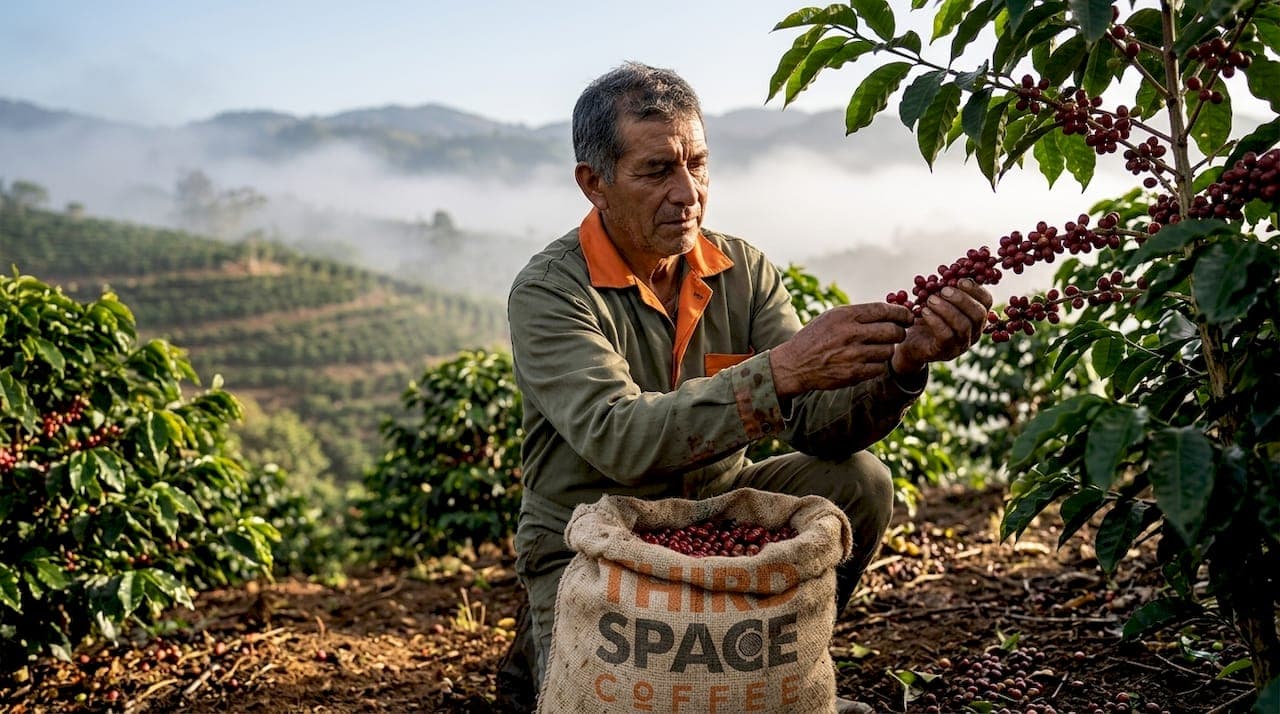
Most coffee drinkers assume origin means the country printed on the bag. It doesn't. What is coffee bean origin, really? It's a layered concept covering altitude, soil chemistry, rainfall patterns, processing methods, and the agricultural traditions of the people who grow the crop. And here's what makes this worth understanding: every cup you've ever loved tasted that way because of where it came from, not how dark it was roasted. This article traces the full picture, from the first wild coffee forests in Ethiopia to the sourcing decisions shaping specialty coffee today.
Table of Contents
- Key takeaways
- What is coffee bean origin, and why does it go deeper than a country name
- History of coffee cultivation: from Ethiopia's forests to the global trade
- What truly defines coffee flavor: ecology and geography
- Major coffee growing regions and their characteristic flavors
- How origin shapes specialty coffee sourcing today
- The botanical reality: what coffee beans actually are
- My take on what origin really teaches you
- Explore origin-forward coffees at Thirdspacecoffee
- FAQ
Key takeaways
| Point | Details |
|---|---|
| Origin is more than a country | Altitude, soil, climate, and microclimate together define a coffee's origin and its flavor. |
| Ethiopia is the birthplace | Coffee cultivation and trade trace back to Ethiopia's Kaffa region and later Yemen. |
| Top five producers dominate | Brazil, Vietnam, Colombia, Ethiopia, and Indonesia supply most of the world's coffee with distinct flavor signatures. |
| Species shapes everything | Arabica thrives at high altitude with complex flavors; Robusta grows lower and carries bolder, more bitter notes. |
| Origin drives specialty coffee | Traceability to specific farms or cooperatives is the backbone of specialty coffee standards worldwide. |
What is coffee bean origin, and why does it go deeper than a country name
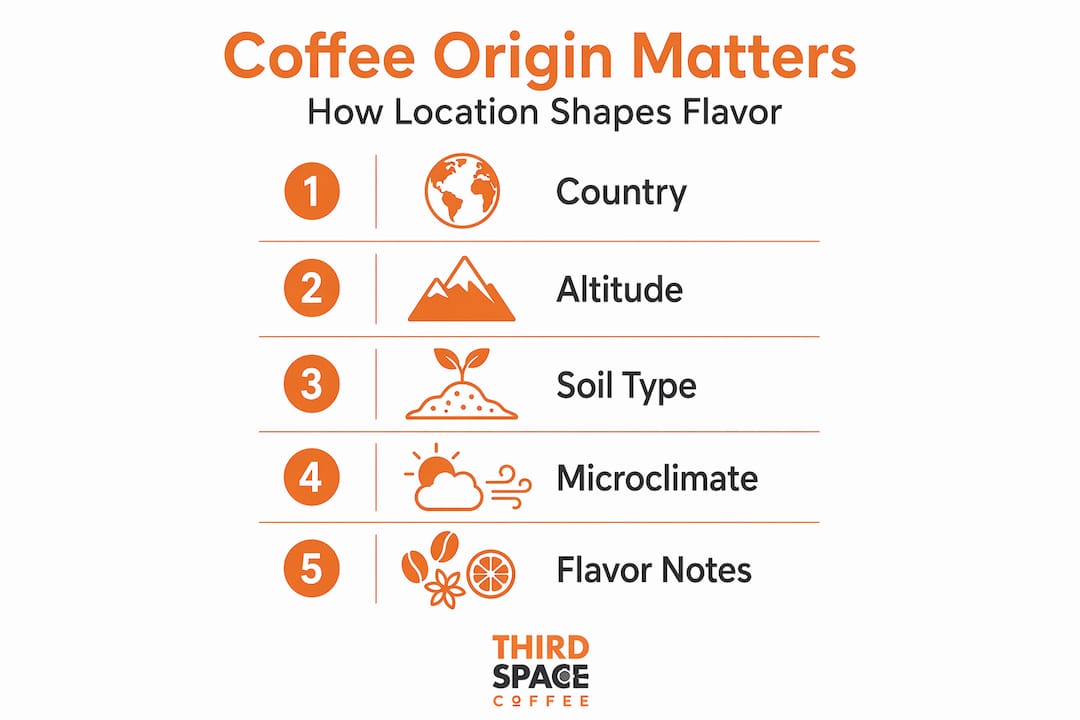
Coffee origin is best understood as the complete environmental biography of a bean. That includes the country of production, yes, but also the specific region, the farm's elevation, the volcanic or mineral content of the soil, the amount of shade cover, seasonal rainfall, and even the genetic lineage of the plant itself. Two bags labeled "Colombian coffee" can taste radically different if one comes from a high-altitude farm in Huila and the other from a lower-elevation plot in the Cauca Valley.
The origin of coffee beans is shaped by altitude, soil type, and microclimate, which work together to produce distinct flavor profiles that no amount of roasting technique can replicate. High-altitude Ethiopian coffees tend toward floral and fruity complexity. Lower-altitude Robusta presents heavier, earthier tones. The growing environment is, in a very real sense, the recipe.
One more thing worth clearing up: coffee beans are not actually beans. They are seeds. They come from inside a small red or yellow fruit called a coffee cherry, and understanding that botanical fact reframes everything about how origin functions. The cherry's skin, pulp, and fermentation environment all influence the seed before it ever reaches a roaster.
History of coffee cultivation: from Ethiopia's forests to the global trade
The story of where coffee comes from begins in Ethiopia, specifically in the Kaffa region of the southwestern highlands. Wild coffee plants grew there long before anyone cultivated them, and local populations likely consumed the cherries as food long before brewing the seeds.
"Coffee's origin story is ultimately a story of human curiosity: trade routes, legends, and agricultural innovation all converging to send one plant across the entire globe." — History of coffee
The legend most people have heard involves a goat herder named Kaldi, who noticed his goats became unusually energetic after eating berries from a particular tree. He reportedly brought the berries to a monastery, where monks brewed a drink and found it kept them alert during evening prayers. Whether the story is literally true is beside the point. It captures something real: coffee plants come from Ethiopia's Kaffa region, and the local communities there interacted with the plant long before formal cultivation began.
Yemen changed everything. By the 15th and 16th centuries, Yemeni traders were cultivating coffee on terraced hillside farms and controlling its export with fierce protectiveness. They were so intent on maintaining their monopoly that they reportedly required all exported beans to be boiled or partially roasted to prevent germination. Coffee spread anyway. Key moments in that global diffusion include:
- Sufi monasteries in Yemen adopting coffee for nighttime devotional use in the 1400s
- Coffee reaching Ottoman coffeehouses (qahveh khaneh) in Constantinople by the 1500s, where it became central to social and intellectual life
- Dutch traders smuggling live plants out of Yemen and establishing the first European-controlled plantations in Java around 1696
- Coffee reaching the Americas via French naval officer Gabriel de Clieu, who transported a single plant to Martinique in 1720, from which most Western Hemisphere crops descend
Each of those moments was as much cultural as agricultural. The history of coffee cultivation is inseparable from the trade routes, politics, and social customs of the civilizations that adopted it.
What truly defines coffee flavor: ecology and geography
Understanding the ecological dimension of coffee origin explains why enthusiasts pay dramatically different prices for beans from different regions, and why that premium is often justified.
The Coffee Belt is the narrow band of equatorial territory between the Tropics of Cancer and Capricorn where climate conditions are ideal for coffee cultivation. Within that belt, enormous variation exists. The factors that matter most are:
- Altitude: Higher elevations mean cooler temperatures, slower cherry maturation, and denser beans with more complex sugars and acids. Most high-quality Arabica grows above 1,500 meters.
- Soil: Volcanic soils in regions like Guatemala's Antigua, Kenya's highlands, and Hawaii's Kona are exceptionally mineral-rich, contributing to bright, distinct flavor notes.
- Microclimate: A single mountain can have multiple distinct growing environments depending on exposure to mist, wind direction, and canopy cover. This is why single-origin microlot coffees can taste wildly different from neighboring farms.
- Rainfall and dry seasons: Consistent wet and dry cycles control the timing of cherry ripening and concentrate flavor compounds in the fruit.
Arabica thrives at high altitudes and is self-pollinating, which contributes to its genetic consistency and flavor complexity. Robusta grows at lower elevations, cross-pollinates, and is considerably more resistant to pests and disease. It carries nearly twice the caffeine of Arabica and a characteristically bolder, more bitter cup profile.
Pro Tip: When you see a coffee labeled with a specific altitude range (like "1,800 to 2,100m"), that's a meaningful signal. It usually indicates the producer is proud of the growing conditions and that the beans were subject to slower development, which tends to mean more complex flavor in the cup.
Major coffee growing regions and their characteristic flavors
Brazil, Vietnam, Colombia, Ethiopia, and Indonesia are the five largest producers, and each carries a flavor fingerprint shaped entirely by its geography.
| Region | Primary bean type | Flavor notes | Typical altitude |
|---|---|---|---|
| Brazil | Arabica | Chocolate, nutty, low acidity | 500 to 1,200m |
| Vietnam | Robusta | Bold, bitter, earthy | Below 500m |
| Colombia | Arabica | Caramel, red fruit, mild acidity | 1,200 to 2,000m |
| Ethiopia | Arabica | Floral, blueberry, citrus | 1,500 to 2,200m |
| Indonesia | Arabica/Robusta | Earthy, full body, wood, tobacco | 1,000 to 1,500m |
Brazil accounts for roughly 39% of global supply and dominates with low-acidity, chocolate-forward Arabica that forms the backbone of most espresso blends worldwide. Vietnam produced 27.9 million bags in 2023/24, making it the world's second-largest producer, almost exclusively in Robusta destined for instant coffee and espresso blends needing body and crema.
Ethiopia's Yirgacheffe sub-region is worth special mention. Coffees from that relatively small area are consistently among the most distinctive in the world, carrying jasmine, bergamot, and stone fruit notes that are completely absent in beans grown at lower elevations nearby. Indonesia's Sumatra produces coffee processed using wet hulling, a method unique to the region that results in a heavier body and earthy, almost savory character. Processing method is itself a dimension of origin.
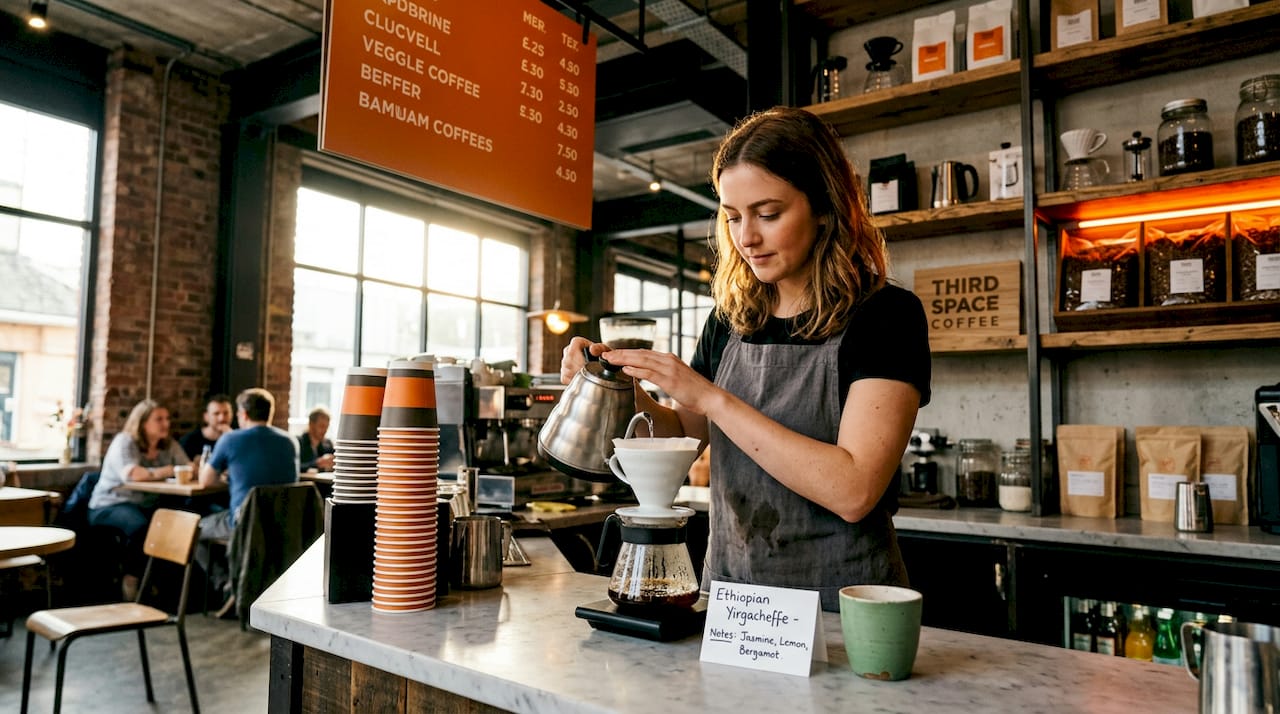
Pro Tip: Explore coffees from different growing regions side by side to train your palate. Tasting a washed Ethiopian against a natural Brazilian back-to-back reveals more about origin's influence on flavor than any written description.
How origin shapes specialty coffee sourcing today
Specialty coffee standards require traceability to farms or cooperatives tied to measurable flavor quality. That requirement exists because origin is the starting point of every quality decision that follows. Roasters can't rescue a poorly grown or carelessly processed bean, no matter how skilled they are.
Here's how to use origin knowledge practically when selecting beans:
- Start with a region's general profile. If you prefer bright, acidic, fruit-forward cups, East African origins like Ethiopia and Kenya give you the best odds. If you want rich, low-acid, chocolatey cups, look to Brazil or Sumatra.
- Look for farm or cooperative attribution. Generic country-level labeling tells you little. A bag that names the farm, the region within the country, and the processing method is giving you real traceability.
- Match origin to your brew method. High-acid Ethiopian beans shine through a pour-over that preserves their delicate aromatics. A Sumatran Mandheling's heavy body translates beautifully to a French press.
- Ask your roaster. A quality roaster knows their sourcing relationships. If they can tell you the harvest year and the producer's name, you're dealing with a serious specialty coffee operation.
Notably, 55% of Americans now consume specialty coffee that scores 80 or more points, reflecting growing consumer awareness of what origin actually delivers. That number has grown steadily as traceability becomes a purchasing expectation, not just a marketing point.
The botanical reality: what coffee beans actually are
Calling a coffee bean a "bean" is technically incorrect, which matters more than it sounds. Coffee beans are seeds inside a fruit called a coffee cherry. Each cherry typically contains two seeds positioned flat-side together. Occasionally, only one seed develops, becoming rounder and denser than usual. These are called peaberries, and many producers sort and sell them separately because their shape affects how heat moves through them during roasting.
The three main species worth knowing are:
- Arabica (Coffea arabica): Grown across most of the Coffee Belt's higher elevations, self-pollinating, genetically diverse, and responsible for the vast majority of specialty coffee. Accounts for 60 to 70% of global production.
- Robusta (Coffea canephora): Lower-grown, higher caffeine, more bitter and less complex. Dominant in Vietnam and widely used in commercial espresso blends for crema and body.
- Liberica (Coffea liberica): Rare, grown primarily in the Philippines and parts of West Africa. Large, asymmetrical beans with a distinctly smoky, woody flavor that divides opinion sharply.
The species a plant belongs to sets the biological ceiling on what flavors are possible. Origin determines how close a crop gets to that ceiling.
My take on what origin really teaches you
I'll admit that when I first got serious about coffee, I thought origin was mostly marketing. A country name on a bag felt like a wine label: decorative and vaguely meaningful. What changed my thinking was tasting two coffees side by side that came from different sub-regions within Ethiopia, grown roughly 80 kilometers apart. One tasted like blueberry jam. The other tasted like black tea and lemon zest. Same country. Completely different cups.
That experience reframed the entire concept for me. Origin isn't a label. It's an explanation. Once you know that altitude slows down cherry maturation and concentrates fruit sugars, or that volcanic soil adds a minerality to the cup, you stop being a passive drinker and start reading the coffee. You can pick up a bag, look at the growing altitude and the processing method, and make a fairly accurate prediction about what you're going to taste.
The practical lesson I keep coming back to: don't start with the roast level when you're choosing coffee. Start with the origin. Understand the agricultural factors first, and then figure out how the roast was designed to highlight them. That sequence makes every other decision easier and every cup more interesting.
— Tanya
Explore origin-forward coffees at Thirdspacecoffee

At Thirdspacecoffee in Colorado Springs, the whole bean selection is built around exactly this kind of origin thinking. Every coffee roasted in-house starts with sourcing decisions grounded in where the beans come from and what those conditions deliver in the cup. You can explore the full whole bean coffee selection to find options sourced from distinct growing regions, each roasted to highlight what the origin naturally offers. If you prefer to experience origin through a finished drink, the specialty drinks menu showcases those same beans in carefully crafted preparations. Online orders are available for convenient front-of-store pickup, making it easy to bring a great origin-specific coffee home today.
FAQ
What is coffee bean origin, exactly?
Coffee bean origin refers to the geographic, ecological, and agricultural conditions under which coffee was grown, including country, region, altitude, soil type, and climate. It's the combination of those factors, not just the country name, that defines a coffee's character.
Where do coffee beans come from?
Coffee beans come from inside the fruit of the Coffea plant, called a coffee cherry. The plant is native to Ethiopia and thrives in the equatorial Coffee Belt spanning parts of Africa, Asia, and Latin America.
Why does origin affect coffee flavor so strongly?
Origin shapes flavor through altitude, soil chemistry, rainfall patterns, and the genetic traits of the plant species. These environmental variables control how slowly cherries mature and how many complex acids and sugars develop in the seed.
What are the best coffee origins for a bright, fruity cup?
Ethiopian and Kenyan origins consistently produce the most floral, fruit-forward cups due to their high altitude growing conditions and the prevalence of naturally processed or washed Arabica varieties.
How can I use origin knowledge when buying coffee?
Match origin to your flavor preferences: East Africa for fruity and bright, Latin America for balanced and sweet, Indonesia and Sumatra for earthy and full-bodied. Look for bags that name the specific region, farm, or cooperative for the most reliable flavor expectation.