

TL;DR:
- Networking at local cafes builds trust, enhances creativity, and fosters community connections better than formal venues. Regular visits to community-oriented cafes lead to organic relationships, referrals, and long-term career growth. Consistent presence, preparation, and choosing the right cafe environment maximize networking success.
Local cafe networking is the practice of using coffee shop environments to build professional relationships, generate referrals, and strengthen community ties outside of formal office settings. Professionals and entrepreneurs who network at local cafes gain access to a social infrastructure that formal venues simply cannot replicate. The "third place" concept, a term coined by sociologist Ray Oldenburg, describes spaces like cafes that sit between home and work and serve as the connective tissue of community life. Research confirms that consistent cafe attendance builds the kind of familiarity and trust that turns strangers into collaborators. If you want to know why network at local cafes matters for your career or business, the answer starts with understanding what these spaces do that no conference room can.
Why network at local cafes instead of formal venues?
Cafes outperform formal networking venues because they remove the pressure that makes professional introductions feel forced. A conference room signals hierarchy and agenda. A cafe signals conversation and possibility. That shift in context changes how people engage with each other from the first handshake.
The coffee shop effect is the documented phenomenon where moderate ambient noise, the kind found in a busy cafe, improves cognitive flexibility and creative thinking. That background hum of conversation and espresso machines is not a distraction. It is a cognitive catalyst. Professionals who meet in that environment tend to think more freely and communicate more openly than those in silent boardrooms.
Cafes also function as genuine third places, bridging the gap between home and work. Third places provide bridging social capital where strangers from different industries and backgrounds connect naturally. That cross-pollination of ideas rarely happens at industry-specific events where everyone already knows each other.
The foot traffic advantage is real and measurable. 32% of regular customers are shared across multiple businesses in the same ZIP code, making cafes natural hubs where your next client, collaborator, or mentor may already be a regular. That overlap creates organic introductions without any formal program or event ticket required.
Here is what makes cafes structurally superior for networking compared to other settings:
- Low barrier to entry. No registration, no dress code, no agenda. You show up and the environment does the social work.
- Consistent foot traffic. A busy cafe brings a rotating cast of professionals through the same door every week.
- Neutral ground. Neither party holds home-field advantage, which levels the dynamic and reduces defensiveness.
- Ambient energy. The coffee shop effect keeps both parties alert and mentally engaged throughout the conversation.
- Community anchor role. Cafes with strong local identities attract regulars who are invested in the neighborhood, exactly the kind of people who refer business and make introductions.
Pro Tip: Choose a cafe with active community programming, bulletin boards, or hosted events rather than a quiet solo-work space. Active hubs generate more spontaneous introductions than silent study environments.
What are the psychological benefits of networking at cafes?
Cafes counter professional isolation in a way that video calls and co-working spaces cannot. Psychologists identify a "loneliness snowball" effect where social withdrawal compounds over time, reducing motivation, creativity, and mental health. Regular cafe visits interrupt that cycle by providing low-pressure social interactions that rebuild a sense of belonging without demanding emotional energy.
The sensory environment of a cafe, the aroma of fresh coffee, the warmth, the background conversation, creates a psychological state of relaxed alertness. That state is ideal for the kind of open, exploratory conversations that produce real professional value. You are not in fight-or-flight mode. You are in discovery mode.
"Going to the same place repeatedly builds a sense of familiarity and community that is genuinely good for mental health. It reduces anxiety, increases trust, and makes social engagement feel natural rather than effortful." — Psychology researchers cited in Self magazine
The concept of weak ties is central to understanding why cafe networking works psychologically. Weak ties are relationships with people you know casually but not deeply. Sociologist Mark Granovetter's landmark research established that weak ties, not close friendships, are the primary source of new job leads, business referrals, and unexpected opportunities. Cafes are the natural habitat of weak ties.
Here is how the psychological benefits stack up in practical terms:
- Reduced social anxiety. The informal setting lowers the stakes of every interaction, making it easier to introduce yourself without rehearsing a pitch.
- Increased community trust. Regular attendees trust their local community more than non-regulars, which translates directly into more generous referrals and introductions.
- Mental freshness. The change of environment from a home office or corporate desk resets focus and boosts creative output.
- Sense of belonging. Knowing the barista's name and having a usual order creates a micro-community that supports well-being on ordinary workdays.
- Organic relationship building. Repeated exposure to the same faces builds familiarity that evolves into trust without any deliberate effort.
How can professionals network at cafes strategically?
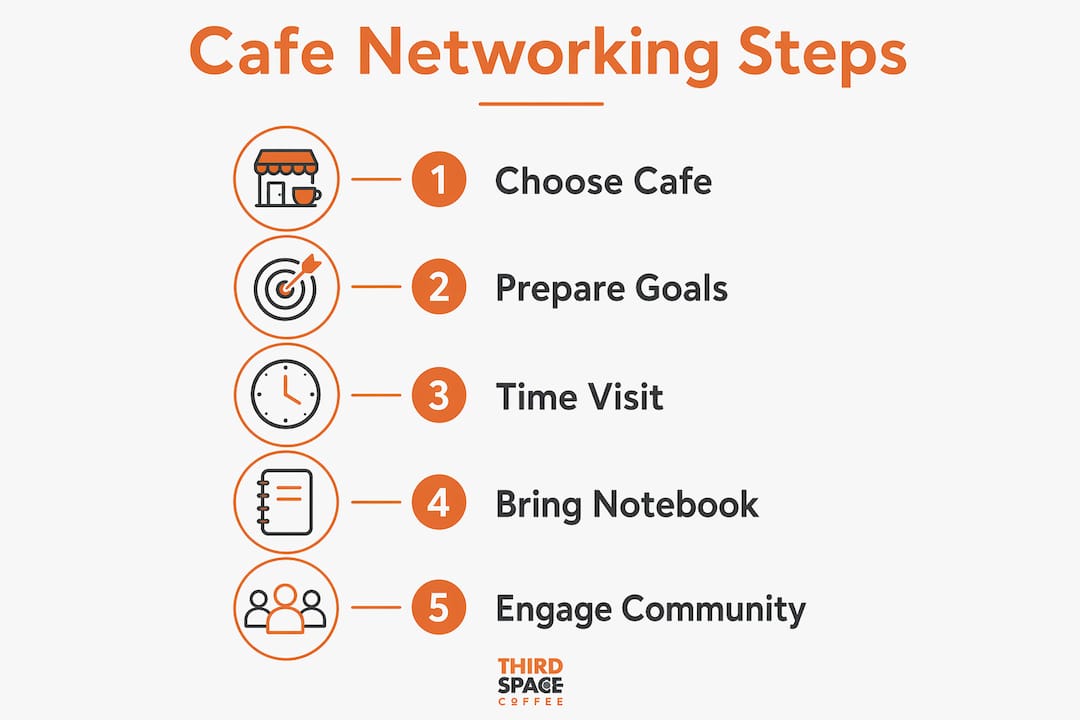
Purposeful cafe networking requires preparation even though the setting is casual. Successful networkers arrive with business cards, a clear 30-second pitch, and specific goals for each visit. That preparation does not make interactions feel scripted. It makes them feel confident and memorable.

Timing matters more than most professionals realize. The mid-morning window, roughly 9:00 a.m. to 11:00 a.m. on weekdays, draws the highest concentration of remote workers, freelancers, and entrepreneurs. Showing up consistently during that window means you will encounter the same faces week after week. Consistency shifts you from stranger to familiar face, and that recognition is the foundation of every organic professional introduction.
Engaging with the barista and cafe owner is not small talk. It is networking infrastructure. Owners and baristas know their regulars and make introductions constantly. A simple conversation about what you do professionally can result in the owner mentioning you to the next person who sits down with a related problem. That kind of warm introduction carries more weight than a cold LinkedIn message.
The dos and don'ts of cafe networking etiquette matter for your reputation:
- Do buy something every time you sit down. Your presence is only welcome if you support the business.
- Do keep initial conversations short and let the other person signal interest before extending the discussion.
- Do follow up within 24 hours after exchanging contact information.
- Don't pitch aggressively. Cafes reward patience and relationship building, not sales pressure.
- Don't monopolize a table during peak hours. Awareness of the space builds goodwill with staff and other regulars.
- Don't wear headphones the entire time if your goal is to meet people. Closed body language closes doors.
Pro Tip: Bring a physical notebook rather than a laptop when your primary goal is networking. It signals openness and invites conversation in a way that a screen does not.
The ripple effect of cafe networking extends beyond the cafe itself. Start-up growth rates increase in areas with established coffee shops compared to areas without them. The cafe becomes a catalyst for the broader local business ecosystem, funneling connections, referrals, and commerce across the neighborhood.
What makes a cafe ideal for professional networking?
Not every cafe produces the same networking outcomes. The best networking cafes share specific characteristics that experienced professionals learn to identify quickly. Active foot traffic and owner facilitation yield better spontaneous professional interactions than quiet, isolated settings. Choosing the right cafe is itself a strategic decision.
The table below outlines the key differences between cafe types and their suitability for networking goals:
| Cafe type | Foot traffic | Community events | Best for |
|---|---|---|---|
| Lively social hub | High | Frequent | Organic introductions, weak-tie building |
| Quiet library-style | Low | Rare | Deep-work sessions, one-on-one meetings |
| Community-anchored local | Moderate to high | Regular | Long-term relationship building, referrals |
| Large chain location | High but transient | Minimal | Brief encounters, low repeat recognition |
A community-anchored local cafe is the strongest environment for sustained networking. The owner knows the regulars, the regulars know each other, and the space actively supports local events and gatherings. That combination creates a social ecosystem where professional introductions happen naturally over weeks and months.
When scouting a new cafe, look for a community event venue role. Cafes that host workshops, meetups, or pop-up markets attract a diverse, engaged crowd. That diversity is the raw material of bridging social capital. You are far more likely to meet someone outside your industry at a hosted event than at a standard morning coffee rush.
Owner involvement is a reliable signal of networking potential. When the owner greets regulars by name and facilitates introductions, the cafe functions as a managed social network rather than just a place to buy coffee. That human layer accelerates the trust-building process that makes networking productive. Thirdspacecoffee in Colorado Springs exemplifies this model, combining specialty coffee with a community-focused space that supports both casual gatherings and professional meetings.
Key Takeaways
Local cafe networking works because consistent presence in a community-anchored space builds the weak ties, trust, and ambient creative energy that formal networking venues cannot produce.
| Point | Details |
|---|---|
| Third place advantage | Cafes sit between home and work, creating neutral ground where professional barriers drop naturally. |
| Coffee shop effect | Moderate ambient noise boosts cognitive flexibility, making cafe conversations more creative and productive. |
| Consistency builds trust | Showing up regularly shifts you from stranger to familiar face, the foundation of organic introductions. |
| Preparation still matters | Arrive with a 30-second pitch, business cards, and clear goals even in casual settings. |
| Choose the right cafe | Community-anchored cafes with owner involvement and regular events produce the best networking outcomes. |
Why I think most professionals underestimate the cafe as a networking tool
Most networking advice focuses on events, LinkedIn, and formal introductions. That advice is not wrong. It is just incomplete. The professionals I have watched build the most durable networks did not do it at industry conferences. They did it by showing up to the same cafe every Tuesday morning for six months.
The cafe strips away the performance anxiety that makes formal networking exhausting. You are not there to network. You are there for coffee. That psychological permission makes every conversation feel lower stakes, and lower stakes conversations go deeper faster. The relationship that starts with "what are you working on?" over a flat white often outlasts the one that starts with a business card exchange at a mixer.
What surprises most people is how quickly the barista becomes a connector. A good barista who knows your name and your work will mention you to the next person who sits down with a related problem. That warm introduction, unprompted and genuine, is worth more than any cold outreach campaign. You cannot manufacture that. You can only earn it through consistent presence and genuine engagement with the local coffee community.
The one mistake I see professionals make is treating the cafe as a backdrop rather than an active part of their networking strategy. They sit with headphones in, eyes on the screen, and wonder why nothing happens. The cafe rewards openness. Show up, put the laptop away occasionally, and let the environment do what it was designed to do.
— Tanya
Thirdspacecoffee: where Colorado Springs professionals connect
Thirdspacecoffee in Colorado Springs is built for exactly the kind of professional and community engagement this article describes. The space combines in-house roasted specialty coffee with a welcoming atmosphere that supports both casual drop-ins and planned meetings.

Whether you are building your network over a morning specialty drink or hosting a small team gathering in the event space, Thirdspacecoffee provides the community-anchored environment that makes organic professional connections possible. The cafe's focus on local engagement, quality coffee, and genuine hospitality creates the conditions where regulars become collaborators and conversations become opportunities. Visit Thirdspacecoffee to experience a space designed around the kind of community connection that actually moves your career and business forward.
FAQ
Why are cafes better for networking than formal events?
Cafes remove the performance pressure of formal networking by providing a neutral, low-stakes environment. The coffee shop effect, where moderate ambient noise boosts creativity, also makes conversations more open and productive than those held in conference rooms.
How often should I visit a cafe to build a network?
Consistency is the key variable. Showing up regularly shifts you from a stranger to a recognized face, which is the foundation of organic introductions and trust-building in any cafe community.
What should I bring to a cafe networking session?
Bring business cards, a clear 30-second description of what you do, and a specific goal for the visit. Prepared networkers are more memorable and more likely to convert casual conversations into lasting professional relationships.
Do local cafes actually help business growth?
Yes. Areas with established coffee shops show higher start-up growth rates than areas without them, and 32% of regular customers are shared across multiple local businesses, creating a cross-referral ecosystem that directly supports business development.
What type of cafe is best for professional networking?
Community-anchored local cafes with active foot traffic, regular events, and an involved owner produce the best networking outcomes. These spaces function as managed social networks where introductions happen naturally over time.