 how-to
How to Organize a Small Home Workspace in 7 Steps
Quick Summary
To organize a small home workspace, start by emptying it and sorting every item into keep, donate, recycle or discard. Then add storage in budget tiers, use vertical space, group supplies by use, and reset the desk weekly.
- Empty the space and sort everything before buying any storage.
- Use the strict six-month test: if unused for six months, ask whether you would miss it.
- Add storage in tiers: no-cost moves first, then under $50, then under $150.
- Live with the space for a week after free changes to find which gaps are real.
- Choose removable hooks and freestanding shelves to avoid marks if you rent.
Table of Contents
- Sorting Into Keep, Donate, Recycle and Discard
- How to Organize a Small Home Workspace on a Budget
- Plan Your Layout for Your Space: Corner, Closet, Shared Room or Studio
- Use Vertical Space: Shelves, Pegboards and Wall Storage
- How to Organize Office Supplies at Home With Trays, Caddies and Drawer Dividers
- Office Organization Ideas for Paperwork and a Home Office Filing System
- Keep Your Desk Clear: A Weekly Reset Routine and Ergonomic Setup
- Set Up Your Next Work Session in Minutes
- Frequently Asked Questions
Start With a Clear-Out: Sort Everything Before You Store Anything
Many small home workspaces have a too-much-stuff problem. Before you buy a single bin or shelf, empty the space and decide what deserves to come back. This one step saves more room than any organizer will.
Pull everything off the desk, out of the drawers and off the floor. Put it in one pile. Seeing the full amount in one place is often the moment people realize how much they have.
Sorting Into Keep, Donate, Recycle and Discard
Sort each item into one of four groups:
- Keep: Things you use every week, such as your laptop, charger, notebook and go-to pens
- Donate: Working items you no longer need, like an old printer or spare monitor in good shape
- Recycle: Paper, cardboard, batteries and electronics your local program accepts
- Discard: Dried-out markers, broken staplers and tangled cables you can't identify
Be strict with the keep pile. If you haven't used something in six months, ask whether you would miss it. Most people find they would not.
Watch out: Don't toss old tax records or contracts on instinct. Check how long you need to keep financial and legal papers before you shred them.
How to Organize a Small Home Workspace on a Budget
Organizing a small workspace does not require a shopping trip. The highest-value moves are free: clearing clutter, cleaning surfaces, and deciding where each category lives. Once the layout is set, add storage in tiers so you spend only where a real gap exists. A practical way to budget is to separate the project into three tiers: no-cost, under $50, and under $150.
Tier 1: No-cost moves (do these first)
- Empty every drawer and surface, sort into keep, donate, recycle and discard, and put back only what you used in the last month.
- Repurpose shoeboxes, sturdy shipping boxes and glass jars as drawer dividers and pen cups.
- Use the back of a door for hanging storage with existing hooks or an over-the-door rack you already own.
- Move a bookcase or small table from another room to create a vertical storage column.
- Route cables with binder clips or twist ties you already have, and label them with masking tape and a marker.
Live with the space for a week after Tier 1. You will learn which gaps are real and which were imaginary, and you will avoid buying organizers for items you no longer keep.
Tier 2: Under $50 total
- A desktop caddy or utensil holder for pens, scissors and markers.
- A set of drawer dividers or a shallow drawer organizer.
- A pack of adhesive cord clips or a cable sleeve.
- A small inbox tray for paperwork.
- A pack of removable adhesive hooks rated for the weight you plan to hang.
These items solve the most common small-space problems, and most are removable, which matters for renters.
Tier 3: Under $150 total, only if a real gap remains
- A wall-mounted shelf or pegboard system.
- A monitor stand or laptop riser to free desk space and improve screen height.
- A rolling storage cart that tucks under the desk.
- A small file box or desktop file organizer.
Buy one piece at a time and live with it before adding the next. A common budget mistake is buying a matching storage set before knowing what needs to be stored.
Renter-friendly constraints
Renters should favor solutions that leave no permanent marks. Removable adhesive hooks and strips, tension rods, over-the-door racks, freestanding shelving, and rolling carts all avoid drilling.
Watch out: Do not buy storage for a category you have not yet sorted. A drawer organizer bought before decluttering often ends up holding items you would have discarded, which wastes both money and space.
Plan Your Layout for Your Space: Corner, Closet, Shared Room or Studio
Organizing advice often stops at "measure your space." The harder question is how to map zones when the room is doing double duty.
Then sketch a simple zone map on paper. Divide the workspace into three reach zones: primary (within arm's reach while seated, roughly 18 to 24 inches), secondary (one step away, about 3 to 4 feet), and storage (behind you or above shoulder height).
Corner desk in a bedroom or living area
A corner desk works when the two walls meet at 90 degrees and you can dedicate one wall to vertical storage. Put the monitor in the corner itself, angled slightly, and use the wall to your dominant side for a narrow shelf or pegboard. Keep the return leg of the desk clear so the surface reads as one continuous work area. If the desk faces a bed or couch, add a low divider, such as a bookcase turned sideways, to signal where work ends and rest begins.
Closet office
A closet office succeeds when the doors can close and the interior is treated like a cabinet, not a room. Measure the interior width and height, then plan shelves at three levels: a top shelf for archive boxes, a middle shelf at eye level for binders and reference materials, and a desk surface at standard desk height (about 28 to 30 inches). Leave at least 24 inches of clear desk depth.
Shared room or partner's office
When two people share a room, the layout problem is access, not storage volume. Split the room into two zones with a clear boundary, either a physical divider or a marked line on the floor, and give each person their own vertical storage column so neither has to reach across the other's desk. Use labeled bins or color-coded folders to keep shared supplies separate from personal ones. Agree on one shared inbox tray for household paperwork and one shared charging station, placed in neutral territory.
Studio apartment
In a studio, the workspace has to convert. Choose a desk that can double as a dining or project table, and plan storage that hides in plain sight: a storage ottoman, a rolling cart that tucks under the desk, or a wall cabinet with doors.
Watch out: Do not block the only window or the room's main walkway with storage. Keep the window and walkway clear while adding small decorative touches that make the workspace feel personal, with Light and Salt Boutique offering another point of inspiration.
Use Vertical Space: Shelves, Pegboards and Wall Storage
Walls are often the most underused space in a small workspace. Move storage up instead of out.
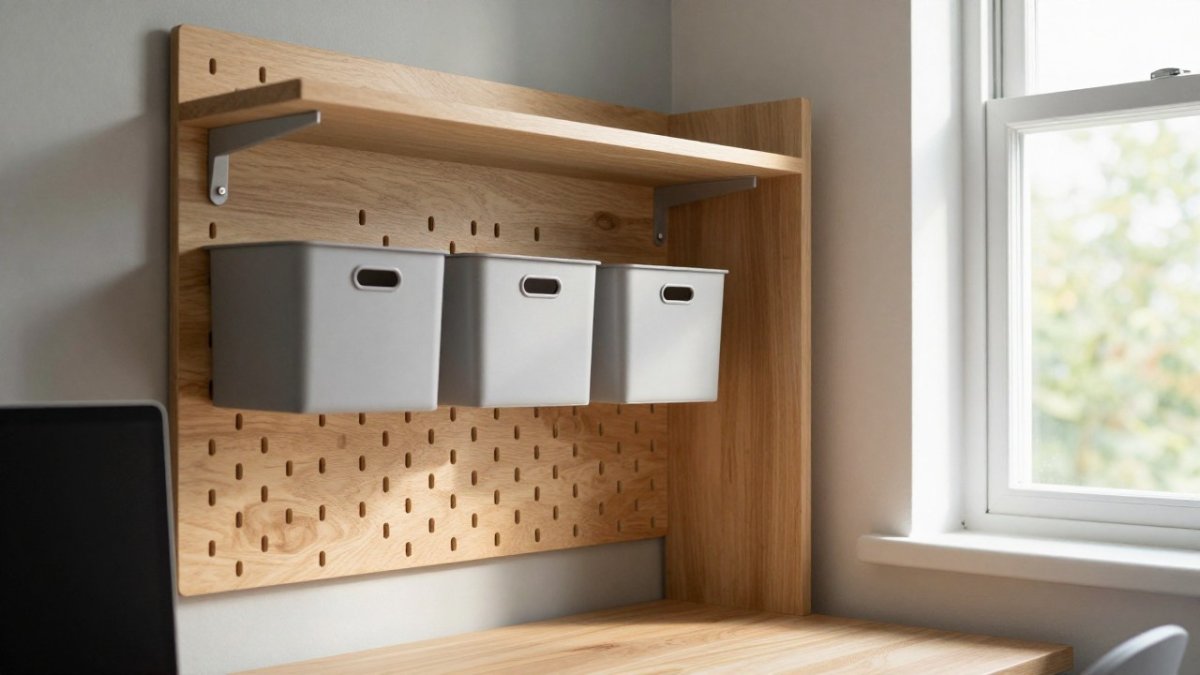
Magnetic strips work well for metal tools and can hold small items without taking up any desk space. Keep heavy items on lower shelves and anything you reach for daily at eye level.
Check that wall-mounted pieces are rated for the weight you plan to store. Use wall anchors when you hang shelves on drywall.
How to Organize Office Supplies at Home With Trays, Caddies and Drawer Dividers
Small supplies are where clutter hides. Pens, sticky notes, paper clips and cables spread out fast. Group them by how you use them, not by type. Keep writing tools in one desktop caddy, cables in a labeled tray and sticky notes in a shallow drawer divider.
Use these tools to contain small items:
- Desktop caddies for pens, scissors and markers
- Shallow trays for sticky notes and paper clips
- Drawer dividers to keep small items from sliding around
- Cord clips or a cable organizer to keep power cords off the desk
Review your supply groups every few months. Remove anything you no longer use.
Office Organization Ideas for Paperwork and a Home Office Filing System
Paper piles grow quickly. Set up one inbox tray for incoming mail and documents, then process it weekly.
For a simple home office filing system, use a small set of labeled folders or a single file box.
Scan important papers and store the digital copies in one folder on your computer. This cuts paper volume and makes search faster.
The paperwork routine comes down to three decisions for each item and a simple folder setup.
| Step | What to do | Frequency |
|---|---|---|
| Inbox tray | Collect incoming mail and documents in one tray | Ongoing |
| Process | Sort each item: act on it, file it or recycle it | Weekly |
| Filing | Group files by category in labeled folders or a file box | As needed |
| Digital copies | Scan important papers into one computer folder | As needed |
Keep Your Desk Clear: A Weekly Reset Routine and Ergonomic Setup
Organization fades without a routine. Pick one time each week, such as Friday afternoon, to clear the desk, empty the inbox tray and return supplies to their zones.
Your setup also affects how long you can work comfortably. Position your monitor at about arm's length with the top of the screen near eye level.
Good ergonomics matter for small spaces because you often sit closer to your equipment. Small changes, like a laptop stand or a footrest, can reduce strain over a long day.
For more on setting up a home office, see our guide to Best Work-From-Home Setup: A Complete Guide. Our post on 7 Biggest Productivity Killers (And How to Fix Them) covers the habits that most often lead to clutter and distraction.
Set Up Your Next Work Session in Minutes
Before you start your next work session, take two minutes to prepare. Clear the desk surface, set out only the items you need for the task and close any tabs that don't belong to it. This simple habit keeps your space ready for focused work.
If you work better outside the house, a change of setting can help too. Read more about why Why Coffee Shops Are Better for Creative Work in 2026 and try the 3-3-3 Rule for Productivity: A Practical Guide to structure your next session.
Third Space Coffee serves high-quality, in-house roasted coffee and offers flexible meeting room rental for teams and events. Visit Third Space Coffee's website for current details before you plan your next work session.
Frequently Asked Questions
How can I effectively organize my small home office?
Start by clearing the desk and removing anything you do not use weekly. Sort remaining items into keep, donate, recycle and discard piles, then assign every keeper a home. Use the vertical wall space above the desk for shelves or a pegboard so the work surface stays open. Set a fixed spot for paperwork and supplies, and spend ten minutes at the end of each workday returning items to those spots. Consistency matters more than buying more containers.
What should I remove first when decluttering my workspace?
Remove anything that does not support your current work: old cables, expired supplies, duplicate pens, broken devices and paper you no longer need. Begin with the desk surface, then the drawers, then shelves. Keep a box labeled donate or recycle nearby so items leave the room as you sort them instead of being moved back into the space. Clear surfaces first, because visible clutter is what makes a small workspace feel cramped.
How do I keep a small home workspace clutter-free?
Use a short weekly reset: clear the desk, empty the inbox tray, file loose paper and check that supplies sit in their designated trays or caddies. Limit the number of storage containers so there is less to fill. Route cables through a cable organizer or clips to keep the work surface clear. Note that a clean desk at the start of a session helps you focus, so make the reset part of your end-of-day habit rather than a periodic project.
How can I organize a home office filing system on a budget?
Use a single inbox tray for incoming paper, a small set of hanging file folders in a drawer or box, and one labeled folder per category such as bills, taxes, contracts and receipts. Review the inbox weekly and file or shred items immediately. Digital scans of important documents, stored in one clearly named folder, reduce how much paper you need to keep at all. Affordable plastic bins and folders from office supply stores cover most needs.