
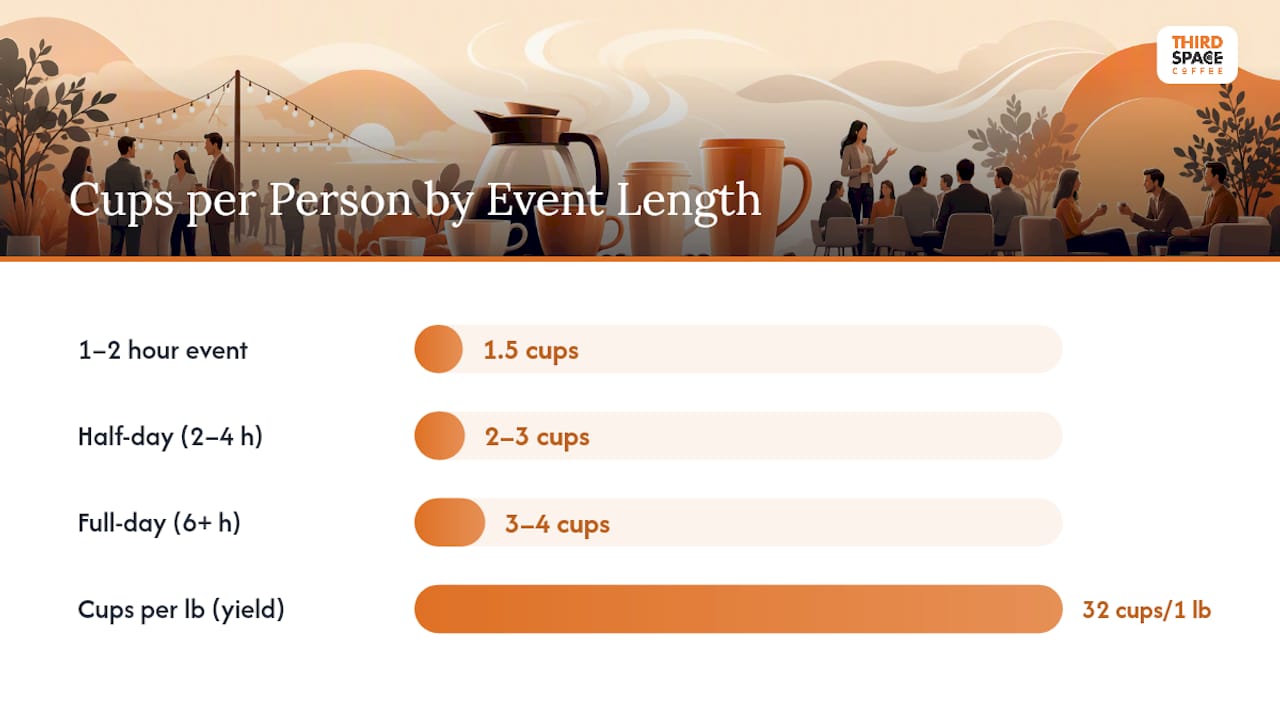
Plan on 1.5 cups per person for a standard 1–2 hour event, 2–3 cups for a half-day, and 3–4 cups for a full day. That single number, applied to your guest count, drives every other calculation in this guide. One pound of whole bean coffee yields roughly 32 eight-ounce cups using a standard 1:16 coffee-to-water ratio, so the quick formula is: cups needed ÷ 32 = pounds of beans to order.
What counts as "a cup" matters here. For event planning, a cup is typically 8 oz for drip coffee served in standard disposable cups. Espresso drinks run 2–4 oz per shot, and large café cups (12–16 oz) cut your yield per pound nearly in half. Adjust your baseline whenever the service format changes.
Quick baselines by event type:
- 1-hour meeting: 1–1.5 cups per guest
- 2–4 hour half-day: 2–3 cups per guest
- Full-day (6+ hours): 3–4 cups per guest
- Morning breakfast event: lean toward the top of each range. Morning corporate events trend toward 1.5–2 cups per guest
Key Takeaways
For most events, the right amount of coffee per person depends on event length, service style, and a buffer to ensure sufficient supply.
| Point | Details |
|---|---|
| Baseline cups per person | Use 1.5 cups for 1–2 hours, 2.5 for half-day, 3.5 for full day. |
| Bean conversion | 1 lb of beans yields ~32 eight-ounce cups; divide total cups by 32 for pounds needed. |
| Freshness window | Brewed coffee stays fresh ~1.5 hours; stage brews rather than brewing everything at once. |
| Buffer recommendation | Add 15% for standard events; 20–25% for high-profile or high-consumption crowds. |
| Thirdspacecoffee | Offers in-house roasted beans, drip and espresso service, and event space for up to 150 guests in Colorado Springs. |
Table of Contents
- How much coffee do you need for 10, 25, 50, and 100 guests?
- How do you convert cups to pounds of beans and urn volumes?
- When should you brew, and how long does coffee stay fresh?
- Self-serve urns, staffed bars, or espresso stations: which fits your event?
- What does event coffee actually cost, and what fees should you watch for?
- Supplies checklist for coffee service at events
- Copy-ready formulas and scenarios for vendor emails
- How do attendee demographics change your coffee estimate?
- How do you handle decaf, espresso, and specialty drink requests?
- What most planners get wrong about coffee quantities
- Thirdspacecoffee handles your event coffee in Colorado Springs
- Sources
How much coffee do you need for 10, 25, 50, and 100 guests?
The table below uses the 1.5-cup baseline for a standard event and a 2.5-cup baseline for a half-day. Bean weight assumes 32 eight-ounce cups per pound.
For 50 guests at a half-day conference, you need roughly 125 cups and just under 4 pounds of beans. That fits in two standard 3-gallon urns with a little room to spare.
According to the Flashquotes coffee catering calculator, a 15% buffer is standard practice; bump that to 20–25% for high-profile or reputation-sensitive events where running short is not an option.
Buffer math:
- Standard buffer: multiply your cup total by 1.15
- High-stakes event buffer: multiply by 1.20–1.25
- Pre-order beans or brewed coffee in advance so the buffer doesn't become a last-minute scramble
Pro Tip: Order your buffer beans whole and grind on-site if possible. Pre-ground coffee stales faster, and a buffer that tastes flat defeats the purpose.
How do you convert cups to pounds of beans and urn volumes?
The math is straightforward once you fix your brew ratio. A common event-planning baseline is approximately 40 g of coffee per liter of water, which aligns with the Flashquotes calculator's inventory inputs. Industry guides also cite 1 kg of beans yielding roughly 120–140 cups at standard 8-oz serving sizes, which translates to roughly 40–50 cups per pound.
Conversion reference:
Worked example — 300 cups:
- 300 cups ÷ 32 cups/lb = 9.4 lbs of beans
- 300 cups × 8 oz = 2,400 oz ÷ 128 oz/gallon = 18.75 gallons
- At 3 gallons per urn: 7 urns (or fewer, larger urns staged over time)
One gallon of brewed coffee yields roughly 10–16 cups depending on cup size, per Cvent's event planning guidance. Use 10 cups/gallon for generous 12-oz pours, 16 for standard 8-oz service.
When should you brew, and how long does coffee stay fresh?
Brewed coffee stays hot and fresh for roughly 1.5 hours. Brew everything at once for a 4-hour event and the last guests get something closer to bitter soup. Stage your brews instead.
Timing guide by event length:
- 1-hour event: Brew once, 15 minutes before doors open. Done.
- 2–4 hour event: Brew at open, refresh at the 1.5-hour mark.
- All-day event: Plan a fresh brew every 90 minutes; schedule staff to monitor urn levels and temperature.
The freshness science behind this comes down to oxidation and heat degradation. Coffee held above 175°F on a burner continues to cook, turning acidic within an hour or two.
Pro Tip: For all-day events, brew in smaller batches (half-urn quantities) every 90 minutes rather than filling full urns twice. Guests notice the difference, and you waste less.
Self-serve urns, staffed bars, or espresso stations: which fits your event?
Service style changes your staffing needs and your per-person consumption estimate. Here's how each option plays out:
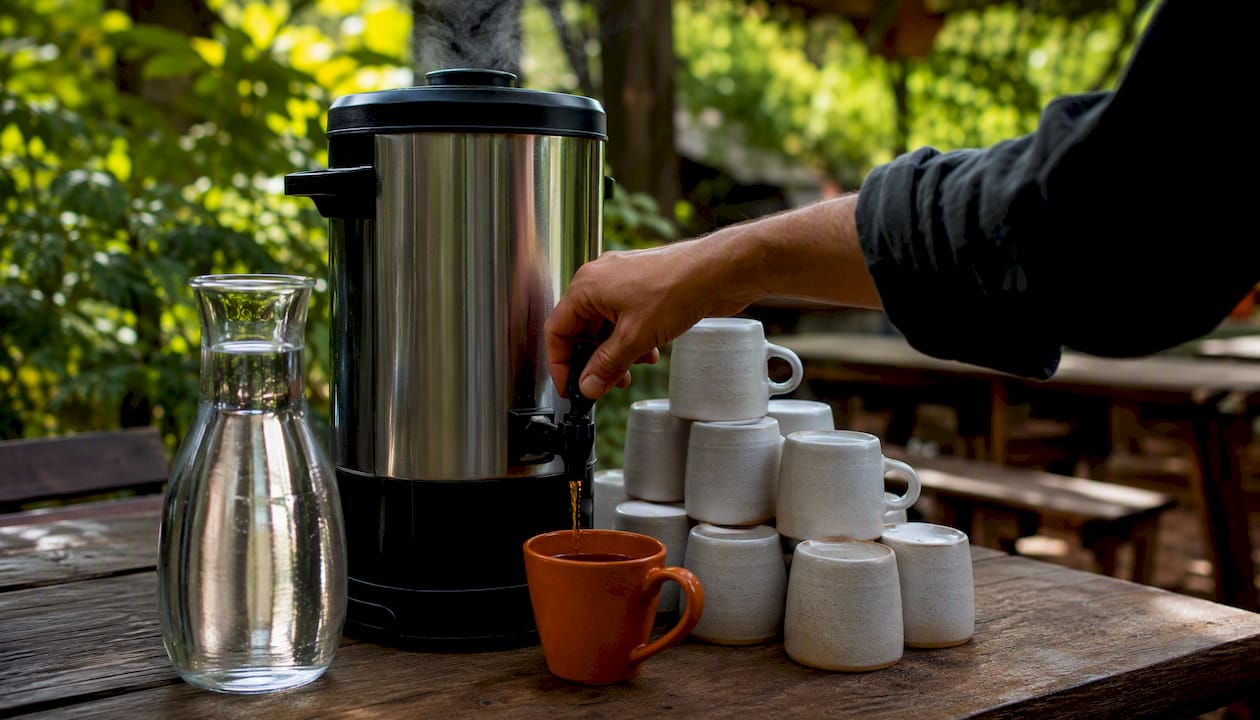
Self-serve urns work well for meetings under 50 people where guests can help themselves. No staff required beyond someone to monitor levels. Consumption tends to run slightly lower because guests don't have a barista prompting a second cup.
Staffed drip or airpot setup suits conferences and corporate breakfasts. One attendant can manage 2–3 urns and keep condiment stations stocked. Consumption rises because service is visible and accessible.
Espresso-based stations are the highest-engagement option and the most labor-intensive. A single experienced barista can handle a steady line, but for groups over 50 expecting espresso drinks, plan for at least two baristas or a queuing system. Per the Flashquotes catering calculator, staffing ratios are critical at high-throughput espresso bars.
Matching service style to event type:
- Board meeting (10–20 guests): self-serve airpots, one attendant
- Corporate breakfast (25–75 guests): staffed drip station, one attendant per 2 urns
- Conference or gala (75–150 guests): espresso station plus drip backup, 2+ baristas
- All-day training (any size): rotating staffed drip with scheduled refreshes
For events at a venue designed for coffee service, the infrastructure is already in place. That matters more than most planners realize until they're renting equipment the morning of.
What does event coffee actually cost, and what fees should you watch for?
Per-cup costs vary by service type. Drip coffee from a caterer typically runs $1–$3 per cup; specialty espresso drinks run $4–$7 per cup. Those numbers shift fast once service fees enter the picture.
UCI Special Events catering guidelines flag service fees commonly in the 20–24% range on top of base pricing, plus applicable sales tax. On a $500 coffee order, that's $100–$120 in fees before tax. Caterers may also charge per-refill or per-gallon rather than a flat rate, so a quote that looks reasonable for one urn can double if you need three refreshes.
What to confirm before signing:
- Is the quote per gallon, per cup, or per person?
- Are refreshes included or billed separately?
- What is the service fee percentage, and does it apply to labor, product, or both?
- Is sales tax itemized or rolled in?
Pro Tip: Ask for a fully itemized quote in writing. "Plus plus" pricing (base price + service fee + tax) is standard in catering, but the percentages vary. A quote that shows each line separately is the only one you can compare accurately.
Supplies checklist for coffee service at events
A solid coffee setup needs more than beans and an urn. Use this list when building your order or briefing a venue:
- Cups (8 oz, 12 oz, or 16 oz depending on service style)
- Lids (match to cup size; have extras)
- Cup sleeves for hot drinks
- Stirrers or spoons
- Napkins
- Sugar (white, raw, and packets)
- Non-dairy milk alternatives (oat, almond, or soy)
- Whole milk and half-and-half, refrigerated until service
- Trash bins and recycling bins near the station
- Signage for regular, decaf, and allergen-relevant items (dairy, nut-based milks)
For flow, place the coffee station away from the main food line to prevent bottlenecks. Hot liquid near a crowded buffet is a safety issue, not just a logistics one.
On sustainability: reusable cups with a rinse station cut waste significantly for events over 50 guests. Compostable cups and lids are a middle-ground option when reusables aren't practical. A full booking checklist for Colorado Springs events covers venue-specific logistics beyond the supplies list.
Copy-ready formulas and scenarios for vendor emails
Two formulas cover most situations:
- Cups needed: guests × cups per person (use 1.5 for standard, 2.5 for half-day, 3.5 for full day)
- Beans needed: cups ÷ 32 (for 8-oz cups at standard brew strength), then multiply by 1.15–1.25 for buffer
Three paste-ready scenarios:
- 2-hour morning meeting, 25 guests: "Please provide coffee service for 25 guests, approximately 40–45 cups total (1.5 cups/person + 15% buffer), drip or airpot, with regular and decaf options."
- Half-day conference, 50 guests: "We need coffee for 50 guests over 4 hours, approximately 145 cups (2.5 cups/person + 15% buffer), with one refresh at the 2-hour mark. Please include condiment setup."
- All-day training, 100 guests: "Please plan for 100 guests over 8 hours, approximately 430 cups (3.5 cups/person + 25% buffer for a high-profile event), with staged brewing every 90 minutes and a staffed station."
Running short at a client-facing event costs more than the extra beans.*
How do attendee demographics change your coffee estimate?
Not every crowd drinks the same. A room of software engineers at 8 AM will drain urns faster than a mixed-age community gathering at 2 PM.
Light drinkers (one cup, maybe none) are common at evening events and afternoon receptions. Heavy drinkers (three or more cups) cluster in morning corporate settings and all-day workshops. A practical approach: estimate your crowd composition, assign each segment a cups-per-person figure, and add them together rather than applying a single flat rate to everyone.
For events with a significant non-coffee-drinking population, redirect some of the budget toward tea, juice, or water service so those guests aren't left with nothing.
How do you handle decaf, espresso, and specialty drink requests?
Plan for roughly 70% regular coffee, 20% decaf, and 10% tea in a typical mixed crowd. Skipping decaf is one of the most common planning mistakes, and it shows up as a mid-event complaint from the guests who needed it most.
Espresso-based drinks (lattes, cappuccinos, Americanos) require separate equipment and a different per-person estimate. A guest ordering a latte is consuming roughly 2 oz of espresso and 6–8 oz of milk, not a standard drip cup. If you're offering specialty drinks, build a separate count for that station and don't fold it into your drip total.
For events where the menu matters as much as the volume, a specialty coffee menu changes the per-person math entirely. Signature drinks and seasonal options drive higher per-person consumption because guests come back for something they can't get at the office.
What most planners get wrong about coffee quantities
The standard advice is to pick a cups-per-person number and multiply. That works fine for a simple meeting. Where it breaks down is timing. Most planners calculate total cups correctly and then brew all of it at once, which means the last hour of a 3-hour event is served stale coffee. The 1.5-hour freshness window isn't a suggestion; it's the difference between guests complimenting the coffee and quietly leaving their cups half full.
The second gap is the decaf blind spot. Experienced caterers plan decaf as a percentage of total volume, not an afterthought.
The third thing planners underestimate is how much service style affects consumption. A staffed espresso bar at a gala will see higher per-person consumption than a self-serve urn at the same event, simply because a barista handing you a drink is more compelling than walking to a table yourself. Build that into your estimate before you finalize the order.
Thirdspacecoffee handles your event coffee in Colorado Springs
Calculating the right amount is step one. Having someone execute it well is step two, and that's where most DIY event coffee falls apart.

Thirdspacecoffee roasts whole bean coffee in-house at its Colorado Springs location and offers drip, espresso, and specialty drink service for private events. The event space holds up to 150 guests, and the meeting room works for smaller groups who want a coffee-shop setting without the logistics of renting equipment. In-house roasted whole beans are available for planners who want to brew on-site, and online ordering makes pre-event pickup straightforward. To discuss your event's coffee needs and get a quote, visit Thirdspacecoffee or reach out directly through the contact page.
Sources
- How to Estimate Coffee Consumption at Events | Cvent Blog
- Catering Guidelines — UCI Special Events
- Coffee Catering Calculator for Events | Flashquotes
- Coffee Quantity Calculator for Events — Mobile Barista Melbourne
- How Much Coffee Do You Need for an Event? (2026 Calculator & Guide)