
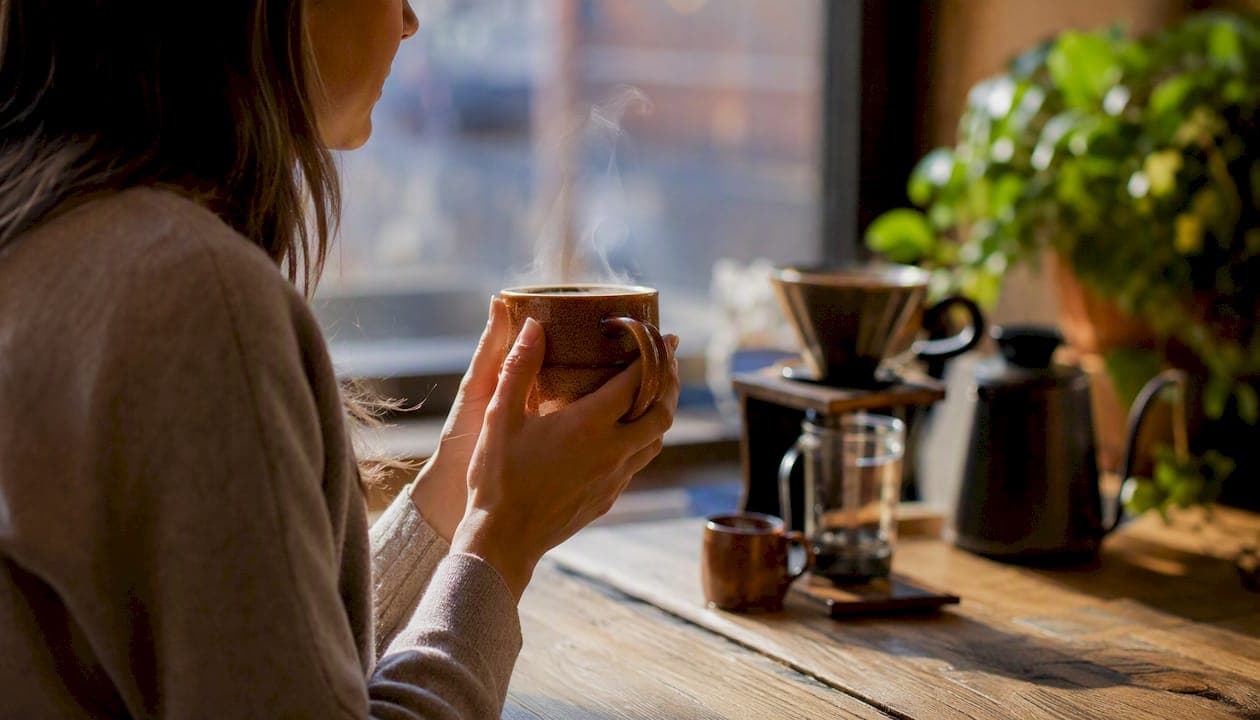
For photos, comfort, and spill prevention, hold your coffee with your index finger through the handle, thumb resting on top, and your remaining fingers curled lightly beneath — this is the standard etiquette hold for seated or standing shots. When you're walking, switch to the overhand "claw" grip: spread your fingers over the rim and cup the top of the mug from above. Researcher Jiwon Han's experimental work, covered by both NPR and Smithsonian Magazine, found that this overhand posture reduces the hand acceleration that causes sloshing. If you're in Colorado Springs and want to practice these holds in a real café setting, Thirdspacecoffee at 2840 is a natural spot to try them out.
- Photo-ready hold: index finger through handle, thumb on top, wrist angled slightly toward the camera
- Transport hold: overhand claw grip over the rim, fingers spread, palm facing down
- Seated/social hold: handle grip with relaxed fingers, cup resting near chest height
- Safety note: the claw grip brings your hand closer to steam; use it for short carries, not long walks with a very hot drink
Pro Tip: Use the claw grip when you're walking from the counter to your table; switch to the handle hold the moment you sit down for photos or conversation.
Key Takeaways
The overhand claw grip reduces sloshing during transport, the handle hold works best for photos and social settings, and the cup you choose communicates as much as the pose itself.
| Point | Details |
|---|---|
| Best transport grip | Use the overhand claw grip for short carries; switch to the handle hold when seated or stationary. |
| Photo-ready styling | Matte ceramic mugs, relaxed fingers, and side lighting produce the cleanest, most natural coffee-holding images. |
| Social meaning | An open, fanned-finger hold reads as confident and approachable; a tight clutch reads as distracted or stressed. |
| Spill prevention | Fill cups to a moderate level and avoid carrying by the handle alone while walking. |
| Practice respectfully | Community spaces and local coffee shops like Thirdspacecoffee are ideal for real-world practice; always ask before photographing others. |
Table of Contents
- What does holding a coffee look like? 12 poses for every mood
- How do you shoot someone holding coffee well?
- Science-backed grips and everyday hacks to carry coffee without spilling
- Styling choices and props that read well on camera
- What does the way you hold your coffee say about you?
- Where to find coffee-holding images and how to use them legally
- Quick do's and don'ts for holding and photographing coffee
- Where to practice these poses in public, and how to do it respectfully
- Why the way you hold your coffee actually matters
- Try it yourself at Thirdspacecoffee
- Sources
What does holding a coffee look like? 12 poses for every mood
Visual inspiration is where most people start, and the range of poses is wider than you'd think. Each hold below reads differently on camera and in person.
- The Casual Sip: Cup at lip level, eyes slightly down. Shoot from slightly above at 50mm. Works for lifestyle and editorial.
- The Hot-Girl Hold: Fingers fanned out, cup held loosely at chest height, slight wrist rotation outward. Shoot straight-on or from a low angle; this is the pose The Telegraph identified as a social status signal in its cultural commentary on coffee-holding trends.
- Two-Handed Cozy: Both palms wrapped around a ceramic mug, elbows close to the body. Shoot tight on the hands from above at 85mm for maximum warmth.
- The Commute Clutch: Claw grip on a paper cup, arm slightly extended, body in motion. Shoot at 1/500s or faster to freeze the walk; 35mm gives environmental context.
- The Look-Away: Cup held at mid-chest, subject gazing off-frame. Works at any focal length; leave space in the direction of the gaze.
- The Thoughtful Lean: Subject leaning on a table, cup cradled in both hands near the chin. Shoot at eye level; a 50mm or 85mm keeps the background soft.
- The Overhead Flat-Lay: Cup on a surface, one hand resting beside it. Shoot directly overhead at f/5.6 or tighter for full sharpness.
- The Confident Grip: Single-hand handle hold, arm slightly extended, wrist neutral. Shoot from a three-quarter angle; this reads as purposeful and direct.
- The Slow Pour: Cup tilted slightly as if mid-pour or mid-stir. Shoot from the side at 85mm; shallow depth isolates the cup against a blurred background.
- The Window Seat: Cup near the sill, subject looking out. Backlight from the window creates steam highlights; expose for the face, not the window.
- The Shared Moment: Two people, each holding a cup, leaning toward each other. Shoot wide enough to include both faces; 35mm works well here.
- The Solo Ritual: Cup on a saucer, both hands framing it without touching. Shoot from slightly above; negative space around the cup tells the story.
Browse Pinterest for mood-board references and iStock for high-resolution licensed examples of each pose type. Search terms like "woman holding coffee cup close-up" or "man coffee hand detail" pull strong results on both platforms.
Pro Tip: Before the shoot, scroll through 10–15 reference images on Pinterest and screenshot the three that match your intended mood. Show them to your subject so they understand the feel you're going for, not just the mechanics.
How do you shoot someone holding coffee well?
Getting the pose right is half the job. The other half is camera position, light, and timing.
Composition and crop
Three crops cover most coffee-holding scenarios. A tight hand-and-cup frame (from wrist to fingertips) isolates texture and grip detail. A three-quarter portrait from mid-torso up includes the face and tells a fuller story. An environmental wide shot places the subject in the café or outdoor space and gives the image context. Mix all three in a single session.
Focal length and settings
An 85mm equivalent is the workhorse for coffee portraits: it compresses background nicely and flatters the hands. A 50mm is more versatile for environmental shots. A 35mm works when you want the room in the frame. For aperture, f/1.8–f/2.8 separates the cup from the background cleanly; go to f/4–f/5.6 if you want both the face and the cup sharp. When your subject is walking, set your shutter speed to at least 1/500s to freeze motion without blur.
Lighting
Side light from a window is the most reliable setup for coffee photography. It catches texture on ceramic surfaces and creates the steam highlights that make a hot drink look genuinely inviting. Backlight from behind the subject produces a halo effect around steam. If the face falls too dark, a white foam-core board on the opposite side bounces enough fill without adding a second light source.
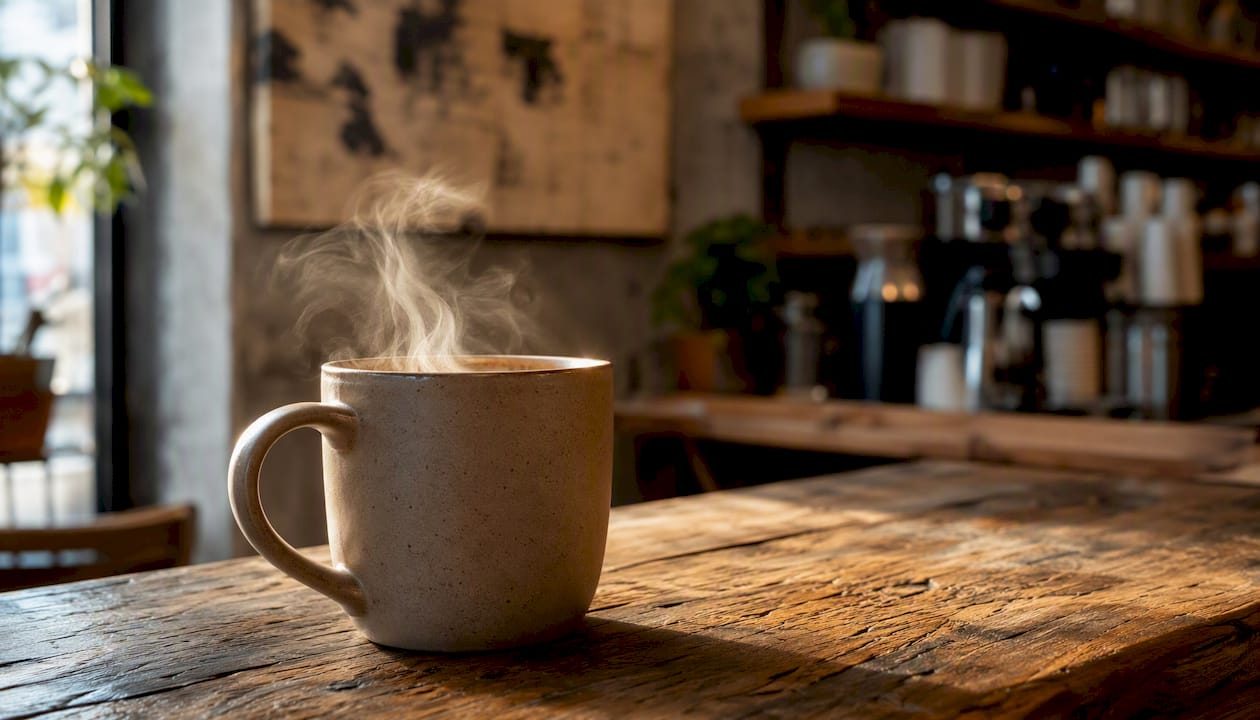
Pro Tip (smartphone): Tap to focus on the cup, then slide the exposure wheel down slightly so highlights on the rim don't blow out. Portrait mode works well for the two-handed cozy hold.
Pro Tip (DSLR/mirrorless): Shoot tethered to a laptop if you're directing a subject. Seeing the image large in real time lets you catch a stray finger or an awkward wrist angle before you've taken 200 frames of the same mistake.
Direction and timing
The best coffee-holding images usually happen between poses, not during them. Ask your subject to take an actual sip, then lower the cup naturally. Fire the shutter as the cup comes down, not at the peak of the sip. That transition captures a genuine, unguarded moment that staged holds rarely match.
Science-backed grips and everyday hacks to carry coffee without spilling
The physics of a sloshing mug are straightforward: liquid oscillates when your hand accelerates, and the frequency of that oscillation depends on the cup's geometry and how you're gripping it.
Jiwon Han's experimental work, reported by Smithsonian Magazine, found that taller or stemmed vessels slosh less than standard cylindrical mugs, and that a claw-like overhand grip reduces the hand acceleration that drives sloshing. NPR's coverage of the same research adds an important caveat: the claw grip brings your palm directly over the opening, which increases steam exposure to your hand.
Beyond grip, Snug Science's analysis of mug handle ergonomics points out that a well-designed handle accommodating two to three fingers, with a flattened thumb rest and adequate standoff from the mug body, reduces heat conduction to your fingers and keeps the mug balanced. That balance matters for spill prevention as much as grip style does.
Do:
- Fill your cup to a moderate level before walking, avoiding overfilling
- Use the claw grip for short carries (counter to table)
- Walk with short, even steps; avoid sudden stops
- Switch to a two-handed carry for distances longer than a few feet
- Use a lid for any cup you're carrying through a crowd
Don't:
- Carry a full mug by the handle alone while walking; the pendulum motion amplifies sloshing
- Take fast steps or pivot quickly with a full, open cup
- Use the claw grip with a very hot drink if you have reduced hand sensitivity
- Overfill past the three-quarter mark, regardless of grip style
Safety note: Steam burns happen fast. If your drink was just pulled from an espresso machine or poured from a kettle, give it 60–90 seconds before using the claw grip.
Pro Tip: A silicone lid on a ceramic mug gives you the best of both worlds: spill resistance for the walk, easy removal for the photo. Keep the lid in your pocket once you sit down.
Styling choices and props that read well on camera
The cup you choose does as much visual work as the pose.
Cup types and their visual effect:
| Cup type | Visual mood | Practical note |
|---|---|---|
| Ceramic mug | Warm, homey, artisan | Matte glazes photograph best; avoid high-gloss decals that create hot-spot reflections |
| Porcelain espresso cup | Refined, minimal | Small size reads well in tight crops; pair with a saucer for editorial shots |
| Paper takeaway cup with sleeve | Lifestyle, on-the-go | Easy to read; branded cups add context but logos can distract in close-ups |
| Clear glass | Modern, transparent | Shows drink color and layers; backlight makes it glow |
| Insulated tumbler | Active, outdoorsy | Works for environmental shots; less intimate in portrait crops |
For clothing, longer sleeves add warmth and frame the hands; rolled cuffs add a casual, intentional feel. Avoid busy patterns near the cup since they compete with the subject. Rings and bracelets photograph well when they're simple; chipped nail polish reads clearly in close-ups, so either clean it up or commit to a full-nail look. Keep fingers relaxed and slightly separated; a white-knuckle grip reads as tense on camera.
Props that consistently work: a saucer under the cup, a pastry or small plate in the background, an open book or notebook, and a window with natural light behind the subject. Use negative space deliberately. A cup floating in the center of a clean, light-toned surface tells a quieter story than a cluttered table.
Pro Tip: Handle ergonomics affect more than comfort. A mug your subject genuinely likes holding will show in how relaxed their grip looks on camera. Let them choose their cup.
What does the way you hold your coffee say about you?
Hand posture communicates before you say a word. Fanned fingers read as open and confident; a tight clutch signals preoccupation or stress. The "Hot-Girl Hold," with fingers spread and the cup held loosely at chest height, projects ease and social awareness. A two-handed wrap around a mug reads as warmth and approachability. A single-finger handle hold with a relaxed wrist signals composure.
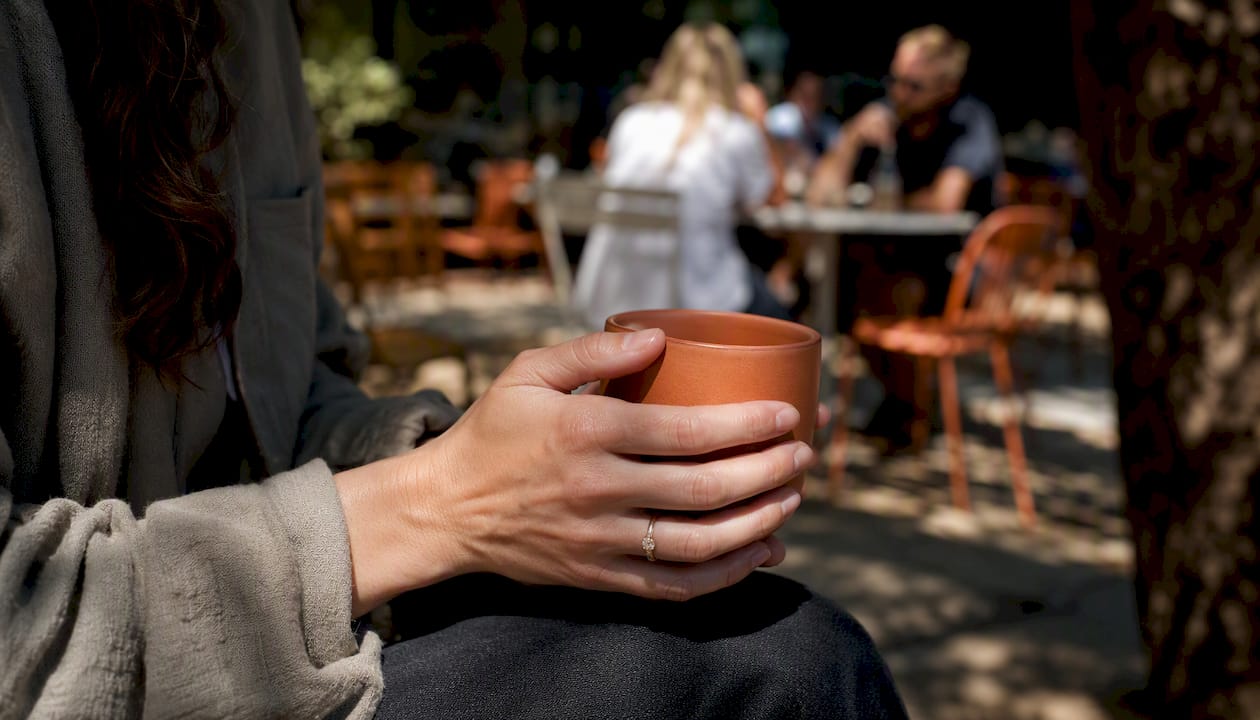
Body-language commentary in the style of analysts like Adrianne Carter suggests these reads are consistent across social contexts: the way you grip a cup tells observers whether you're present in the conversation or distracted by it.
Coffee's social function goes beyond the grip. Boston University's Howard Thurman Center runs Coffee Convo programs that use shared beverages to structure inclusive, idea-focused community conversation. The act of holding a cup together creates a low-stakes social ritual that lowers conversational barriers. Carnegie Library of Pittsburgh's Coffee and Conversation sessions work on the same principle: a warm drink in hand signals openness and invites exchange.
For photographers, this translates directly. The hold you direct your subject into shapes the story the image tells. A tight clutch reads as vulnerability; a relaxed fan reads as confidence. Choose the grip that matches the narrative, not just the one that looks good in isolation.
- Thumb-and-forefinger hold: curated, deliberate, slightly editorial
- Two-handed wrap: warmth, intimacy, comfort
- Claw grip on a paper cup: busy, in-motion, purposeful
- Single-handle hold, arm extended: confident, social, ready to engage
- Cup balanced on fingertips: relaxed, unhurried, at ease
Where to find coffee-holding images and how to use them legally
Pinterest and iStock serve different needs, and mixing them up costs time or money.
Pinterest is ideal for quick inspiration and mood-boarding. You can build a board of reference images in minutes, and the visual search makes it easy to find adjacent ideas. The catch: most images on Pinterest are not licensed for commercial use. They're pinned from third-party sources, and the original rights belong to the photographer or publication. Use Pinterest to understand what you want to shoot, not as a source for images you'll publish or sell.
iStock is built for licensed use. Every image comes with a clear license type: royalty-free (pay once, use within the license terms) or rights-managed (fee tied to specific use, duration, and distribution). For commercial projects, always confirm whether the image includes a model release. A photo of a recognizable person holding a coffee requires a model release before you can use it in advertising or branded content.
| Platform | Best use | Licensing caution |
|---|---|---|
| Mood-boarding, pose reference, creative direction | Not a licensing source; most images are third-party pinned | |
| iStock | Commercial and editorial licensed images | Confirm royalty-free vs. rights-managed; check model release status |
Search terms that work on both platforms:
- "woman holding coffee cup close-up"
- "man coffee hand detail"
- "coffee cup hands warm"
- "barista holding espresso"
- "coffee to go walking"
A model release is required any time a recognizable person's image is used for commercial purposes, including advertising, product packaging, or branded social media. Editorial use (news, education, commentary) generally does not require one, but the line between editorial and commercial blurs quickly on social platforms. When in doubt, license an image that explicitly includes a model release.
Quick do's and don'ts for holding and photographing coffee
Do
- Check your cup fill level before walking; three-quarters full is the practical ceiling.
- Use the claw grip for short carries from counter to table.
- Switch to the handle hold for seated shots and social situations.
- Angle your wrist slightly toward the camera for cleaner lines in photos.
- Choose a matte ceramic mug for close-up photography; it handles light without glare.
- Use a lid for any carry through a crowd, then remove it for the shot.
- Let your subject choose a cup they actually like; comfort shows in the grip.
- Shoot between poses to capture natural, unguarded moments.
- Check model release status before using any licensed image commercially.
Don't
- Don't carry a full cup by the handle alone while walking.
- Don't use the claw grip with a very hot drink if you have limited hand sensitivity.
- Don't let chipped nail polish or busy jewelry distract in close-up frames.
- Don't overfill past three-quarters, regardless of grip style.
- Don't use Pinterest images for commercial publication without tracing and licensing the original source.
- Don't shoot with the light directly behind the camera; it flattens texture and kills steam highlights.
- Don't direct your subject into a grip that looks good but feels unnatural; tension in the hand reads clearly on camera.
Where to practice these poses in public, and how to do it respectfully
Community spaces are the best practice environments because they offer real light, real props, and real social context. Carnegie Library's Coffee and Conversation drop-in sessions and the Howard Thurman Center's Coffee Convo programs are examples of structured settings where coffee-holding is already a social act. Practicing in those contexts feels natural rather than performative.
In any café, a few guidelines keep the experience positive for everyone. Stay out of service areas and don't block the counter or pickup zone. Ask before photographing other patrons; most people are happy to say yes when you ask directly. Keep your setup minimal: a phone or small camera, one cup, and natural light. A full lighting rig in a busy café is a disruption.
Thirdspacecoffee in Colorado Springs is well-suited for small-scale practice sessions. The space supports community gatherings and private events, and the coffee shop hospitality ethos there is built around making people feel at home. For a larger shoot, the event space accommodates up to 150 guests and can be booked privately. For a solo practice session or a quick pickup before you head somewhere else, the online ordering system lets you pre-order so your drink is ready when you arrive.
Coffee is also central to the social fabric of Colorado Springs more broadly. Practicing poses in a community coffee shop rather than a studio gives your images a lived-in quality that's hard to fake.
Why the way you hold your coffee actually matters
There's a version of this topic that's purely aesthetic: get the grip right, nail the photo, move on. But the more you pay attention to how people hold their coffee, the more you notice it's doing real social work.
A relaxed, open hold at a community event signals that you're present and approachable. A tight clutch while checking your phone signals the opposite. The researchers and community programs cited in this guide aren't overthinking it; they're pointing at something most people already sense but rarely articulate. The cup is a prop in a social performance, and how you hold it shapes how others read you before you've said anything.
At Thirdspacecoffee, that idea is baked into the space itself. It's a venue where people come to connect, whether over a specialty drink at the counter, a meeting in the event space, or a community gathering. The coffee shop ambience is designed to make those interactions feel easy. Practicing your hold there isn't just about getting a good photo. It's about showing up in a space built for exactly that kind of presence.
Come in, order something you'll enjoy holding, and pay attention to what your hands are doing.
Try it yourself at Thirdspacecoffee

The best way to practice any of these holds is with a great drink in your hand. Thirdspacecoffee roasts its beans in-house in Colorado Springs and pulls made-to-order espresso drinks that photograph beautifully in a ceramic cup. Order online for quick pickup, or come in and take your time.
Browse the specialty drinks menu to find a drink worth holding, or explore the whole bean coffee selection if you want to style a home shoot with quality packaging. For a low-stakes practice visit, the drip coffee is an easy starting point.
Sources
- How To Keep Your Coffee In Its Cup: The Claw Grip — NPR
- Scientists Have Found The Most Efficient Way to Hold a Coffee Mug — Smithsonian Magazine
- Coffee Convo — Howard Thurman Center, Boston University
- Coffee Conversation connections — Carnegie Library of Pittsburgh