
TL;DR:
- A specialty barista operates as a technician and quality gatekeeper, ensuring precise, consistent results through technical skill and disciplined workflows. Mastery involves careful dial-in procedures, milk microfoam techniques, and attentive customer service to deliver exceptional coffee experiences. Technology automation shifts focus to monitoring, troubleshooting, and maintaining high standards for quality and consistency.
Walk into any specialty café and it looks simple enough: someone takes your order, pulls a shot, steams some milk, and hands you a beautifully crafted drink. But calling that "just making coffee" is like calling a surgeon "just someone with a knife." Behind every specialty cup is a complex set of decisions, precise physical techniques, and real-time quality judgments that most customers never see. Whether you're pursuing a barista career in Colorado Springs or simply trying to understand what separates good coffee from extraordinary coffee, this guide breaks down every layer of the craft, from science to service to artistry.
Table of Contents
- What makes a specialty barista different?
- Dialing-in espresso: The science behind consistency
- Milk microfoam and latte art: Technique as artistry
- Customer connection: The service and hospitality side
- Adapting to new tech: Automation, monitoring, and edge cases
- Why repeatable processes matter more than pure artistry
- Ready to experience or become a specialty coffee expert?
- Frequently asked questions
Key Takeaways
| Point | Details |
|---|---|
| Baristas are technical gatekeepers | In specialty coffee, baristas oversee quality through precision and consistency, not just drink preparation. |
| Workflows build mastery | Repeatable processes like dialing in espresso underpin both reliability and artistry in specialty drinks. |
| Milk technique matters | Microfoam creation and latte art require controlled, measurable methods that merge skill and creativity. |
| Customer service is essential | Great baristas blend technical craft with hospitality, enhancing the guest experience in every interaction. |
| Tech changes require new skills | Automation means baristas must focus more on monitoring, troubleshooting, and maintaining drink quality. |
What makes a specialty barista different?
To understand what makes a specialty coffee experience unique, let's first clarify how the barista's job differs in these settings.
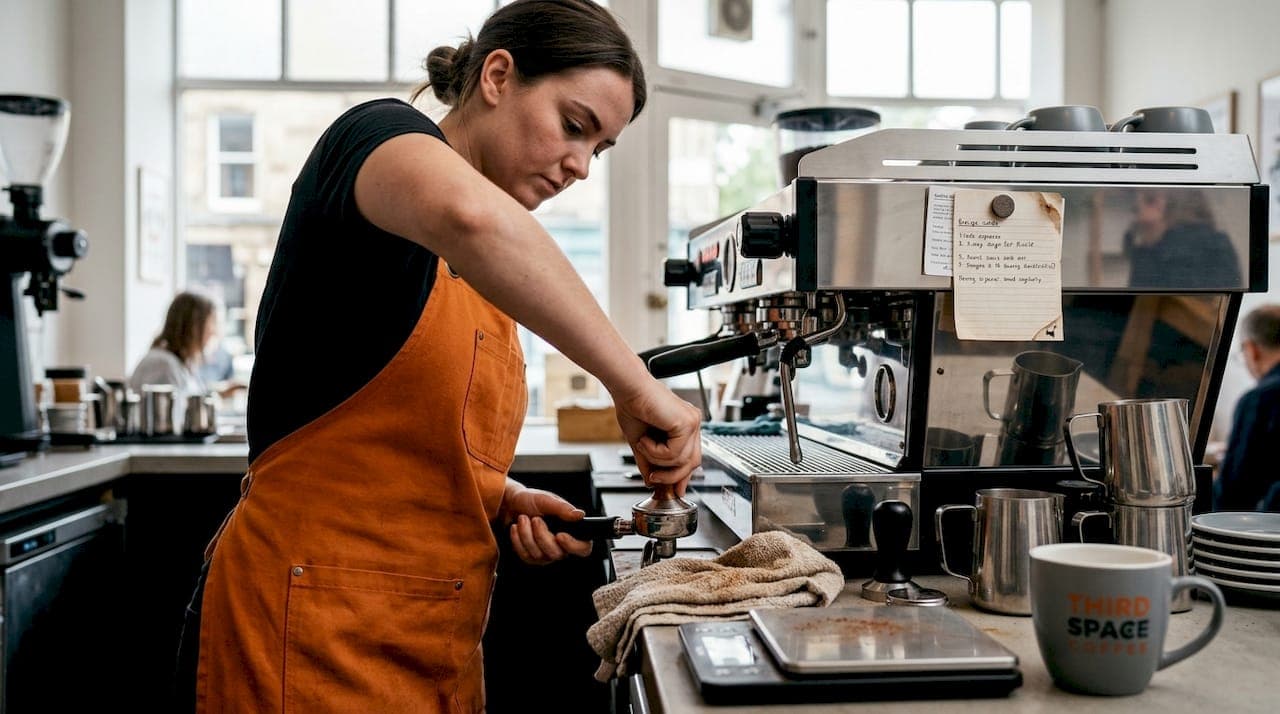
Most people picture a barista pressing buttons and pouring hot water. In a standard coffee chain, that picture is not entirely wrong. But in a specialty café, the role shifts dramatically. A specialty barista operates more like a technician on a production line where quality tolerances are tight and the product is perishable in seconds. Every shot has a defined flavor target. Every milk texture has a standard. Every adjustment has a consequence.
Specialty baristas act as quality gatekeepers, combining consistent espresso and milk execution with continuous monitoring and real-time adjustments throughout each shift. That means the role is not just physical. It requires analytical thinking, sensory awareness, and the discipline to follow repeatable workflows even when the rush is on.
Here is how the two environments compare:
| Factor | Standard coffee shop | Specialty café |
|---|---|---|
| Espresso recipe | Pre-set, rarely changed | Dialed in daily per bean lot |
| Milk texture | Frothed to volume | Microfoam to specific consistency |
| Quality control | Occasional manager checks | Barista-led, continuous |
| Menu complexity | Simple, limited options | Detailed, origin-specific offerings |
| Technical skill demand | Moderate | High |
The daily tasks in a specialty setting reflect this complexity. A specialty barista typically begins each shift by:
- Calibrating the grinder for that day's beans
- Pulling test shots and evaluating taste, timing, and yield
- Documenting adjustments in a shot log
- Monitoring milk steam temperature and texture throughout service
- Noting when extraction drifts and correcting before it affects customers
"The barista's role in specialty coffee is less about following a script and more about maintaining a living standard. Every variable changes. The barista's job is to keep the outcome constant."
That mindset is what separates a great specialty barista from someone who simply knows how to use equipment.
Dialing-in espresso: The science behind consistency
Having established the unique technical barista role, let's zoom in on "dialing in," the heart of specialty espresso preparation.
"Dialing in" means systematically adjusting coffee variables until the shot hits its target flavor profile. It is not guesswork. It is a controlled, repeatable process where you stabilize foundational settings, observe outcomes, adjust one variable at a time, and verify the result before moving on.
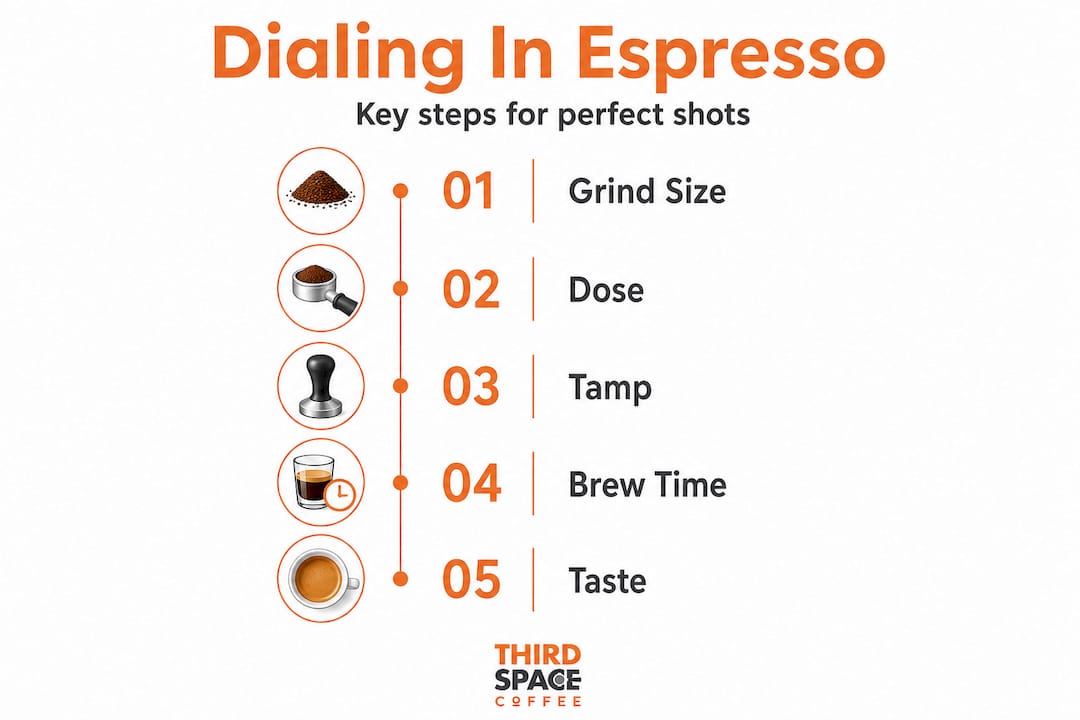
The core variables you are managing look like this:
| Variable | Typical specialty range | Effect on flavor |
|---|---|---|
| Grind size | Fine to medium-fine | Finer = more extraction, slower flow |
| Dose | 18 to 22 grams | Higher dose = more body and strength |
| Tamp pressure | Consistent, firm | Affects puck density and flow rate |
| Water temperature | 195 to 205°F | Higher temp = more extraction |
| Yield (output) | 36 to 44 grams | Controls concentration |
| Shot time | 25 to 35 seconds | Indicator of overall extraction balance |
The dial-in process follows a clear sequence:
- Set your recipe baseline. Start with the roaster's recommended dose, yield, and time.
- Pull a test shot. Observe the pour rate, color, and timing without adjusting anything yet.
- Taste immediately. Identify whether the shot is sour (under-extracted) or bitter (over-extracted).
- Adjust one variable only. If sour, grind finer. If bitter, grind coarser. Do not change multiple settings at once.
- Pull another test shot. Compare directly to your previous result.
- Verify and lock in. Once flavor hits your target, note every setting and keep it consistent.
Pro Tip: Always change one variable at a time. If you adjust both grind size and dose simultaneously, you will not know which change caused the improvement, and you will waste time and coffee trying to replicate it.
In a Colorado Springs specialty café, receiving a new bag of beans from a different harvest year or farm lot often means starting the dial-in process from scratch. Beans from higher altitudes, like those grown in Ethiopia or Colombia, tend to be denser and require a finer grind compared to lower-altitude lots. That is not a problem. It is part of the process. Experienced baristas expect it and build time into their opening routine for it. Exploring a whole bean coffee selection roasted in-house means you are working with freshly roasted beans that often behave differently batch to batch, which makes dialing in even more important. For those curious about applying similar principles beyond espresso, the same logic applies to a dial-in workflow for drip coffee.
Milk microfoam and latte art: Technique as artistry
Once espresso is dialed in, milk-based drinks present the next technical and creative challenge for specialty baristas.
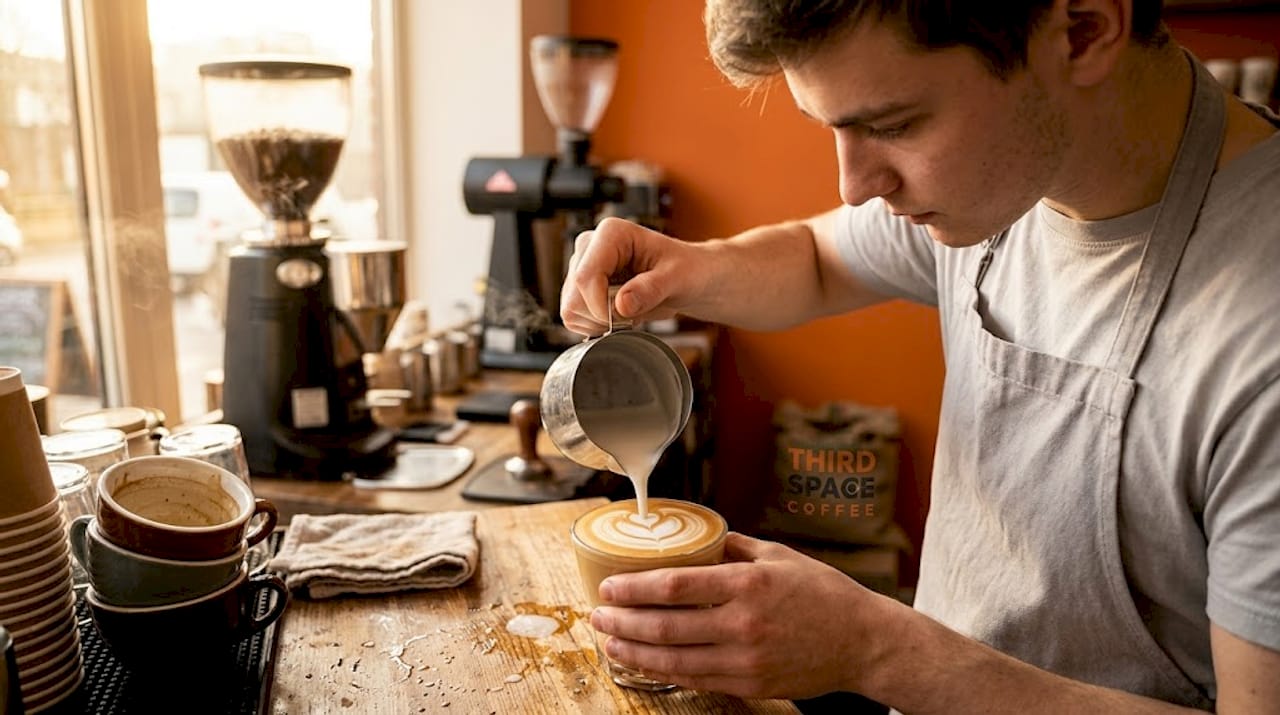
The goal of milk steaming is not simply to make milk hot. It is to create microfoam, which is a velvety, glossy milk texture where tiny, nearly invisible air bubbles are suspended evenly throughout. That texture allows milk and espresso to integrate smoothly, producing a creamy mouthfeel and a surface ready for latte art. Baristas achieve microfoam through a two-stage steaming approach: first aerating (stretching) the milk, then creating a vortex to refine the texture.
Here is the step-by-step process:
- Purge the steam wand. Remove any condensed water before introducing the wand to milk.
- Position the wand near the surface. Submerge the tip just below the milk surface, slightly off-center to encourage spinning.
- Open the steam valve fully and aerate. Lower the pitcher just enough to hear a soft "tss" sound. This introduces air and increases milk volume. Stop aeration once milk reaches about 100°F.
- Raise the pitcher and create a vortex. Submerge the wand deeper and angle the pitcher to spin the milk. This breaks down large bubbles and integrates texture.
- Stop steaming at 140 to 150°F. Use a thermometer until you can judge temperature by hand.
- Tap and swirl. Tap the pitcher on the counter to pop any surface bubbles, then swirl firmly to maintain the glossy, paint-like consistency.
- Pour immediately. Microfoam settles and separates within seconds, so transition from steaming to pouring without delay.
"Good microfoam should look like wet paint. If it looks like shaving cream, you have over-aerated. If it looks watery, you did not aerate enough."
The most common mistakes aspiring baristas make include holding the steam wand too high (introducing too much air too fast), stopping the vortex phase too early (leaving large bubbles), and waiting too long to pour (letting milk separate). Each error affects both taste and the ability to create latte art.
Pro Tip: Practice steaming with cold water and a drop of dish soap before you work with milk. The foam behavior mimics real milk and lets you perfect wand positioning without wasting dairy.
Latte art emerges from controlled pouring. A rosette, tulip, or simple heart all come from managing pour height, pour speed, and wrist movement. The design forms as the lighter microfoam floats on top of the espresso base while denser milk flows underneath. Learning to make a clean heart on a latte is often a barista's first milestone and a reliable signal that their milk technique is consistent.
Customer connection: The service and hospitality side
Specialty drinks are only half the equation. Interacting with guests is where baristas truly shine in specialty cafés.
A specialty menu is more complex than a standard one. Customers see words like "natural process," "washed," "single origin," and "ristretto" and sometimes need guidance. A good barista does not just explain what a drink is. They match the customer's preference to the right option, making the interaction feel natural rather than academic.
Daily barista responsibilities extend well beyond the machine and include customer communication, handling complex orders, managing speed versus accuracy trade-offs, and supporting a welcoming environment. In practice, this looks like:
- Greeting regulars by name and remembering their usual order
- Asking clarifying questions about flavor preferences before recommending a drink
- Explaining the difference between a cortado and a flat white without making the customer feel uninformed
- Resolving a complaint quickly and with genuine care, not scripted politeness
- Managing ticket volume during a morning rush without letting accuracy slip
Consider two quick scenarios. First, a customer mentions they are lactose intolerant and want something creamy. A skilled barista immediately suggests oat milk, explains how it steams differently (it produces excellent microfoam), and might recommend a specific espresso origin that pairs well with oat's natural sweetness. Second, a customer receives the wrong drink. An experienced barista does not point fingers at the kitchen or the customer. They apologize sincerely, remake the drink immediately, and follow up before the customer leaves. Exploring resources on coffee menu curation can help aspiring baristas understand how drinks are designed with specific guest experiences in mind.
Pro Tip: Ask open questions rather than yes/no questions when helping a customer choose. "Do you prefer something bright and fruity or rich and chocolatey?" gets you to the right recommendation faster and makes the customer feel heard.
Adapting to new tech: Automation, monitoring, and edge cases
With hospitality and technique covered, today's barista must also keep pace with evolving tools in Colorado Springs specialty shops.
Modern espresso equipment increasingly automates pressure profiling, volumetric dosing, and even milk steaming. On the surface, this sounds like it reduces the barista's workload. In reality, automation shifts the barista's responsibility from direct manual control to active monitoring and fast intervention when quality drifts. The machine handles execution, but the barista is still accountable for the outcome.
Key responsibilities in an automated environment include:
- Watching shot timing and yield even when the machine doses automatically
- Monitoring steam output pressure and temperature consistency across multiple drinks
- Running scheduled equipment maintenance checks mid-shift, not just at open and close
- Catching grinder wear or calibration drift before it produces off-spec shots
- Logging anomalies and flagging them for the lead barista or manager
"The danger with automated equipment is complacency. Baristas who trust the machine entirely will miss the moment it starts producing substandard output."
A real-world example: a grinder's burrs wear down gradually. The grind becomes slightly coarser over weeks without any obvious mechanical failure. Shots start running fast and tasting thin. A barista who is actively monitoring yield and timing catches this quickly and adjusts. A barista who assumes the machine is always right serves dozens of mediocre cups before anyone investigates. For those interested in how equipment knowledge applies outside a professional setting, understanding how to properly set up a home coffee bar builds the same monitoring instincts in a low-pressure environment.
Why repeatable processes matter more than pure artistry
Looking beyond daily routines, it is worth questioning: what really defines barista mastery in today's specialty coffee world?
There is a persistent romantic image of the barista as an artist, someone who expresses creativity through every pour, who improvises flavor combinations, and who works by feel and intuition. That image is appealing. It is also incomplete. The baristas who consistently produce exceptional coffee are almost always the ones with the most disciplined process, not the most creative flair.
Specialty barista artistry is tightly coupled to process control, with measurable technique loops driving quality outcomes far more reliably than intuition alone. Think of it this way: a jazz musician improvises freely because they have spent thousands of hours drilling scales, chord progressions, and rhythm patterns until those fundamentals are automatic. The creativity is real, but it emerges from a foundation of rigorous practice.
The same is true here at Third Space Coffee. We see this distinction clearly in new baristas. Those who try to express style before mastering workflow produce inconsistent results. Those who commit to the dial-in process, to practicing microfoam texture daily, to logging their shots and tracking patterns, they are the ones whose creative instincts eventually produce something genuinely special.
The practical advice is this: if you are new to specialty coffee, treat the first three to six months as pure technical training. Build your workflow until it is automatic. Master your dial-in sequence. Steam milk until microfoam feels like second nature. Once those processes run on autopilot, your attention frees up for genuine creativity, customer connection, and the subtle art of making someone's day better through a single cup.
Ready to experience or become a specialty coffee expert?
If you're inspired to deepen your skills or enjoy expertly crafted drinks, here's how you can take your next step.
At Third Space Coffee in Colorado Springs, every cup is built on the exact skills and workflows covered in this article. Our team dials in beans roasted right here in-house, steams milk to proper microfoam texture, and brings genuine hospitality to every interaction.

Whether you want to taste what these skills produce firsthand or you are building your own coffee knowledge, we have you covered. Explore specialty drinks crafted with precision and care, or shop whole bean coffee to practice your own dial-in process at home. Stop in, place a pickup order, or follow us on Instagram to see the craft in action every day.
Frequently asked questions
What does "dialing in" mean for a barista?
"Dialing in" is the process of calibrating espresso variables like grind size, dose, and yield to achieve the best possible flavor, approached as a structured, repeatable workflow where only one variable changes at a time.
How important is latte art in specialty coffee cafés?
Latte art is more than decoration. It signals precise milk microfoam technique and demonstrates overall drink quality, because you cannot pour clean art without properly textured milk.
What skills set a specialty coffee barista apart?
Specialty baristas stand out for precise espresso preparation, microfoam mastery, and hospitality. Professional barista standards also emphasize consistent equipment operation and cleanliness as core competencies alongside technical skill.
How does automation affect the barista's role?
Automation reduces some manual inputs but raises the stakes for monitoring and intervention, making active quality control more important than ever when equipment handles extraction or steaming automatically.