
TL;DR:
- Altitude influences coffee bean density, flavor, and chemical composition by creating cooler growing conditions at higher elevations. Growing above 1,200 meters often produces denser beans with brighter, more complex flavors, primarily due to slower maturation. However, elevation alone does not guarantee quality; soil, variety, and processing also significantly impact the final cup.
Altitude in coffee growing is defined as the elevation above sea level at which coffee plants are cultivated, measured in meters above sea level (MASL). This single variable shapes bean density, flavor complexity, and chemical composition more than almost any other agricultural factor. High-altitude coffee is classified at 1,200 MASL or higher and carries industry labels like Strictly High Grown (SHG) and Strictly Hard Bean (SHB). Understanding coffee growing elevation gives growers a scientific foundation for making cultivation, processing, and quality decisions that directly affect cup scores and market value.
What is altitude in coffee growing and why does it matter?
Altitude in coffee cultivation is the primary environmental variable that determines how slowly or quickly a coffee cherry matures. The standard industry classification divides growing elevations into three bands: low altitude up to 750 MASL, medium altitude from 750 to 1,200 MASL, and high altitude above 1,200 MASL. Each band produces measurably different beans in terms of density, acidity, and flavor potential.
The terms SHG and SHB are not marketing labels. They are grading standards used by coffee-producing countries, particularly in Central America, to certify that beans were grown above specific elevation thresholds. SHG typically applies to beans grown above 1,350 MASL, while SHB is used in regions like Hawaii where the same quality threshold occurs at a lower elevation due to latitude effects. Growers who understand these standards can position their crops more accurately in specialty markets.
Altitude matters because cooler temperatures at higher elevations slow the entire growth cycle of the coffee plant. A cherry that takes six months to ripen at 800 MASL may take eight or nine months at 1,600 MASL. That extended ripening window allows the plant to accumulate more sugars, acids, and aromatic compounds in the bean. The result is a denser, more chemically complex seed that produces a brighter, more layered cup.
How does altitude affect coffee bean maturation and sensory quality?
Slower maturation at high altitudes is the direct cause of the flavor complexity that specialty buyers prize. As cherries ripen slowly under cooler conditions, the bean accumulates higher concentrations of phenolic compounds, organic acids, and sugars. Studies find that total phenolic content increases with altitude while caffeine levels actually decrease. That chemical shift explains why high-altitude coffees taste brighter and more nuanced rather than simply stronger.
The sensory scoring data from Panama is among the clearest evidence available. A study of Panamanian Geisha coffees found that beans grown above 1,700 MASL scored 87–90 points on the Specialty Coffee Association scale, compared to 86–87 points for lower-elevation lots. Altitude alone explained approximately 72% of the sensory variation between samples. That is a statistically dominant relationship, meaning elevation outweighed processing method, harvest timing, and other variables in predicting cup quality.
Flavor notes shift predictably across elevation bands:
- Low altitude (up to 750 MASL): Mild, earthy, or woody notes; lower acidity; heavier body; common in commodity-grade production
- Medium altitude (750–1,200 MASL): Balanced acidity and sweetness; nutty or chocolatey notes; reliable quality for blends
- High altitude (above 1,200 MASL): Bright acidity, floral or fruity aromatics, complex sweetness; the profile associated with specialty coffee flavor and premium pricing
Pro Tip: When evaluating a new lot, cross-reference the stated MASL with the cupping notes. If a coffee claims 1,800 MASL but shows flat, low-acid flavor, investigate the processing and post-harvest handling before assuming the altitude data is accurate.
Chemical changes in high-altitude beans, particularly increased flavonoids and phenolics, are the biochemical explanation for the bright, complex profiles that consumers and Q graders consistently reward. These compounds develop during the extended maturation period and are preserved when post-harvest processing is handled carefully.
How does altitude influence agricultural performance and bean physical properties?
Bean density is the most practically useful physical measurement that altitude affects. A Peruvian study found that farms at 1,600 to 2,100 MASL showed reduced pest damage and exportable yield improvements of 79–82%. An Indonesian study found that elevation correlated with green bean bulk density at r=0.88, which is an exceptionally strong statistical relationship. Denser beans absorb roasting heat more evenly, which gives roasters greater control over flavor development.

The temperature relationship is direct and measurable. For every 100-meter increase in elevation, ambient temperature drops approximately 0.6°C. That consistent gradient is why altitude functions as a reliable proxy for growing climate across different regions and farm types.
| Elevation Band | Typical Temp. Change | Pest Pressure | Bean Density | Flavor Complexity |
|---|---|---|---|---|
| Low (up to 750 MASL) | Baseline | High | Low | Mild |
| Medium (750–1,200 MASL) | 2.5–3°C cooler | Moderate | Medium | Balanced |
| High (above 1,200 MASL) | 5°C+ cooler | Low | High | Complex |
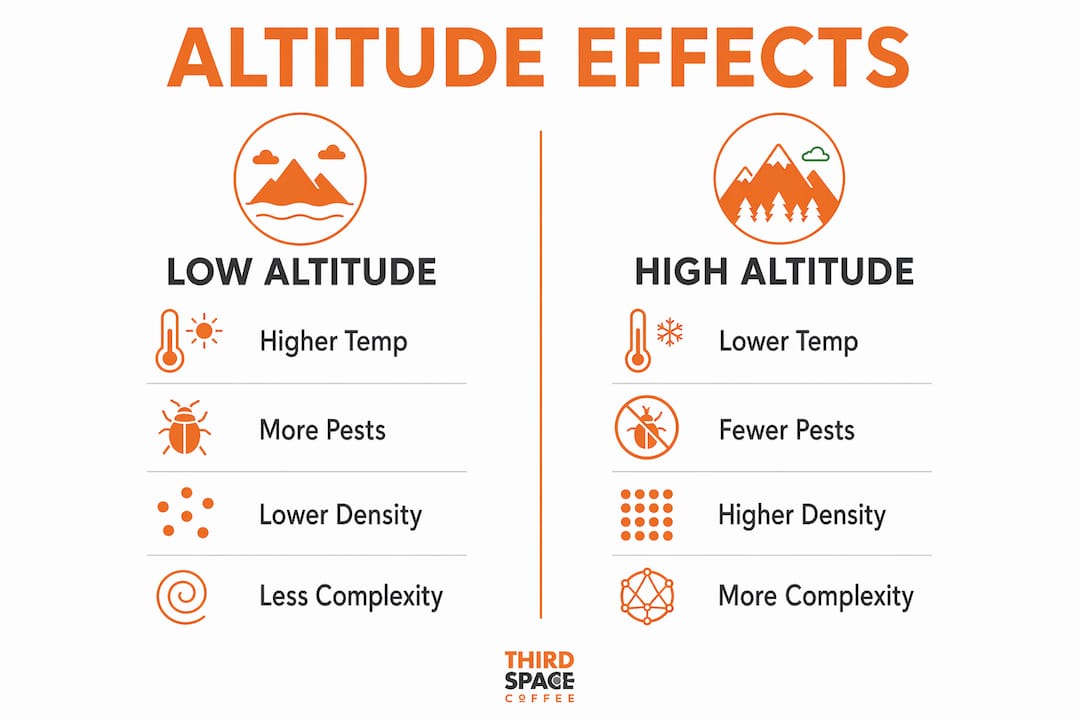
Reduced pest pressure at high altitudes has a direct economic benefit. Coffee berry borer (Hypothenemus hampei), the most destructive coffee pest globally, thrives in warmer, lower-elevation conditions. Farms above 1,500 MASL experience significantly lower infestation rates without chemical intervention. That reduction lowers production costs and supports organic certification pathways.
Pro Tip: Use a calibrated moisture meter alongside a bulk density test on your green beans. High-density beans from well-managed high-altitude farms will show consistent moisture levels between 10–12%. Wide variation in density within a single lot signals uneven maturation, regardless of the stated elevation.
High-altitude farming does carry real agronomic challenges. Steep terrain increases labor costs for harvesting and transport. Slower plant growth means longer time to first productive yield. Infrastructure for water and processing equipment is harder to establish at elevation. These costs are real, and growers should factor them into financial planning before expanding to higher plots.
Does altitude alone determine coffee quality?
Temperature is the primary driver of coffee quality. Altitude is a reliable proxy for temperature, but the two are not interchangeable. Experts confirm that the actual ambient temperature experienced by the plant determines maturation rate and chemical development. Altitude predicts temperature well in most equatorial regions, but that relationship shifts with latitude.
Hawaii illustrates this clearly. Coffee farms in Kona sit at elevations that would be classified as medium altitude in Colombia, yet they produce cup profiles associated with high-altitude growing. The reason is latitude. Hawaii's higher latitude means the same elevation produces cooler average temperatures than it would near the equator. Latitude modifies the effective growing climate at any given MASL, which is why growers cannot apply a universal altitude threshold across all origins.
Other factors that interact with altitude to shape final cup quality include:
- Soil composition: Volcanic soils at high altitude in regions like Ethiopia's Yirgacheffe or Guatemala's Huehuetenango add mineral complexity that elevation alone cannot replicate
- Shade cover: Tree canopy moderates temperature fluctuation at high altitudes, reducing frost risk and extending the maturation window further
- Coffee variety: Geisha, Bourbon, and Typica each respond differently to elevation; the same altitude produces different results depending on genetic variety
- Processing method: Washed processing preserves the bright acidity that high altitude develops; natural processing can mask or alter those characteristics
Experts caution against the "higher is always better" assumption. Success at high altitude requires the right combination of soil, variety, and processing alongside elevation. A poorly managed farm at 1,800 MASL will produce inferior coffee to a well-managed farm at 1,200 MASL. Altitude creates potential. Farming practice determines whether that potential is realized.
Practical steps for growers to use altitude data effectively
Growers who treat altitude as a starting point rather than a final answer make better cultivation decisions. These four steps translate elevation data into farm-level action.
-
Match altitude to your local climate profile. Before expanding to higher plots, map the actual temperature range at that elevation across all seasons. A site at 1,400 MASL in a frost-prone microclimate carries more risk than a site at 1,200 MASL with stable temperatures year-round.
-
Adjust fermentation temperature to complement elevation. Fermentation temperature can offset or amplify altitude's flavor effects. At higher elevations where ambient temperatures are already cool, controlled fermentation at slightly warmer temperatures preserves aromatic compounds that cold fermentation can suppress.
-
Avoid wide altitude ranges when sourcing or blending. Wide altitude ranges on packaging often indicate blended origins. Beans from 900 MASL and 1,800 MASL have different densities and require different roast profiles. Blending them produces uneven development in the roaster and inconsistent flavor in the cup.
-
Use bean density as a quality control checkpoint. Measure green bean bulk density at intake. Consistent high density confirms that the stated altitude and maturation claims are reflected in the physical bean. Low density on a supposedly high-altitude lot signals a problem worth investigating before roasting or export.
Understanding coffee quality factors at the farm level gives growers a direct line between cultivation decisions and the cup scores that determine market positioning.
Key Takeaways
Altitude in coffee growing is the single most predictive environmental variable for bean density, chemical complexity, and sensory quality, but it works best when combined with sound farming practice and processing control.
| Point | Details |
|---|---|
| Altitude defines quality potential | Beans above 1,200 MASL consistently show higher density, acidity, and sensory scores. |
| Temperature is the real driver | Altitude predicts temperature; latitude modifies that relationship across different regions. |
| Density signals maturation quality | Green bean bulk density correlates strongly with elevation and predicts roast consistency. |
| Altitude alone is not enough | Soil, variety, shade, and processing all determine whether altitude potential becomes cup quality. |
| Avoid wide altitude blends | Tight elevation ranges improve traceability, roast consistency, and flavor predictability. |
Altitude is a tool, not a guarantee
I have visited farms across a wide elevation range, and the ones that consistently produce exceptional coffee share one trait: the grower understands altitude as a condition to work with, not a credential to market. I have cupped coffees from 1,900 MASL that tasted flat and lifeless because the fermentation was mismanaged. I have also cupped coffees from 1,100 MASL that were extraordinary because the farmer understood their microclimate, their variety, and their processing window with precision.
The research on Panamanian Geisha is compelling, and the correlation between elevation and sensory scores is real. But correlation is not a farming strategy. What altitude gives you is a slower, cooler growing environment that creates the conditions for complexity. What you do with that environment, from harvest timing to drying method to fermentation control, determines whether those conditions produce a great cup or a wasted opportunity.
My honest recommendation for any grower considering higher-elevation expansion: spend a full growing season monitoring temperature, humidity, and pest pressure at the target elevation before planting. The data you collect will be more valuable than any general altitude guideline. Altitude is the starting point. Your farm management is the finish line.
— Tanya
Thirdspacecoffee and the altitude difference in every cup
Thirdspacecoffee in Colorado Springs sources and roasts whole bean coffees that reflect the real quality differences altitude creates. Every roast at Thirdspacecoffee starts with green beans selected for origin integrity, elevation traceability, and cup profile consistency.

Growers and enthusiasts who want to taste the altitude difference firsthand can order whole bean coffee directly from Thirdspacecoffee, roasted in-house and available for pickup. The specialty drinks menu showcases how high-altitude beans translate into complex, layered flavor in the cup. Whether you are researching origin characteristics or simply want to experience what elevation does to flavor, Thirdspacecoffee gives you a direct, local way to taste the science.
FAQ
What is the minimum altitude for high-altitude coffee?
High-altitude coffee is defined as grown at 1,200 MASL or above. Coffees meeting this threshold often carry the SHG or SHB certification label depending on the producing country.
Why do high-altitude coffees taste more acidic and complex?
Cooler temperatures at high elevations slow cherry maturation, allowing beans to accumulate more phenolic compounds, organic acids, and sugars. These compounds produce the bright acidity and layered flavor complexity associated with specialty-grade coffee.
Does higher altitude always mean better coffee?
Higher altitude creates favorable conditions for quality but does not guarantee it. Soil composition, coffee variety, shade management, and processing method all determine whether altitude potential translates into a high-scoring cup.
What does MASL mean on a coffee bag?
MASL stands for meters above sea level. It is the standard unit used to communicate the growing elevation of a coffee lot, giving buyers and roasters a reference point for expected bean density and flavor profile.
How does latitude affect altitude in coffee growing?
Latitude modifies the temperature at any given elevation. Farms at higher latitudes experience cooler temperatures at the same MASL compared to equatorial farms, which means the effective quality threshold shifts depending on geographic location.