
TL;DR:
- Direct trade coffee involves roasters purchasing directly from farmers and paying premiums based on quality. It emphasizes transparency, long-term relationships, and higher prices linked to cup quality, unlike Fair Trade. Consumers can verify genuine direct trade through disclosed farm names, FOB prices, and documented origin visits.
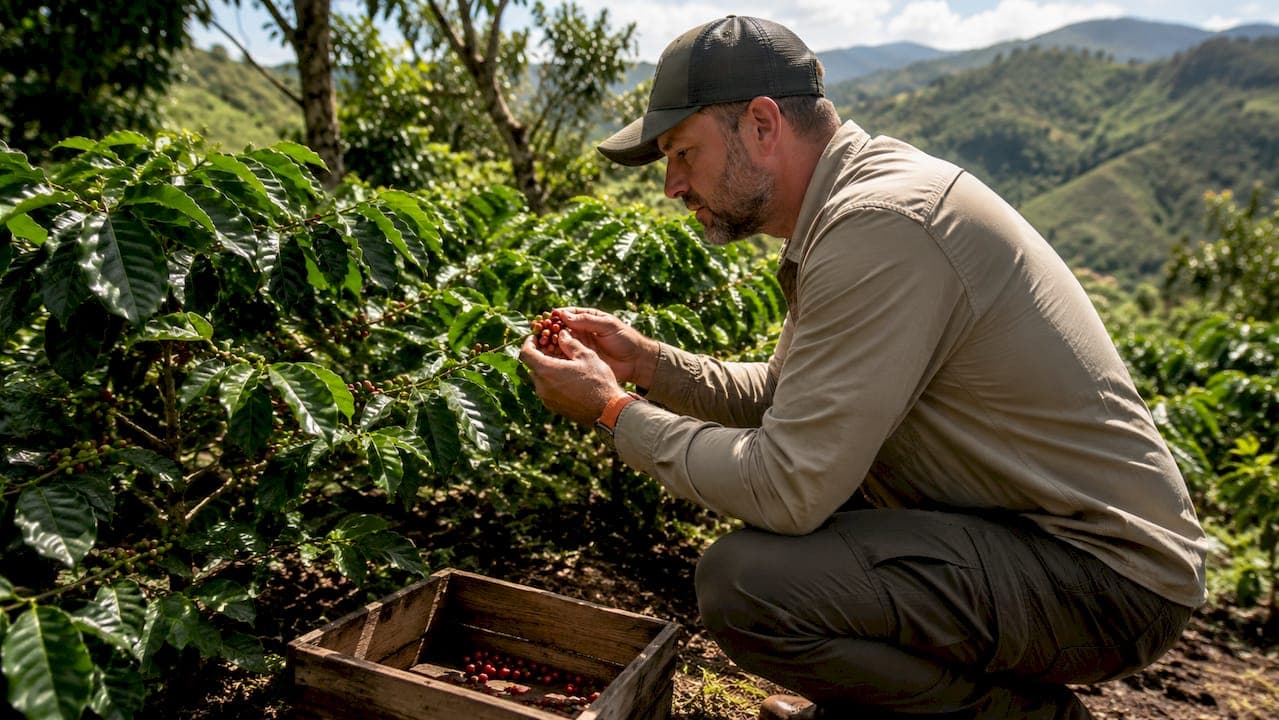
Direct trade coffee is defined as coffee purchased directly from producers by roasters, cutting out brokers, importers, and commodity markets to pay premium prices based on quality and build lasting relationships. This sourcing model has reshaped specialty coffee over the past two decades, shifting power and money closer to the farmers who grow the beans. Unlike Fair Trade, direct trade carries no official certification. Its credibility rests entirely on transparency, relationship depth, and the prices actually paid. If you want to understand why your bag of single-origin beans costs more and tastes better, direct trade coffee sourcing is the answer.
What is direct trade coffee and how does it work?
Direct trade is a sourcing model where a roaster identifies a farm, negotiates a price based on cup quality and production costs, and buys directly without a middleman. The roaster and farmer agree on terms face to face, often after the roaster visits the farm and cups the coffee on site. Premium prices range from $3.00 to $8.00 per pound FOB, with exceptional lots sometimes exceeding $15.00 to $50.00 per pound. That price range far exceeds what commodity markets or standard Fair Trade floors offer farmers.
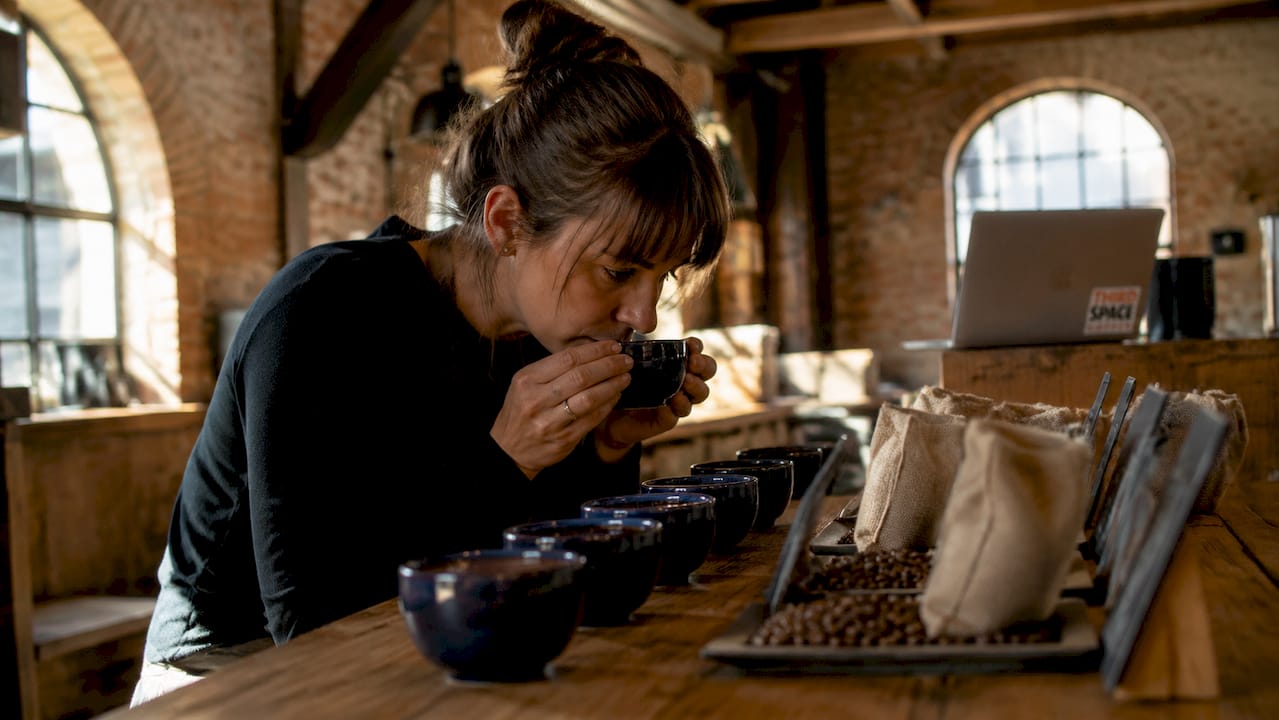
The term "direct trade" is informal. The specialty coffee industry uses it broadly, but there is no governing body that defines or enforces it. Credible programs distinguish themselves through transparent pricing disclosure, specific farm identification, and repeated purchasing commitments over multiple years. A roaster who names the farm, publishes what they paid, and returns season after season is practicing genuine direct trade. A roaster who simply skips an importer and slaps the label on a bag is not.
The Free on Board (FOB) price is the key metric to watch. FOB is the price paid at the point of export in the origin country, before shipping costs. When a roaster publishes their FOB price, you can compare it against commodity benchmarks and Fair Trade floors to judge whether the premium is real.
How does direct trade differ from Fair Trade?
Fair Trade certification sets a minimum price floor and requires producers to meet cooperative and labor standards. It provides a safety net for farmers but does not reward quality. Fair Trade certification offers a floor price and cooperative support but does not intrinsically reward coffee quality, unlike direct trade. A mediocre lot and an exceptional lot from the same cooperative receive the same Fair Trade price.
Direct trade flips that logic. Price is tied directly to quality. Established direct trade programs commit to paying at least 25% above Fair Trade prices and require annual roaster visits to partner producers. That premium is not charity. It reflects the actual value of a superior cup and creates a financial incentive for farmers to invest in better processing and harvesting.
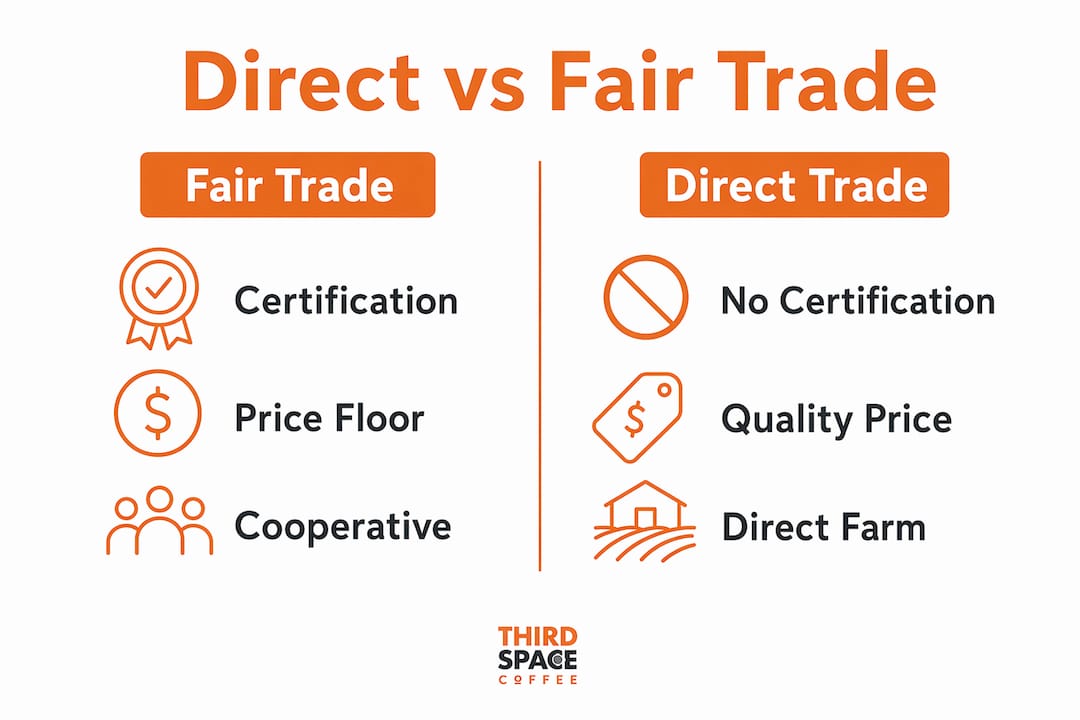
The table below summarizes the core differences between the two models.
| Feature | Fair Trade | Direct trade |
|---|---|---|
| Certification | Yes, third-party certified | No official certification |
| Pricing | Minimum floor price | Quality-linked premium |
| Relationship | Cooperative or regional | Individual farm or producer |
| Quality incentive | Low | High |
| Transparency | Standardized audit | Varies by roaster |
| Accountability | Certification body | Consumer and roaster |
Neither model is perfect. Fair Trade reaches more farmers through its cooperative structure. Direct trade reaches fewer farmers but pays more and demands higher quality. The two are not mutually exclusive. Some roasters combine both approaches depending on origin and producer scale.
What are the key benefits of direct trade coffee?
Direct trade creates advantages for every person in the supply chain, from the farmer to the person drinking the cup.
For farmers: Multi-year contracts and quality-linked pricing provide income stability that commodity markets cannot match. Farmers know what they will earn before harvest, which lets them plan investments in equipment, labor, and land. Ongoing feedback from roasters also helps farmers refine their processing methods, which raises quality and justifies higher prices in future seasons.
For roasters: Direct relationships give roasters supply consistency and full control over quality. They know exactly which farm produced the coffee, how it was processed, and what it scored on the cupping table. Direct trade is increasingly viewed as a strategic business asset, helping roasters manage volatile markets and build consumer loyalty through shared value creation.
For coffee enthusiasts: You get a better cup and a real story. Direct trade coffees carry specific origin information, cupping scores, and often the name of the farmer. That traceability is not marketing. It reflects a genuine chain of custody from farm to roaster to your grinder.
Pro Tip: Look for roasters who publish farm names, FOB prices paid, and trip reports from origin visits. Those three details together are the strongest signal that a direct trade claim is authentic.
Challenges exist alongside the benefits. Direct trade demands significant time and travel from roasters. Relationship maintenance across language barriers and time zones is not simple. Market volatility can strain even well-established partnerships. And because the model rewards quality, farmers who produce average coffee may not qualify, which limits its reach.
How can coffee lovers identify genuine direct trade coffee?
Identifying real direct trade coffee requires looking past the label and into the details a roaster chooses to share. Direct trade lacks legal definition or certification, so transparency is the key accountability measure for consumers. The label alone means nothing. The evidence behind it means everything.
Here is what to look for:
- Farm or producer name: A bag that says "Ethiopia Yirgacheffe" is a region. A bag that says "Dumerso Washing Station, Gedeo Zone, Ethiopia" is a specific source. Specificity signals authenticity.
- Published FOB price: Roasters committed to transparency post what they paid at origin. If that number is not available anywhere on the website or packaging, ask.
- Repeated purchases: A roaster buying from the same farm for three or more consecutive seasons has a real relationship. One-off purchases do not qualify as direct trade in any meaningful sense.
- Origin visit documentation: Trip reports, photos, and harvest updates from the farm are strong evidence of genuine engagement.
- Cupping scores: High-quality direct trade lots typically score 85 or above on the Specialty Coffee Association (SCA) 100-point scale. Quality and direct trade go together by definition.
Pro Tip: Visit the roaster's website and search for a "sourcing" or "transparency" page. Roasters who practice authentic direct trade almost always publish this information because it is a point of pride, not an afterthought.
Red flags include vague sourcing language like "ethically sourced" with no specifics, prices inconsistent with premium quality, and no mention of farm visits or producer relationships. Skepticism is warranted. The term is unregulated, and consumers should be skeptical of direct trade claims without transparency.
For a deeper look at how direct trade compares to certified models, the Fair Trade sourcing guide at Thirdspacecoffee covers the key distinctions in detail.
What challenges and limitations does direct trade face?
Direct trade is not a solution to every problem facing coffee farmers. Direct trade is not a silver bullet for social or environmental systemic issues. It rewards quality effectively but cannot address land tenure disputes, climate change, or infrastructure gaps on its own.
The absence of legal standards creates real inconsistency. One roaster's direct trade program may include annual farm visits, published prices, and multi-year contracts. Another roaster's program may simply mean they bought green coffee from an importer who claims to know the farmer. Both can legally use the same label.
High-quality focus also creates exclusion. Direct trade premiums flow to farms producing exceptional coffee. Smallholder farmers in regions with less favorable growing conditions or limited processing infrastructure may never qualify, regardless of their effort. The model concentrates benefits among already-capable producers.
Direct trade best rewards exceptional coffee quality but is limited by broader systemic challenges facing coffee farmers such as climate change and land tenure. Roasters who recognize this often combine direct trade with additional support, such as funding farm infrastructure, contributing to reforestation projects, or partnering with nonprofits working on farmer education.
The resource demand on roasters is also significant. Traveling to origin, cupping on site, and maintaining year-round communication requires budget and staff time that smaller roasters may not have. This is why direct trade tends to be concentrated among mid-size and larger specialty roasters with the capacity to sustain it.
How do direct trade relationships function in practice?
Successful direct trade roasters visit farms, cup coffee on-site, negotiate directly, and publish transparency documents. That process follows a consistent pattern across the industry.
The typical direct trade sourcing cycle moves through these stages:
| Stage | Activity | Purpose |
|---|---|---|
| Scouting | Identify farms with quality potential | Build a candidate list for relationship |
| Cupping at origin | Taste and score coffee lots on site | Confirm quality before committing |
| Price negotiation | Agree on FOB price based on quality and cost | Set fair, quality-linked compensation |
| Contract and purchase | Formalize multi-year buying commitment | Give farmers income predictability |
| Feedback loop | Share roasting and cupping notes with producers | Help farmers improve processing |
| Transparency reporting | Publish prices, farm names, and trip reports | Build consumer trust and accountability |
The typical direct trade purchasing process creates a feedback loop that improves coffee quality and farmer outcomes over time. A farmer who receives detailed feedback on their natural-process lot can adjust drying times or cherry selection in the next harvest. That improvement raises cup scores, which justifies a higher price in the following season.
Multi-year contracts are the backbone of the model. A single-season purchase is a transaction. A five-year purchasing commitment is a partnership. The difference matters enormously to a farmer deciding whether to invest in a new wet mill or hire additional pickers.
Understanding how this relationship model translates to the cup is part of what makes the retail coffee experience so meaningful for enthusiasts who care about origin.
Key Takeaways
Direct trade coffee is the most quality-focused sourcing model available, defined by premium prices, transparent relationships, and multi-year commitments between roasters and individual producers.
| Point | Details |
|---|---|
| No certification exists | Authenticity depends on published prices, farm names, and documented visits. |
| Premiums are quality-linked | Direct trade pays at least 25% above Fair Trade prices, tied to cup quality. |
| Transparency is the test | Look for FOB prices, farm-specific sourcing, and trip reports before trusting a label. |
| Benefits flow to all parties | Farmers earn more, roasters gain supply control, and enthusiasts get better coffee. |
| Limitations are real | Direct trade cannot fix systemic issues like climate change or land tenure alone. |
Direct trade is worth the scrutiny
I have spent years tasting coffees from roasters who claim direct trade and roasters who actually practice it. The difference shows up in the cup and in the conversation. When a roaster can tell you the name of the farmer, the elevation of the farm, and what they paid per pound, you are holding something real. When the bag says "ethically sourced" and the website says nothing else, you are holding a marketing decision.
What I find most compelling about direct trade is not the ethics. It is the quality logic. Paying more for better coffee creates a financial incentive for farmers to keep improving. That feedback loop, when it works, produces coffees that no commodity system can replicate. I have cupped Ethiopian naturals and Guatemalan washed lots from genuine direct trade programs that were simply in a different category from anything available through standard channels.
The challenge I see most often is roasters using the term loosely because there is no penalty for doing so. My advice is to treat "direct trade" the way you treat any unverified claim. Ask for the evidence. A roaster who practices it will be proud to share the details. One who does not will change the subject.
Direct trade has evolved from a values-driven project to a strategic business tactic, and that shift is mostly good news. When roasters see direct trade as a business advantage, they invest in it more seriously. The farmers who partner with those roasters benefit from that seriousness. Support the roasters who show their work.
— Tanya
Specialty coffee roasted with purpose at Thirdspacecoffee
Thirdspacecoffee in Colorado Springs roasts whole bean coffees in-house, sourcing with the same attention to origin and quality that direct trade principles demand. Every bag reflects a commitment to knowing where the coffee comes from and why it tastes the way it does.

If you want to taste the difference that quality-focused sourcing makes, the whole bean coffee selection at Thirdspacecoffee is a strong place to start. For something ready to drink, the specialty drinks menu brings that same sourcing philosophy into every cup. Order online for pickup or stop in at the Colorado Springs location to talk coffee with people who take it seriously.
FAQ
What does direct trade mean in coffee?
Direct trade means a roaster buys coffee directly from a producer, bypassing brokers and commodity markets, and pays a premium price based on cup quality and a direct relationship with the farmer.
How is direct trade different from Fair Trade?
Fair Trade sets a certified minimum price floor for cooperatives but does not reward quality. Direct trade pays quality-linked premiums, typically at least 25% above Fair Trade prices, and focuses on individual farm relationships rather than cooperative certification.
Is direct trade coffee certified?
Direct trade has no official certification or legal definition. Credible roasters demonstrate authenticity through published FOB prices, specific farm names, and documented origin visits rather than a third-party stamp.
Why should I choose direct trade coffee?
Direct trade coffee delivers higher cup quality, full origin traceability, and the knowledge that farmers received fair, quality-linked compensation. It also creates a feedback loop that improves coffee quality season over season.
How do I know if a direct trade claim is real?
Look for the farm name, the FOB price paid, and evidence of repeated purchases or origin visits. Roasters who practice genuine direct trade publish this information openly because transparency is the foundation of the model.