
TL;DR:
- Fair trade coffee guarantees farmers a minimum price and funds community development through social premiums. Certification ensures environmental standards and empowers smallholders via cooperative structures, providing price stability during market downturns. Consumers should verify the Fairtrade seal for authenticity, as fair trade enhances ethics and ecology but does not guarantee flavor quality.
Fair trade coffee is coffee certified to guarantee farmers a minimum price and ethical working conditions, protecting them from the volatility of global commodity markets. Fairtrade International, the primary certifying body, sets a floor price of $1.40 per pound for washed Arabica, plus a $0.20 social premium that funds schools, clinics, and infrastructure in farming communities. Organic-certified fair trade coffee earns an additional $0.30 per pound. Beyond the price structure, certification enforces environmental standards around soil health, water quality, and chemical use. The result is a supply chain designed to benefit farmers, communities, and ecosystems, not just roasters and retailers.
What is fair trade coffee and how does certification work?
Fairtrade International operates the most recognized certification system in the world, covering over 2 million farmers across approximately 80 countries. The system works through cooperatives. Farmers join democratically governed organizations that negotiate collectively, access credit, and share the costs of certification audits conducted by FLOCERT, Fairtrade's independent auditing arm. This cooperative structure is not just an administrative detail. It shifts bargaining power toward farmers who would otherwise sell individually to local middlemen at whatever price the market offers that week.
The certification process requires farms to meet standards across three categories: economic, social, and environmental. On the economic side, buyers must pay at least the Fairtrade minimum price regardless of where the commodity market sits. The social premium goes into a communal fund that farmers vote on how to spend. Environmental requirements include shade-growing practices, limits on synthetic pesticides and fertilizers, and active soil and water conservation measures.
| Standard category | Key requirement |
|---|---|
| Economic | Minimum price floor of $1.40/lb for washed Arabica |
| Social | $0.20/lb premium directed to community development fund |
| Environmental | Shade-growing, reduced chemicals, soil and water protection |
| Organic add-on | Additional $0.30/lb for certified organic production |
One real limitation: certification costs exclude many small independent farms that cannot afford the fees alone. This is why fair trade coffee is almost exclusively a cooperative product. Individual smallholders without cooperative membership rarely access the system.
Pro Tip: When you see "fair trade" on a bag, check for the official Fairtrade seal with the FLOCERT audit mark. The term itself is not legally protected, so the seal is the only reliable signal.
What are the benefits of fair trade coffee for farmers and communities?
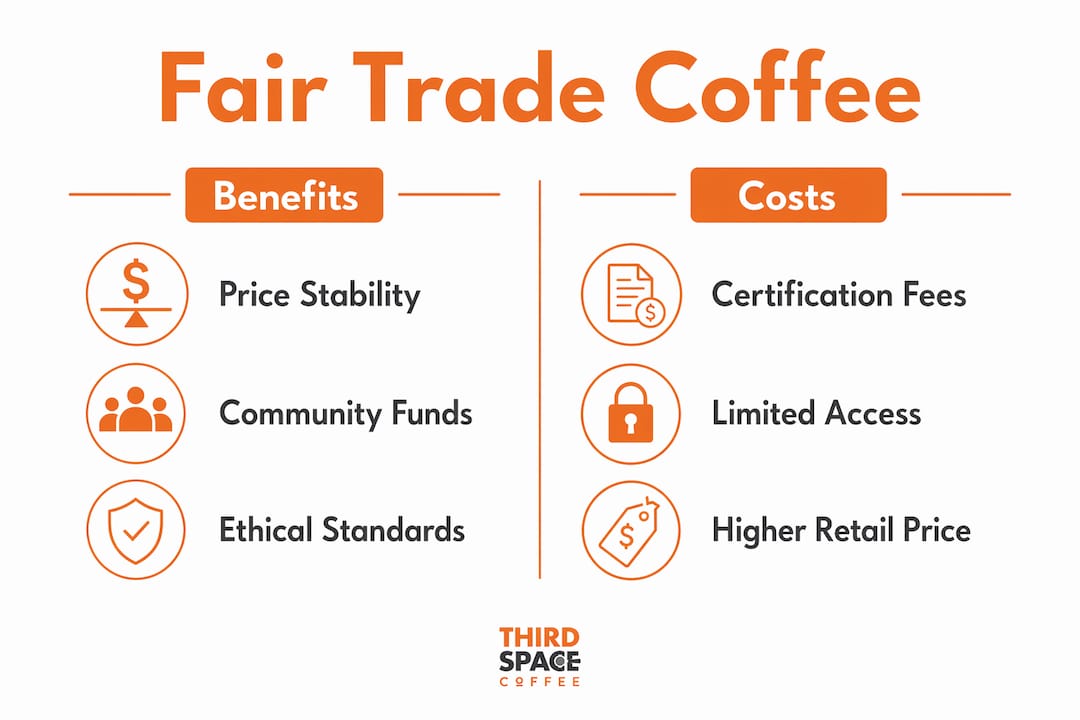
The most direct benefit fair trade delivers is price stability. When global coffee prices crash, as they did severely in the early 2000s, conventional farmers can receive less per pound than it costs to grow the crop. The Fairtrade floor price acts as insurance, keeping income above production costs even in the worst market conditions. This is not a theoretical benefit. It is the reason cooperatives in Colombia, Ethiopia, and Peru have remained financially viable through multiple commodity downturns.

The social premium creates a second layer of impact that goes beyond individual farm income. Communities vote on how to spend the fund, and the results are concrete: water filtration systems in rural Guatemala, school construction in Tanzania, and health clinics in Peru. Oxfam's research confirms that fair trade strengthens farmer organizations and improves credit access and bargaining conditions, even when direct per-household income gains remain modest.
Environmental benefits are measurable and significant. Shade-grown fair trade plantations support up to 95% more birdlife than conventional sun-grown operations. That figure reflects a genuine ecological difference. Shade canopy preserves habitat corridors, reduces erosion, and supports the pollinators that coffee plants depend on.
Key benefits worth understanding before you buy:
- Price floor protection guards farmers against commodity market crashes that can make growing coffee economically impossible
- Social premiums fund community infrastructure decided by farmers themselves, not external organizations
- Cooperative strengthening gives smallholders collective bargaining power they cannot achieve individually
- Environmental standards reduce chemical runoff and preserve biodiversity in some of the world's most ecologically sensitive regions
- Credit access improves for certified cooperatives, allowing investment in equipment and processing facilities
"Fair Trade should be viewed as a baseline ethical sourcing standard rather than a perfect solution; combining certifications with transparent supply chain practices benefits consumers and producers alike." — Adams & Russell
How does fair trade coffee compare to direct trade and organic?
Fair trade and direct trade are frequently confused, but they operate on fundamentally different models. Fair trade is a formal third-party certification with audited standards and a price floor. Direct trade is a sourcing philosophy with no standardized definition, no certifying body, and no guaranteed minimum price. A roaster can call their coffee "direct trade" after a single farm visit or after a decade of deep partnership. The label itself tells you nothing without additional transparency from the roaster.
The focus differs as well. Fair trade prioritizes social standards and market access for smallholder cooperatives. Direct trade prioritizes quality and relationship, with specialty roasters paying premiums that often exceed the Fairtrade minimum, but only for exceptional lots. A farmer producing average-quality coffee has no path into direct trade. Fair trade, by contrast, sets a floor for all certified cooperative members regardless of cup score.
| Feature | Fair trade | Direct trade | Organic |
|---|---|---|---|
| Third-party certification | Yes (FLOCERT) | No | Yes (USDA or equivalent) |
| Price guarantee | Yes ($1.40/lb floor) | No | No |
| Focus | Social equity and market access | Quality and producer relationship | Agricultural and environmental practices |
| Who benefits most | Smallholder cooperatives | High-quality specialty producers | Environmentally focused farms |
| Can they overlap? | Yes | Yes | Yes |
Organic certification focuses entirely on agricultural practices: no synthetic pesticides, no GMOs, and documented soil management. It says nothing about what the farmer was paid. A coffee can be certified organic and sourced through exploitative labor practices simultaneously. Many fair trade coffees are also organic, earning that additional $0.30 per pound premium, but the certifications address different problems.
Pro Tip: Look for bags that carry both the Fairtrade seal and a USDA Organic certification. That combination signals both ethical sourcing and clean agricultural practices, and the farmer receives a higher combined premium for both.
Why is fair trade coffee more expensive and is it worth it?
Fair trade coffee costs more at retail for three compounding reasons. First, the guaranteed minimum price and social premium are built into every transaction, raising the base cost of green coffee before roasting begins. Second, FLOCERT auditing and certification compliance add administrative costs that cooperatives pass through the supply chain. Third, the cooperative model itself, while empowering for farmers, adds organizational layers that conventional commodity sourcing bypasses entirely.
Whether the premium is worth it depends on what you are buying. Consider these realities:
- Fair trade does not guarantee cup quality. Certification rewards ethical sourcing, not flavor. A fair trade-certified farm producing mediocre beans receives the same minimum price as one producing exceptional lots. If taste is your primary criterion, fair trade alone is not sufficient guidance.
- The price floor functions as insurance. When commodity prices fall below $1.40 per pound, fair trade farmers are protected. You are partly paying for that stability, which keeps farming communities viable long-term.
- Social premiums create compounding community value. The $0.20 per pound premium sounds small, but across an entire cooperative's annual harvest, it funds meaningful infrastructure that no individual farmer could finance alone.
- Conventional coffee's low price has a real cost. The gap between fair trade and conventional retail prices often reflects costs that conventional supply chains externalize onto farmers, their families, and their land.
The honest answer is that fair trade coffee is worth the premium if you care about supply chain ethics and community development. It is not the right tool if your primary goal is finding the highest-quality specialty coffee, where direct trade relationships at transparent roasters often deliver better results.
How can you identify authentic fair trade coffee when buying?
The single most reliable signal is the official Fairtrade seal, a blue and green logo administered by Fairtrade International and audited by FLOCERT. The term "fair trade" is not legally protected, which means any brand can print it on packaging without meeting any standard. Only the certified seal guarantees that the coffee was purchased at or above the minimum price from an audited cooperative.
Practical steps for buying fair trade coffee with confidence:
- Check for the FLOCERT-audited Fairtrade seal, not just the words "fair trade" or "fairly traded" in the brand's own font
- Read the roaster's sourcing page. Transparent roasters name the cooperatives they buy from, the country of origin, and the price paid above the floor
- Avoid vague ethical claims like "farmer-friendly" or "ethically sourced" without certification backing. These phrases carry no enforceable meaning
- Cross-reference with Fairtrade International's producer database, which lists certified cooperatives by country and product
- Consider the roaster's overall transparency. A roaster that explains coffee shop hospitality and sourcing practices openly is more likely to take certification seriously than one that treats it as a marketing checkbox
The specialty coffee world has moved toward greater supply chain transparency in recent years, and the best roasters now publish detailed sourcing reports. Fair trade certification is a strong baseline, but a roaster who combines the seal with published cooperative relationships and quality scores gives you the most complete picture.
Key takeaways
Fair trade coffee is a certified sourcing system that guarantees farmers a minimum price, funds community development through social premiums, and enforces environmental standards, making it the most structured ethical baseline available in the coffee market.
| Point | Details |
|---|---|
| Certified price floor | Fairtrade International guarantees $1.40/lb for washed Arabica, protecting farmers from market crashes. |
| Social premium impact | The $0.20/lb premium funds community-voted projects like schools, clinics, and water systems. |
| Cooperative structure | Certification works through cooperatives, giving smallholders collective bargaining power they lack individually. |
| Quality is not guaranteed | Fair trade certifies ethics, not flavor. Combine it with roaster transparency for the best results. |
| Seal verification matters | Only the FLOCERT-audited Fairtrade seal confirms authenticity. The words alone carry no legal weight. |
Why fair trade is a floor, not a ceiling
I have spent years tasting coffees from certified fair trade cooperatives alongside direct trade lots from the same regions, and the honest takeaway is this: fair trade is the most important baseline the coffee industry has, but it is not the finish line. The certification protects millions of farmers from the worst outcomes of commodity market volatility, and that matters enormously. But it does not reward the farmer who spent three years perfecting a natural process lot that scores 90 points. That farmer needs a direct trade relationship with a roaster who pays for quality.
What I tell people who ask me where to start is simple. Look for the Fairtrade seal as your ethical floor. Then look for roasters who go further, publishing cooperative names, harvest years, and prices paid above the minimum. Those two things together, certification plus transparency, give you a supply chain you can actually trust. Fair trade alone is better than nothing. Fair trade combined with a roaster who treats sourcing as a community-building practice is where the real value lives.
The environmental benefits are also underappreciated. Shade-grown certification requirements preserve habitat in regions like Ethiopia's Yirgacheffe and Colombia's Sierra Nevada that are genuinely irreplaceable. Every bag you buy from a certified cooperative is a small vote for keeping those forests intact. That is not marketing language. It is ecology.
— Tanya
Explore ethically sourced coffee at Thirdspacecoffee
Thirdspacecoffee in Colorado Springs roasts whole bean coffee in-house, sourcing with the kind of care that makes certification meaningful rather than decorative. If this article has you thinking more carefully about where your coffee comes from, the next step is straightforward.

Browse Thirdspacecoffee's selection of freshly roasted whole bean coffees, sourced from ethical supply chains and roasted on-site for maximum freshness. For something ready to drink, the specialty drinks menu showcases what thoughtfully sourced coffee actually tastes like in the cup. Stop in at the Colorado Springs location or order online for front-of-store pickup. Good coffee and good sourcing are not mutually exclusive, and Thirdspacecoffee proves it with every roast.
FAQ
What is the fair trade coffee definition in simple terms?
Fair trade coffee is coffee purchased from certified farmer cooperatives at a guaranteed minimum price, currently $1.40 per pound for washed Arabica, with an additional social premium that funds community development. The certification is managed by Fairtrade International and audited by FLOCERT.
Does fair trade coffee taste better than regular coffee?
Fair trade certification does not guarantee superior flavor. It certifies ethical sourcing and minimum pricing, not cup quality. Some fair trade coffees are exceptional, but the certification alone is not a reliable indicator of taste.
How is fair trade coffee different from direct trade?
Fair trade is a formal third-party certification with a price floor and audited standards. Direct trade is an unregulated sourcing model where roasters buy directly from farms, often paying higher premiums for quality, but with no standardized definition or minimum price guarantee.
Is the "fair trade" label on coffee packaging always trustworthy?
No. The term "fair trade" is unprotected and any brand can use it without certification. Only the official Fairtrade seal, verified by FLOCERT audits, confirms that the coffee meets certified standards.
Where can I buy fair trade coffee in Colorado Springs?
Thirdspacecoffee in Colorado Springs carries ethically sourced whole bean coffees roasted in-house. You can browse their selection online and pick up your order at the front of the store.