

TL;DR:
- Coffee tasting notes are natural compounds in beans shaped by origin, processing, and roasting, not added flavors. Understanding the five core attributes—aroma, acidity, body, sweetness, and aftertaste—along with the Flavor Wheel enhances your ability to identify and describe coffee flavors accurately. Practicing structured tasting techniques and comparing different profiles deepens your appreciation and skill in recognizing the subtle complexities of each cup.
You pick up a bag of specialty coffee and read "notes of dried cherry, dark chocolate, and jasmine." You sniff it. Smells like coffee. You brew it. It tastes like coffee. So what are those notes really about? Explaining coffee tasting notes is less about magic vocabulary and more about understanding that those flavors are actually in the bean. They are not added, not marketing fluff. Tasting notes reflect natural compounds developed through farming, processing, and roasting. Once you know how to look for them, your cup never tastes the same way again.
Table of Contents
- Key takeaways
- Explaining coffee tasting notes: the five core attributes
- How to use the Coffee Taster's Flavor Wheel
- What shapes the notes in your cup
- Practical techniques for tasting like a pro
- My honest take on the tasting notes journey
- Taste the difference at Thirdspacecoffee
- FAQ
Key takeaways
| Point | Details |
|---|---|
| Notes are natural, not added | Tasting notes describe compounds already present in the bean, shaped by origin and process. |
| Five core attributes form any profile | Aroma, acidity, body, sweetness, and aftertaste work together to define every cup. |
| The Flavor Wheel builds your vocabulary | Start broad with categories like "fruity," then move outward to specific descriptors like "lemon." |
| Origin and roast drive flavor | Where and how a coffee is grown and roasted determines which notes you will actually taste. |
| Temperature unlocks different notes | Tasting at multiple temperatures reveals layers of flavor that disappear when coffee is too hot. |
Explaining coffee tasting notes: the five core attributes
Before you can identify a specific note like "blood orange" or "brown sugar," you need a framework for what you are actually measuring. These five sensory attributes form the foundation of every professional coffee evaluation: aroma, acidity, body, sweetness, and aftertaste. Each one tells you something different about the cup.
Aroma is what you smell before and after brewing. Dry grounds often reveal stone fruit or nutty characteristics. Once hot water hits the coffee, volatile compounds bloom and you get a second, richer wave of fragrance. Ignore aroma and you are missing roughly half the flavor experience, because smell and taste are deeply connected.
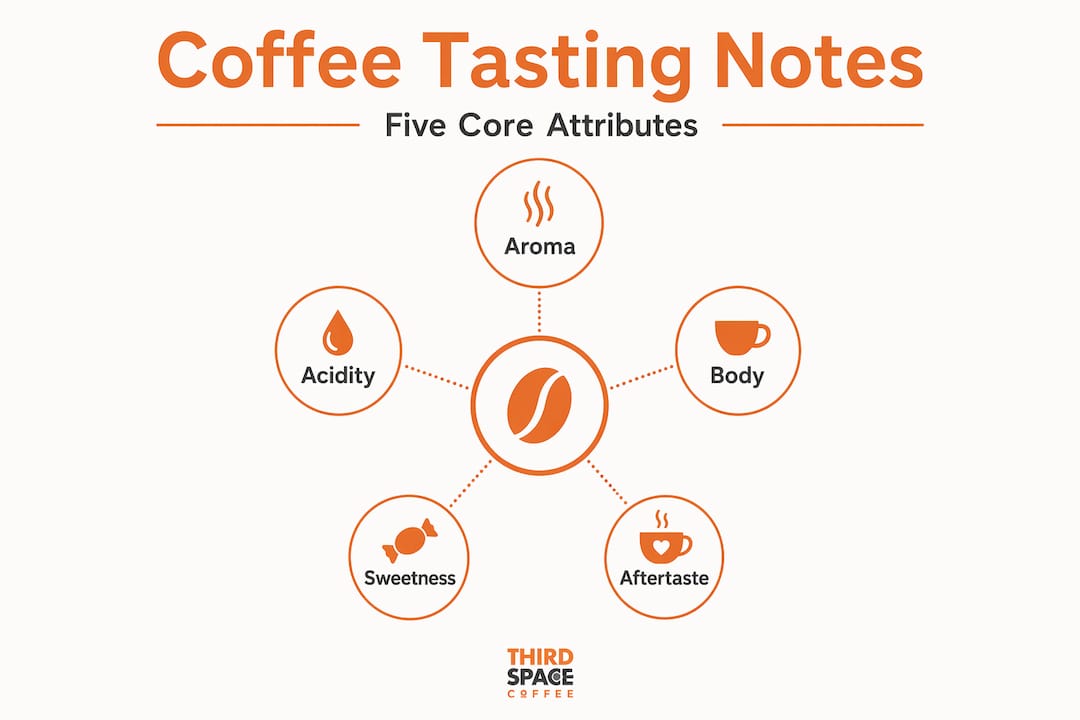
Acidity does not mean sour or unpleasant. It refers to a brightness or liveliness in the cup. Citric acidity reads as lemony and sharp. Malic acidity (common in Ethiopian beans) reminds many tasters of green apple or stone fruit. Phosphoric acidity, found in some Kenyan coffees, has an almost grape-like quality. Different acids create entirely different tasting experiences.
Body is the weight of the coffee on your tongue, what coffee people call mouthfeel. A light-bodied coffee feels clean, almost tea-like. A heavy-bodied coffee coats your mouth, similar to whole milk versus skim. Processing method and roast level both influence this significantly.
Sweetness is the natural sugar perception that softens and balances the other attributes. A well-balanced cup has sweetness that keeps acidity from feeling harsh and prevents bitterness from taking over. It is a sign of quality, not the absence of complexity.
Aftertaste is what lingers after you swallow. Clean, long, or complex aftertastes indicate quality. A short or unpleasant finish can signal over-roasting or a processing defect.
Pro Tip: Smell your dry grounds before brewing and again immediately after adding water. The shift in aroma is dramatic and gives you early clues about what flavor notes to look for when you taste.
How to use the Coffee Taster's Flavor Wheel
The Coffee Taster's Flavor Wheel is one of the most practical tools in specialty coffee, and it works equally well for beginners and experienced tasters. The wheel organizes tasting notes across three rings, moving from broad categories at the center outward to increasingly specific descriptors.
The inner ring gives you large flavor families: fruity, floral, sweet, nutty, spicy, roasted, and others. The middle ring breaks those down. "Fruity" splits into citrus fruit, dried fruit, berry, and more. The outer ring gets precise. "Berry" becomes "blackberry," "raspberry," "blueberry," or "strawberry." This layered structure is what makes the wheel so useful. You do not need to land on "raspberry" immediately. Starting with "fruity" is a perfectly valid first step.
Here is how the wheel compares to just guessing on your own:
| Approach | What you get | What you miss |
|---|---|---|
| Guessing without structure | Vague impressions like "fruity" or "smooth" | Specific notes that could improve your brewing or sourcing |
| Using the Flavor Wheel | Clear, shared coffee tasting terminology | Nothing. You gain precision and vocabulary simultaneously |
| Professional cupping protocol | Systematic attribute scoring | Accessible to beginners with a little preparation |
When you sit down with a cup, start at the center of the wheel and work outward. Your first impression might be "sweet." Then you ask: what kind of sweet? Brown sugar? Honey? Vanilla? Each question moves you one ring further out. Over time, this becomes second nature.
Pro Tip: Print or pull up a digital version of the Flavor Wheel before tasting. Even having it nearby without consulting it constantly trains your brain to organize flavor impressions into categories rather than vague feelings.
What shapes the notes in your cup
Reading coffee tasting notes on a bag makes a lot more sense once you understand why they exist. Three factors drive flavor above everything else: where the coffee was grown, how it was processed after harvest, and how dark it was roasted.
Origin gives coffee its foundational character. Ethiopian coffees are famous for floral and berry notes, often with wine-like complexity. Colombian beans tend toward caramel sweetness and mild citrus. Sumatran coffees lean earthy and full-bodied with herbal undertones. Origin and processing interact constantly, which is why the same variety grown in two different countries can taste completely different.
Processing methods affect how much fruit character survives into your cup:
- Washed (wet) process removes the fruit cherry before drying, producing cleaner, brighter cups where origin flavors shine clearly. Expect higher perceived acidity.
- Natural (dry) process dries the bean inside the fruit, allowing sugars to absorb into the seed. The result is bolder, sometimes wilder fruity notes. Natural process coffees tend to present intense blueberry or tropical fruit characteristics.
- Honey process sits between the two, removing some but not all of the fruit, creating a balance of sweetness and brightness that many tasters love.
Roast level is the final transformation. Light roasts preserve the origin flavors and tend to show brighter acidity, florals, and fruity notes. Dark roasts develop roast-driven characteristics: chocolate, caramel, smoky, or bitter notes that replace more delicate flavors. Understanding how roasting transforms flavor is the missing link between reading a tasting note and actually tasting it.
The next time you see "washed Ethiopian light roast: jasmine and lemon," you now know exactly why those words are there.
Practical techniques for tasting like a pro
Most people taste coffee the same way every day: drink it hot, decide if it is good or bad, and move on. That approach will never reveal tasting notes. Here is a sequence that actually works.
- Smell the dry grounds. Before brewing, put your nose close to the grounds and inhale slowly. This is your first data point. You might detect cocoa, fruit, or something earthy before the water is even boiling.
- Smell the brew immediately. The moment hot water contacts coffee, volatile aromatic compounds release fast. Take a slow breath directly above your mug or French press. This is when floral and fruit notes are most pronounced.
- Taste at a high temperature first. Hot coffee emphasizes acidity and brightness. You will notice sharpness, citrus, or green notes more clearly here.
- Taste again as it cools. As coffee cools, sweet and complex aromatic notes become more prominent. What seemed like a simple coffee at 160°F often reveals caramel, berry, or chocolate at 120°F. This is not imaginary. Temperature physically affects how your taste receptors respond.
- Note the aftertaste. After swallowing, wait ten seconds. Is the finish clean and quick? Lingering and sweet? Bitter or drying? That tells you a lot about roast quality and bean health.
- Compare two cups side by side. Nothing trains your palate faster than comparison. Brew a washed coffee and a natural process coffee simultaneously. The contrast makes individual characteristics far more obvious.
Using real food references like lemon peel, blueberry jam, or dark chocolate squares alongside your coffee is not pretentious. It is calibration. Your brain needs anchors to recognize flavors reliably.
Pro Tip: Avoid discussing tasting notes with others until you have each formed your own impressions. Group influence is real, and one confident voice saying "definitely chocolate" can shut down what you were just starting to identify as "dried cherry."
A common mistake beginners make is tasting too hot. Burning temperatures mask sweetness and make everything taste sharp. Give the cup three to four minutes before your serious evaluation starts.
My honest take on the tasting notes journey
I remember the first time I sat down with a specialty coffee and genuinely tried to find the tasting notes on the bag. I tasted coffee. Just coffee. I felt like I was missing something obvious that everyone else could apparently detect.
What changed for me was not a sudden leap in palate sensitivity. It was building a habit of structured tasting. The Flavor Wheel became less of a reference chart and more of a diagnostic tool. When something tasted off, I could identify whether the problem was acidity, bitterness in the aftertaste, or a flat body. That feedback loop made me a better brewer, not just a better taster.
I have also come to believe that the coffee industry is genuinely expanding how we think about flavor. Broader species recognition is driving new flavor wheels that capture profiles previously ignored. That matters because it means our vocabulary is still growing.
My honest advice: stop trying to taste everything at once. Pick one attribute per session. Spend a week focused only on acidity. Then move to sweetness. The coffee tasting guide approach of building skills incrementally beats trying to be a full expert in a single sitting. Embrace the process. Your palate is trainable, and that is genuinely exciting.
— Tanya
Taste the difference at Thirdspacecoffee
Understanding coffee tasting notes is most rewarding when you have great coffee to practice with. At Thirdspacecoffee in Colorado Springs, every coffee is roasted in-house, and the flavor profiles are not guesswork. They are built intentionally, from bean selection to roast curve.

If you want to put your new sensory skills to work, start with our whole bean coffee selection. Each offering comes with clear flavor descriptors so you know exactly what you are looking for before the first sip. Prefer something ready to drink? Our specialty drinks give you expertly crafted cups that showcase specific flavor profiles, from bright and fruity to rich and chocolatey. And for those building a daily tasting practice, our drip coffee options are an approachable, affordable way to taste something new every week. Come in, order ahead for pickup, or just browse what is available. Good coffee and clear tasting notes make the learning process far more enjoyable.
FAQ
What are coffee tasting notes?
Coffee tasting notes are natural flavor descriptors that reflect compounds present in the bean, developed through origin, processing, and roasting. They are not added ingredients. They are characteristics you can learn to detect with practice.
How do I start reading coffee tasting notes?
Begin with the five core attributes: aroma, acidity, body, sweetness, and aftertaste. Then use the Coffee Taster's Flavor Wheel to match your impressions to specific descriptors, starting broad and working toward more precise language.
Why do tasting notes differ between roast levels?
Light roasts preserve origin-driven flavors like fruit and florals, while dark roasts develop roast-driven characteristics like chocolate and caramel. Roast level fundamentally changes which compounds dominate the flavor profile.
Can beginners really taste the notes on a coffee bag?
Yes, with practice. Coffee flavor appreciation improves by moving beyond "good or bad" judgments and learning to isolate individual attributes. Using physical flavor references and tasting at different temperatures accelerates this process significantly.
What is the Coffee Taster's Flavor Wheel?
It is a structured sensory tool that organizes coffee flavors from broad categories in the center to specific descriptors on the outer ring. It helps tasters build a shared vocabulary and communicate coffee notes precisely rather than relying on vague terms.