
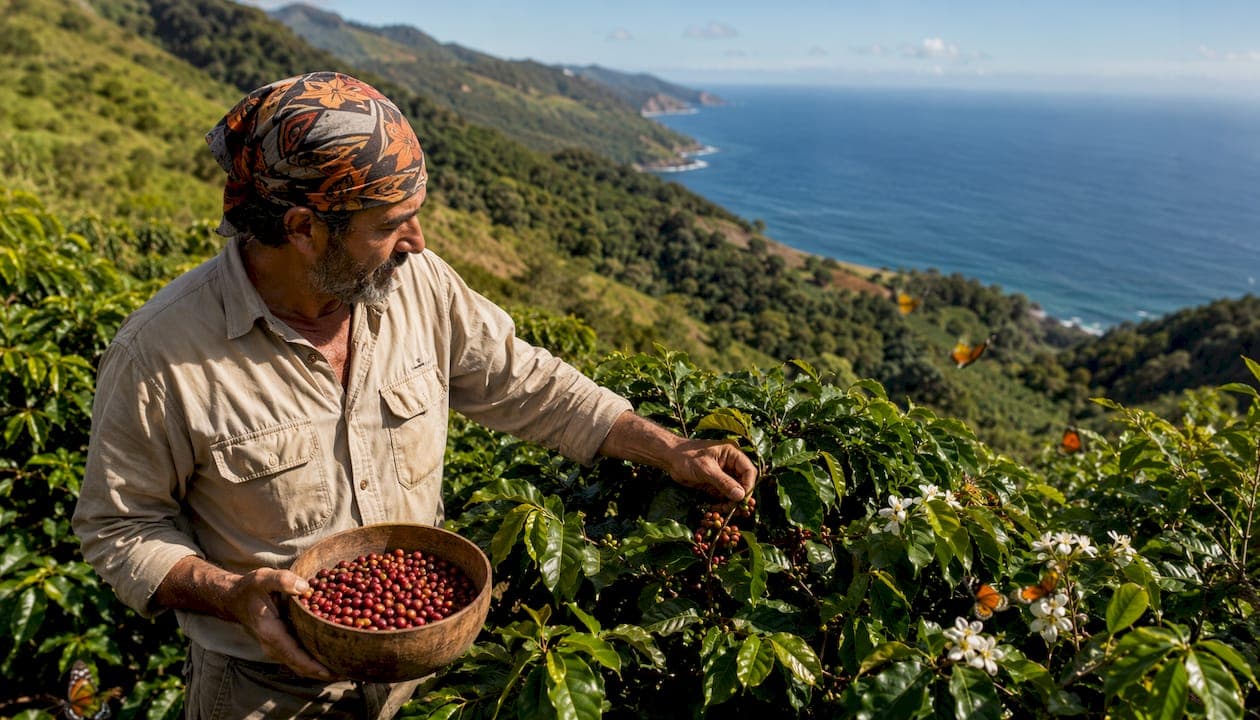
Shade-grown coffee is coffee cultivated beneath a canopy of trees in an agroforestry system, rather than in open, full-sun monoculture fields. Three things matter most about it: the canopy dramatically supports biodiversity (birds, mammals, soil organisms), slower cherry maturation under shade can deepen flavor complexity, and farmers typically trade lower annual yields for reduced input costs and potential specialty-market premiums. If you want to verify a shade-grown claim on a bag, look for the Bird Friendly® seal from the Smithsonian Migratory Bird Center or the Rainforest Alliance certification — those are the most reliable third-party checks available.
Table of Contents
- What shade grown coffee actually is, and how it differs from full-sun farming
- The shade spectrum: rustic, polyculture, and partial shade systems
- How shade-grown systems affect biodiversity, soil, and climate
- How shade changes what ends up in your cup
- How to verify shade-grown claims when you're shopping
- Limitations, trade-offs, and what "shade-grown" doesn't guarantee
- What the research actually says about shade-grown coffee
- How you can support shade-grown coffee right now
- Key Takeaways
- Why shade-grown sourcing matters more than the label
- Authoritative sources and further reading
What shade grown coffee actually is, and how it differs from full-sun farming
Full-sun coffee is exactly what it sounds like: rows of coffee shrubs in cleared fields, maximizing light exposure and yield per hectare. Shade-grown systems do the opposite, placing coffee beneath a multi-layer canopy of native or planted trees that filter sunlight, moderate temperature, and drop organic matter onto the soil below.
That canopy does real work. It buffers the microclimate against temperature swings, which matters more as climate volatility increases. Leaf litter from shade trees feeds soil organisms, reducing the need for synthetic fertilizers. The tree structure also provides habitat for birds and predatory insects that suppress coffee pests naturally, which is why shade systems reduce the need for synthetic pesticides compared to intensively managed full-sun farms.
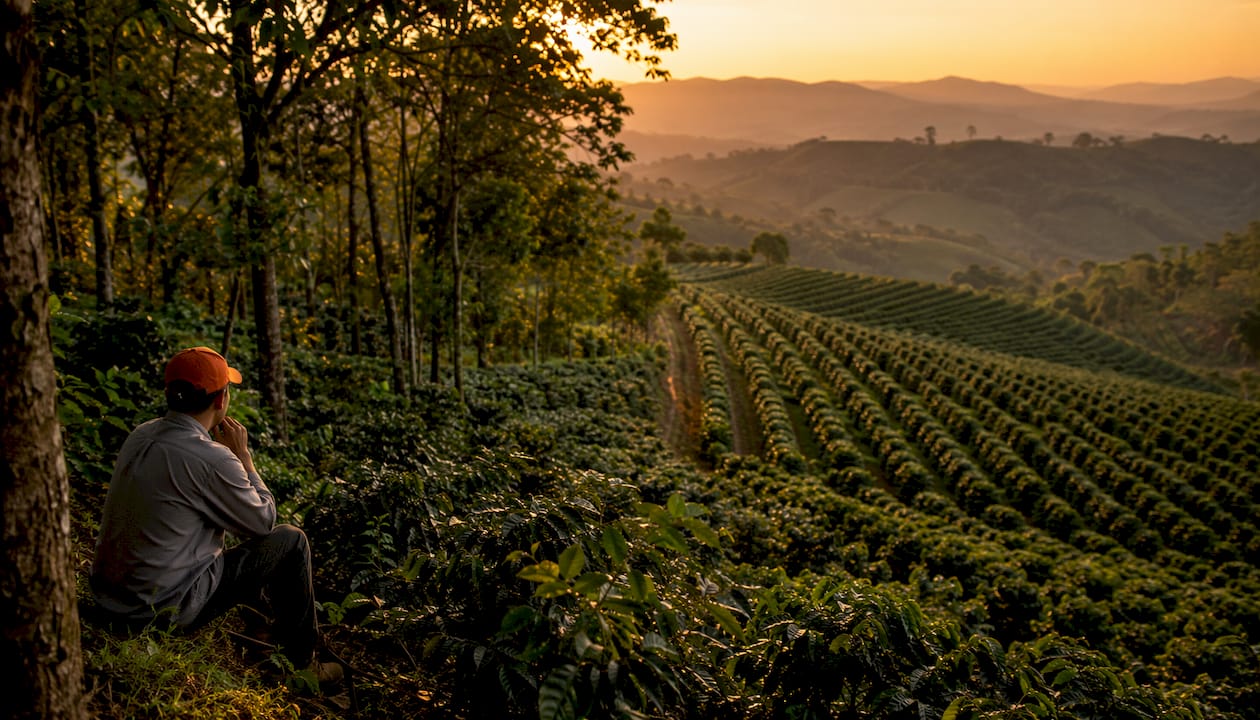
Picture it this way: a full-sun farm looks like a vineyard, open and uniform. A well-managed shade farm looks more like a forest with coffee growing in the understory, multiple tree species overhead, and a layered canopy from ground level up to the tallest emergent trees.
The shade spectrum: rustic, polyculture, and partial shade systems
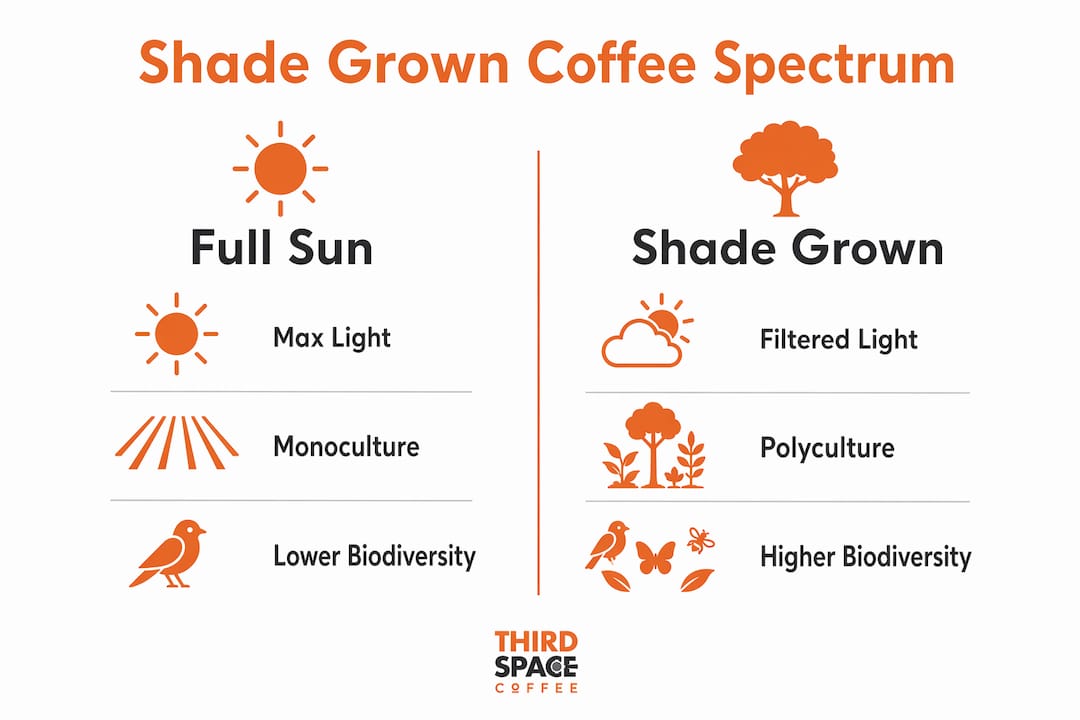
"Shade-grown" is not a single thing. It covers a spectrum from near-forest conditions to modest canopy cover, and the ecological value varies enormously across that range.
Rustic/forest understory systems are the most ecologically intact. Farmers clear minimal vegetation and plant coffee directly beneath existing forest. Tree diversity is high, canopy cover is dense, and the farm functions close to a natural forest ecosystem.
- Very high biodiversity value; closest to natural habitat
- Lowest yields; hardest to scale commercially
- Minimal inputs required; long shrub lifespan
Traditional polyculture / multistrata systems use a planned mix of shade trees, often including fruit trees, timber species, and nitrogen-fixing legumes alongside coffee. This is the most common form of shade farming in Latin America.
- High tree diversity; strong habitat value
- Moderate yields; farmers benefit from multiple income streams (fruit, timber)
- Requires more management than rustic systems but remains input-light
Shaded monoculture / partial shade systems use a single species of shade tree, often planted in rows, over coffee. Canopy cover is lower and tree diversity is minimal.
- Moderate biodiversity benefit; better than full sun, but far below polyculture
- Higher yields than denser systems; easier to manage mechanically
- Often what "shade-grown" on a label means without further specification
Commercial agroforestry blends managed shade with productivity targets, sometimes certified, sometimes not. The ecological value depends entirely on canopy density and tree species diversity.
Pro Tip: When evaluating a "shade-grown" claim, ask specifically how many tree species are in the canopy and what percentage cover they provide. A single row of banana plants over coffee is technically shade but delivers a fraction of the ecological benefit of a multistrata system.
How shade-grown systems affect biodiversity, soil, and climate
The ecological benefits of well-managed shade systems are well-documented. High-shade farms support migratory and resident bird populations, soil stability, and water retention at levels that full-sun monocultures simply cannot match.
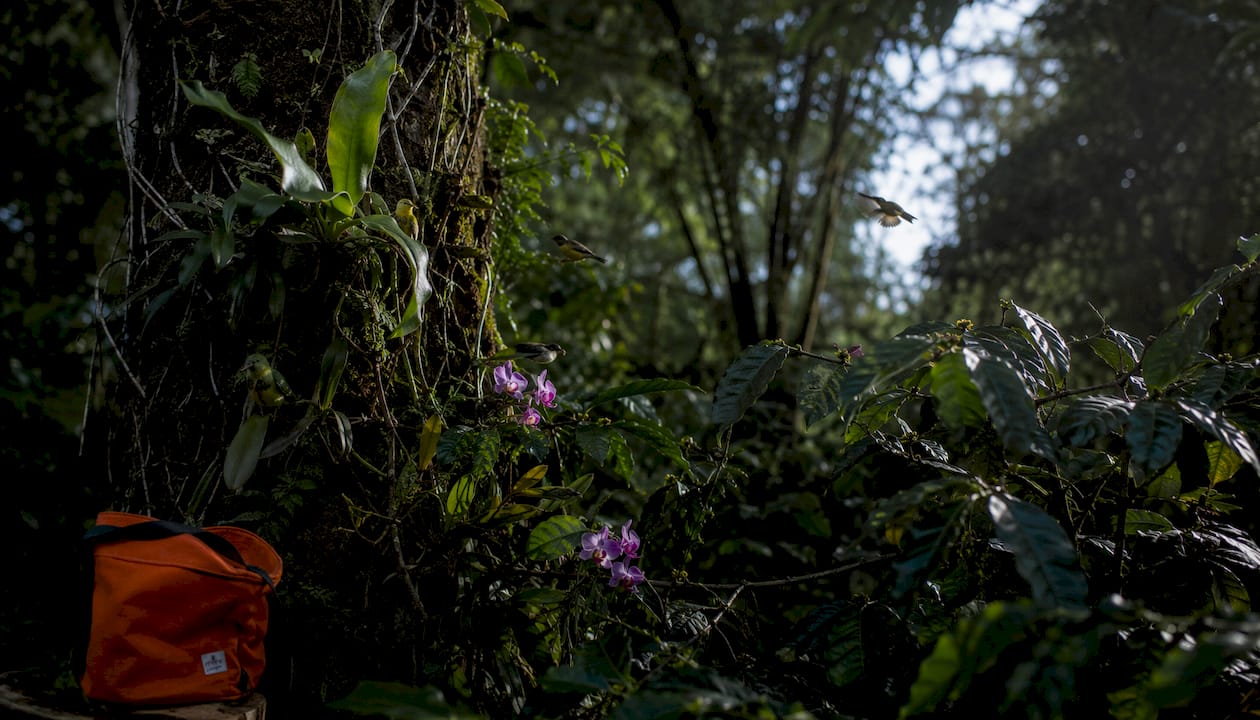
A meta-analysis of 69 studies found that species diversity of birds, mammals, and epiphytes is generally higher in high-shade systems than in low-shade or full-sun systems. That finding holds across most regions, though some exceptions exist (more on that in the research section below).
Beyond biodiversity, shade agroforestry functions as a nature-based climate solution: the canopy buffers soil temperature, reduces evaporation, and sequesters carbon in tree biomass and soil organic matter.
| Ecosystem service | Full-sun monoculture | High-shade agroforestry |
|---|---|---|
| Bird species diversity | Low | High |
| Soil erosion risk | High | Low |
| Carbon sequestration | Minimal | Significant |
| Synthetic input dependency | High | Reduced |
| Water retention | Poor | Strong |
Globally, roughly 25% of coffee land is managed under diverse shade, 35% under partial shade, and 40% under full-sun conditions. That means the majority of the world's coffee still grows in systems with limited ecological function.
How shade changes what ends up in your cup
Shade often favors slower cherry maturation, and that slower development is where the flavor story starts. Under a dense canopy, reduced light intensity slows the ripening process, giving the coffee cherry more time to develop sugars and aromatic precursors inside the bean.
Common flavor characteristics associated with shade-grown coffee:
- Greater acidity complexity: slower maturation tends to preserve and develop organic acids that contribute brightness and nuance
- Larger bean size: extended development time often produces denser, larger seeds
- Sweetness and body: more time for sugar accumulation can translate to a fuller, rounder cup
- Aromatic depth: longer development of volatile aromatic compounds
That said, shade is one variable among many. Processing method, harvest timing, variety, altitude, and roasting technique all shape the final cup. A shade-grown bean that is picked underripe or roasted carelessly will not taste better than a well-managed full-sun lot. Shade creates potential; everything downstream determines whether that potential is realized.
How to verify shade-grown claims when you're shopping
Third-party certification is the most reliable verification method. Two certifications stand out.
- Bird Friendly® (Smithsonian Migratory Bird Center): The most stringent shade-grown standard available. Farms must meet specific canopy cover thresholds, minimum tree height requirements, and tree species diversity criteria. Meeting Bird Friendly standards means the farm provides habitat conditions closest to natural forest. It also requires organic certification as a baseline.
- Rainforest Alliance: Covers broader sustainability criteria including labor standards, water use, and ecosystem protection. Shade requirements exist but are less specific than Bird Friendly. A Rainforest Alliance seal signals a meaningful commitment to sustainability, though not necessarily the same habitat quality as Bird Friendly.
A practical checklist for buyers:
- Look for the Bird Friendly® or Rainforest Alliance seal on the bag
- Ask your roaster which farm or cooperative the coffee comes from
- Ask whether the roaster has visited the farm or has direct producer relationships
- Request information on canopy structure: how many tree species, what percentage cover
- Check whether the roaster publishes sourcing transparency on their website
Red flags to watch for:
- "Shade-grown" on the label with no certification and no farm-level information
- A single species of shade tree used as a marketing claim
- No traceability beyond the country of origin
Certifications vary in rigor, and the Bird Friendly seal remains the gold standard for habitat quality specifically. Other labels address sustainability more broadly, so checking the criteria behind any logo is worth the extra minute.
Limitations, trade-offs, and what "shade-grown" doesn't guarantee
Shade-grown farming involves real trade-offs, and the label carries some common misconceptions worth addressing directly.
Key trade-offs for farmers:
- Lower annual yields per hectare compared to intensive full-sun systems
- Higher labor demands for managing shade trees (pruning, species selection, canopy maintenance)
- Disease dynamics can be complex: shade affects humidity levels, which influences coffee leaf rust pressure differently by region
Common myths:
- "Shade-grown means no pesticides." Not automatically. Certification requirements vary; only Bird Friendly requires organic certification as a prerequisite.
- "Shade-grown equals better quality." Shade creates conditions that can support quality, but harvest and processing decisions matter just as much.
- "All shade is equal." A single banana tree over a coffee row is not ecologically equivalent to a multistrata forest system.
On the economic side, well-managed shade systems can improve long-term farm productivity through longer shrub lifespan and reduced input costs. Specialty-market premiums can offset lower yields, but that depends on market access, certification costs, and whether a roaster is actually paying a premium rather than just marketing the term. For smallholder farmers without access to specialty buyers, the economics are harder to make work.
What the research actually says about shade-grown coffee
The scientific consensus is reasonably clear: high-shade systems deliver measurably better biodiversity outcomes than full-sun systems across most studied regions. The 69-study meta-analysis is the strongest single piece of evidence, showing consistent gains in bird, mammal, and epiphyte diversity under high-shade conditions.
Geographic nuance matters, though. Some studies in parts of Africa show higher species abundance in less-shaded systems, likely reflecting differences in the surrounding landscape context and what species are present locally. This doesn't undermine the general finding; it means management recommendations should be tailored to regional ecology rather than applied as a universal prescription.
Research gaps remain in two areas: how shade systems interact with specific coffee diseases (particularly leaf rust under changing climate conditions), and how to breed coffee varieties that perform well agronomically in agroforestry systems without sacrificing yield too severely.
"Shade agroforestry is increasingly recognized as a nature-based strategy that can simultaneously address biodiversity loss, climate resilience, and long-term farm productivity — though its adoption depends on market incentives, technical support, and regional context." — Frontiers in Sustainable Food Systems
| Evidence source | Key finding |
|---|---|
| Meta-analysis, 69 studies | Higher bird, mammal, and epiphyte diversity in high-shade vs. full-sun systems |
| Global land-use data | 25% diverse shade / 35% partial shade / 40% full sun |
| Frontiers review | Shade buffers microclimate; supports carbon sequestration and climate resilience |
| Springer physiological study | Slower maturation under shade linked to greater sugar and aromatic compound development |
For readers who want to go deeper, the sustainable coffee supply chain review published in PMC covers agroecology transitions and governance dimensions across global coffee systems.
How you can support shade-grown coffee right now
Three immediate actions make the most difference:
- Buy certified when possible. A Bird Friendly® or Rainforest Alliance seal means a third party has verified the claim. No seal, no verification.
- Ask your roaster for traceability. A roaster who can name the farm, the region, and the farming system is one who has done the sourcing work. Vague "origin" information is a signal to dig deeper.
- Pay the premium willingly. Shade-grown coffee from certified farms often costs more. That price difference reflects real costs: lower yields, certification fees, and (ideally) a premium paid to the farmer.
Questions worth asking at your coffee shop or when ordering online:
- Is this coffee certified shade-grown, and by which organization?
- Does your roaster have a direct relationship with the producer?
- What shade system does the farm use — rustic, polyculture, or partial shade?
- Does the farm price reflect a premium paid to the grower?
Beyond purchasing, supporting roasters who publish sourcing transparency and attend origin trips matters. Local roaster events, cuppings, and educational sessions are also places where local coffee sourcing conversations happen in real time. If you work in hospitality or foodservice, integrating certified shade-grown coffee into your program is one of the more concrete sustainability commitments an operator can make.
Key Takeaways
Shade-grown coffee is an agroforestry method that supports measurable ecological benefits and can improve cup complexity, but it is not a single standard or a quality guarantee on its own.
| Point | Details |
|---|---|
| Core definition | Coffee grown beneath a tree canopy (agroforestry), not in open full-sun monoculture fields. |
| Biodiversity impact | A meta-analysis of 69 studies found higher bird, mammal, and epiphyte diversity in high-shade systems. |
| Global land use | 25% of coffee land is managed under diverse shade, 35% under partial shade, and 40% under full-sun conditions. |
| Flavor mechanism | Slower cherry maturation under shade allows greater sugar and aromatic compound development. |
| Best verification | Bird Friendly® certification (Smithsonian) is the most stringent shade-grown standard available. |
Why shade-grown sourcing matters more than the label
Most coffee drinkers encounter "shade-grown" as a marketing phrase before they encounter it as a farming reality. The gap between those two things is where the real conversation starts.
What strikes me most about the research is how clearly it separates shade as a spectrum from shade as a binary claim. A bag labeled shade-grown could represent a rustic forest system with 40 tree species overhead, or it could represent a single row of planted trees over a monoculture. Both are technically accurate. Neither tells you the same story about what happened on that farm.
The Bird Friendly® certification exists precisely because that ambiguity is a problem. It sets specific thresholds for canopy cover and tree diversity because those details are what actually drive the biodiversity outcomes the research documents. Without them, "shade-grown" is a description, not a commitment.
At Thirdspacecoffee, sourcing decisions connect directly to what ends up in the cup and what story we can honestly tell customers about where their coffee came from. Roasters who pay premiums to shade-farming producers, who can name the farm and describe the canopy, are the ones making the label mean something. That's the standard worth holding the industry to — not just the presence of trees, but the depth of the relationship behind them.
Authoritative sources and further reading
- Bird Friendly® certification and ecological benefits — Smithsonian's National Zoo and Conservation Biology Institute: Start here for the certification criteria and a clear summary of habitat benefits.
- Meta-analysis of 69 studies on shade and biodiversity — Oxford Brookes University: The strongest single evidence base for biodiversity outcomes across shade systems.
- Shade-grown coffee and farmer economics — Root Capital: Covers the yield trade-offs, premium dynamics, and land-use statistics cited in this article.
- Shaded coffee as a nature-based climate strategy — Frontiers in Sustainable Food Systems: Best source for the climate resilience and carbon sequestration arguments.
- Shade-grown coffee and ecosystem services — Columbia Climate School: Accessible overview of how shade systems reduce synthetic input dependency.
- Sustainable coffee supply chain governance — PMC: For readers who want the broader policy and agroecology context behind shade-farming adoption.