
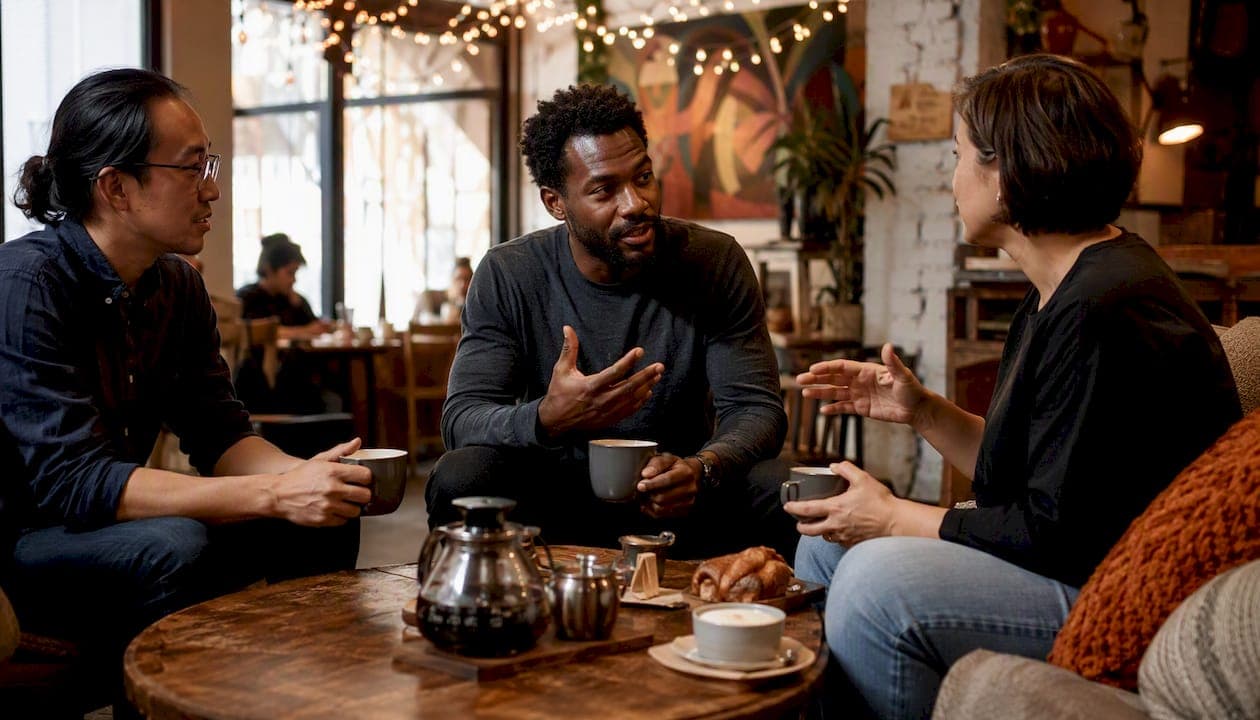
A coffee-and-stories experience is a short, coffee-centered gathering where people share real or fictional stories in an informal setting. Formats range from open-mic nights and guided story circles to curated readings and live podcast tapings. If you want to get started right now, here are three moves:
- Search Eventbrite, Meetup, or your city's community calendar for "storytelling night [your city]" or "coffeehouse open mic."
- Contact a local café directly, like Thirdspacecoffee in Colorado Springs, to ask about event availability or booking.
- Host a small get-together yourself: invite four to six people, pick a prompt, and let the coffee do the rest.
The sections below cover where to find events, how to run one from scratch, what to expect as a first-time attendee, and how Thirdspacecoffee operates as a working model.
Key Takeaways
Coffee-and-stories experiences work because the coffee ritual lowers social barriers, and the right venue and format turn a one-time gathering into a recurring community.
| Point | Details |
|---|---|
| What the format is | Short, coffee-centered gatherings where people share real or staged stories; open-mic, story circle, curated reading, or podcast taping. |
| Where to find events | Search Meetup, Eventbrite, local café calendars, and library program guides using "storytelling night [city]" or "coffeehouse open mic." |
| Hosting starter steps | Book space 3–4 weeks out, seed your sign-up list with anchor storytellers, assign three roles (emcee, timekeeper, tech), and follow up within 48 hours. |
| Attendee etiquette | Order a drink, respect time limits, follow the host's recording policy, and know that listening without performing is always welcome. |
| Thirdspacecoffee | Colorado Springs venue with in-house roasting, specialty drinks, and event space for up to 150 guests, bookable via the contact page. |
Table of Contents
- What do coffee and stories events actually look like?
- Why coffee and storytelling work so well together
- Where can you find coffee + storytelling events near you?
- How to host a coffee-and-stories night step by step
- What should you expect as a first-time attendee?
- How to choose the right venue for your event
- Thirdspacecoffee as a local model for story-driven events
- The one thing most hosts get wrong
- What a well-run story night actually produces
- Thirdspacecoffee is where Colorado Springs story nights happen
- Sources
What do coffee and stories events actually look like?
The format matters more than most organizers realize. A poorly structured evening feels like a meeting. A well-structured one feels like a gathering people talk about for weeks.
The most common formats in the U.S. fall into four categories:
A typical session runs: doors open and guests order (15 minutes), a brief welcome and ground rules (5 minutes), the main program of stories (30–60 minutes), then an informal hangout where the real conversations happen. That last stretch, the unstructured part after the program, is where repeat attendees are made.
Toshikazu Kawaguchi's Tales from the Cafe captures exactly this dynamic in fiction: a café where coffee anchors memory and every conversation carries the weight of something unfinished. The Pan Macmillan and Harlequin editions of the book have both reinforced how deeply the café-as-story-space trope resonates in popular culture. Real events work the same way: the physical ritual of ordering and holding a warm cup lowers the emotional stakes of sharing.
Why coffee and storytelling work so well together
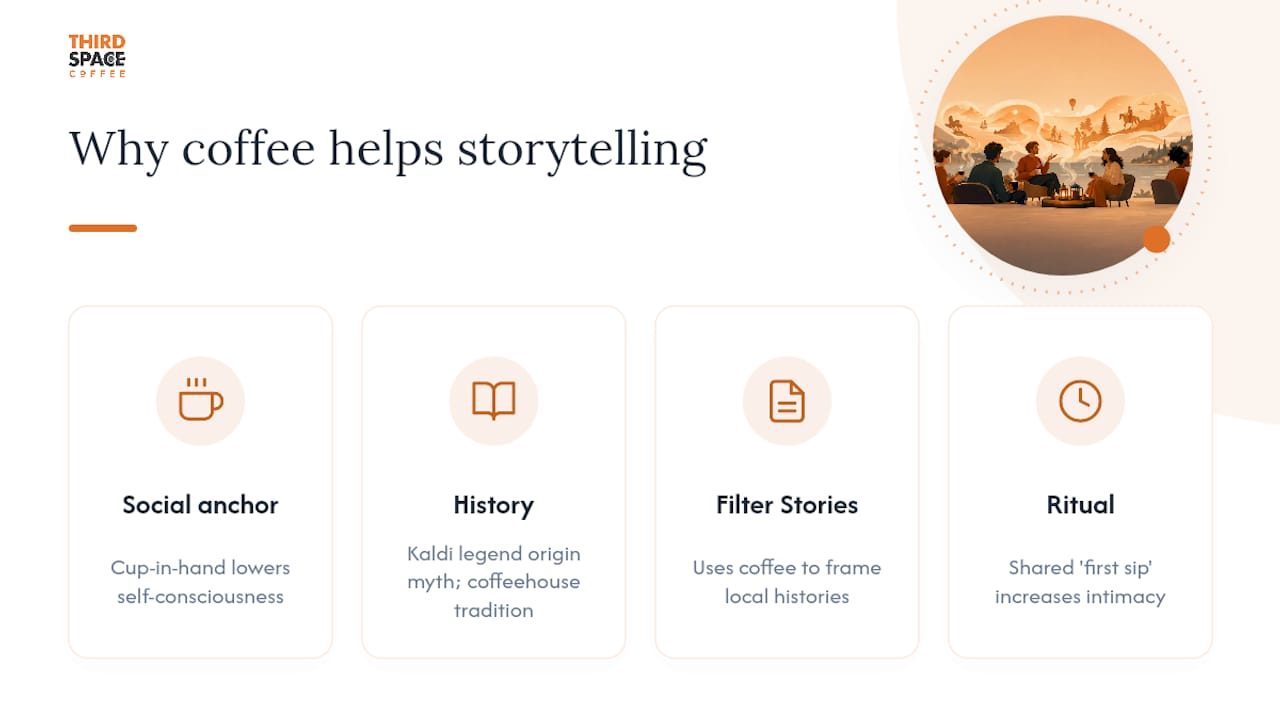
Coffee functions as a low-stakes social anchor. Holding a cup gives people something to do with their hands, which reduces self-consciousness. The act of ordering creates a natural entry point into a space, and the ambient warmth of a café signals "stay awhile" in a way that a conference room simply does not.
The history of coffee is itself a story. The Kaldi legend, in which an Ethiopian goatherd noticed his goats dancing after eating coffee berries, is one of the oldest origin myths in food culture. Coffeehouses in 17th-century Europe were called "penny universities" because for the price of a cup, anyone could sit and join the conversation. That tradition of coffee as a gathering ritual for talk and ideas runs directly into what modern storytelling events are trying to recreate.
Projects like the Filter Stories Podcast demonstrate how narrative media uses coffee and local histories to build place-based storytelling. Their long-form interviews show that when coffee is the frame, people open up about place, memory, and identity in ways that feel natural rather than performed.
Pro Tip: Design the coffee ritual into the program itself. Open the evening with a shared "first sip" moment, a brief pause where everyone takes their first drink together before the first story begins. Hosts who treat this as part of the program report that it increases perceived intimacy and gets the room to settle faster than any verbal cue.
Two practical takeaways: design for intimacy (smaller rooms, circular seating, soft lighting) and make the coffee part of the ritual rather than just the backdrop.
Where can you find coffee + storytelling events near you?
The best channels, roughly in order of reliability:
Local coffee-shop event calendars. Many independent cafés post monthly event schedules on their websites or Instagram. Search the café's name plus "events" or check their bio link.
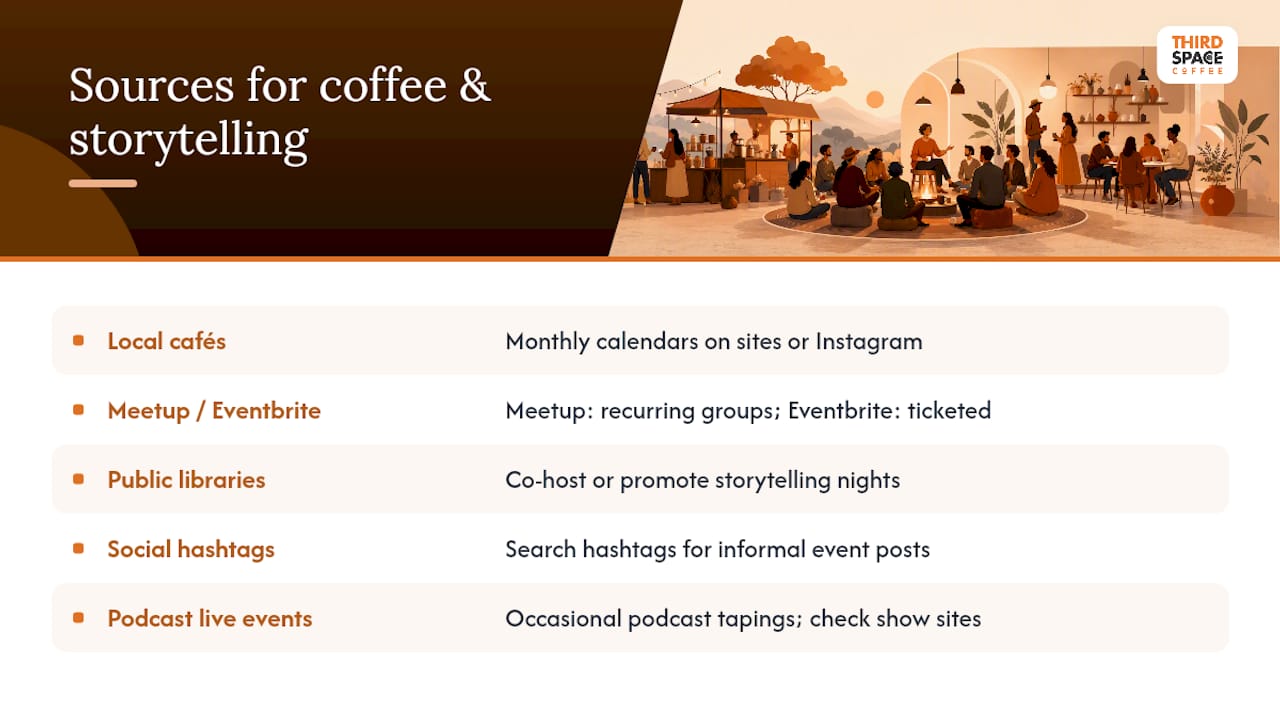
Meetup and Eventbrite. Search "storytelling [your city]," "coffeehouse open mic," or "story circle [your city]." Eventbrite tends to surface ticketed performances; Meetup surfaces recurring community groups.
Public library program guides. Libraries frequently co-host or promote storytelling nights, especially those tied to local author events or oral history projects.
Social media hashtags. #StorytellingSeries, #CoffeehouseOpenMic, and #[YourCity]Stories pull up event announcements that never make it to formal listings.
Podcast live events. Narrative podcasts occasionally tape episodes in front of live café audiences. Check show websites and their social feeds for tour dates.
When reading a listing, a few keywords signal a low-key community night: "free," "drop-in," "no experience necessary," "bring a story or just listen." A ticketed performance with named headliners is a different animal, closer to a theater show than a community gathering. Both are worth attending, but they call for different expectations.
Projects like Coffee Cup Tales show how local author communities often organize around café conversations, making independent bookshops and specialty coffee shops natural hubs for finding these events.
How to host a coffee-and-stories night step by step
The core workflow is simple: book a space, pick a format, recruit storytellers, promote, run the evening, follow up. What separates a one-time event from a recurring series is the follow-up.
- Book your space at least three to four weeks out. Confirm capacity, AV availability, and whether the venue has a minimum spend or room fee. For a first event, aim for a room that holds 20–40 people comfortably.
- Pick a format and set a story length limit. Five minutes per story is the standard for open-mic nights. Themed circles work better with 8–10 minute slots and a shared prompt.
- Recruit three to five anchor storytellers before you open sign-ups. A blank sign-up sheet is intimidating. Seed it with two or three names so newcomers see they are joining something, not starting it.
- Set a clear prompt or theme. "A time you were completely wrong" or "the best meal you ever had" generates better stories than "share anything."
- Assign roles: host/emcee, timekeeper, and tech/sound. One person cannot do all three well. The emcee needs to be present with the audience, not watching a clock.
- Promote two to three weeks out across Instagram, Meetup, Eventbrite, and any local Facebook community groups. A social media strategy built around community rather than broadcast gets more RSVPs.
- Choose a cost model. Donation-based works for first events and builds goodwill. A $5–$10 cover charge covers room fees and signals that the event has value. Tiered ticketing (general admission vs. reserved seating) suits larger, curated performances.
- Run a soundcheck 30 minutes before doors open. A microphone that cuts out mid-story kills the mood faster than anything else.
- Follow up within 48 hours. Email or post a recap, thank your storytellers by name, and announce the next date. Repeat attendance is built in this window.
For a deeper operational checklist, the community coffee workshop workflow covers logistics that apply directly to storytelling nights.
What should you expect as a first-time attendee?
Arrive, order your drink, and find a seat. That is the whole entry sequence. Nobody expects you to perform.
Most events have a sign-up sheet near the door or bar for people who want to share a story. Signing up is always optional. Plenty of regulars have attended a dozen events without ever taking the mic, and hosts welcome them just as warmly.
A few etiquette points worth knowing before you walk in:
- Respect time limits. If the host says five minutes, five minutes is the contract. Running long is the fastest way to lose the room's goodwill.
- Supportive listening is the norm. Applause, laughter, and the occasional "mm-hmm" are all welcome. Cross-talk, phone calls, and loud side conversations are not.
- Recording norms vary. Some hosts ask that no one record stories without the teller's permission. Follow whatever the host announces at the top of the evening.
- Order something. When an event is hosted in a café, buying a drink is how you support the space that made the event possible. It is also just good manners.
For first-time storytellers: pick a story that fits in three minutes, not five. Practice it once out loud before the event. Choose something personal but not raw, something you have already processed enough to tell with some lightness. The room is rooting for you.
How to choose the right venue for your event
Not every café is built for storytelling. Here is what to check before you commit:
- Capacity: Does the space hold your expected headcount without feeling cramped or cavernous? Both extremes hurt the intimacy of the evening.
- Hours and setup time: Can you access the space 45–60 minutes before the event starts for soundcheck and seating?
- Food and drink service: Will the café serve during the event, or do you need to pre-order? A running espresso machine during quiet stories is a problem.
- AV availability: Is there a PA system, a microphone, and a way to connect a laptop if you need music or slides?
- Seating flexibility: Can chairs be rearranged into a circle or theater configuration? Fixed booth seating is a dealbreaker for story circles.
- Noise levels: Is there a street-facing window that lets in traffic noise? Is there a neighboring bar with a sound system?
- Permit and insurance basics: For ticketed events, confirm whether the venue's insurance covers your gathering or whether you need a one-day event policy.
When you contact a venue, ask these questions directly: What is the room capacity? What is the setup and teardown window? Is there a room fee, a minimum spend, or both? What AV equipment is on-site? What is the deposit and cancellation policy?
Balancing community goals with venue revenue is a real tension. Off-peak slots (Sunday afternoons, Tuesday evenings) usually come with lower minimums and more flexibility. A venue that prioritizes hospitality over pure throughput will be a better long-term partner than one that treats your event as a table-turn problem.
Pro Tip: For creative event spaces outside your immediate area, The Slate Space in Rhode Island is a useful model for how a dedicated creative venue structures bookings, minimums, and community programming, even if you are not in their market.
Thirdspacecoffee as a local model for story-driven events
What the venue contributes to an event:
- In-house roasted whole-bean coffee and drip coffee options for event beverage service
- Specialty drinks including espresso-based beverages for curated events
- Event space accommodating up to 150 guests
- Meeting room rental for smaller gatherings
- Online ordering and pickup for pre-event coffee orders
- A community-focused staff familiar with hosting local gatherings
When you contact Thirdspacecoffee about booking, come prepared with your expected headcount, preferred date and time, and a one-sentence description of the event format. The shop's contact page is the starting point for availability inquiries. Lead times of two to four weeks are reasonable for most community events; larger private bookings may need more runway. Colorado Springs has a strong coffee culture that makes the city a natural fit for this kind of programming.
The one thing most hosts get wrong
Most hosts spend their planning energy on the storyteller lineup and almost none on the room itself. That is the wrong priority.
Seating arrangement and acoustic control shape whether attendees feel like they are at a performance or a conversation. A single row of chairs facing a podium creates a lecture. A loose semicircle or cluster of small tables creates a gathering. The physical signal of "you belong here" matters before the first story starts.
Specifically: avoid hard parallel rows, position the speaker area so no one is more than 25 feet from the storyteller, and if the room has hard floors and bare walls, add a rug or fabric panels to reduce echo. A story told in a reverberant room loses emotional texture. The audience hears the sound bouncing before they hear the meaning.
Pro Tip: Run a clap test before guests arrive. Stand at the storyteller position, clap once sharply, and listen. If you hear a distinct echo or flutter, the room needs acoustic treatment before the event. A few moving blankets hung on the back wall will do more for your event than any lighting upgrade. For more on how physical design affects community feel, the coffee shop ambience guide covers the principles that apply directly to storytelling nights.
What a well-run story night actually produces
The first time a story night clicks, it usually surprises the host. A regular who has ordered the same oat milk latte every Tuesday for two years gets up and tells a story about moving across the country alone at 22. Three people cry. Two of them introduce themselves to her afterward. She comes back the next month and brings a friend.
That is not a hypothetical. It is the pattern that hosts describe when a storytelling series finds its footing: the space stops being a place people pass through and starts being a place they belong to. Repeat attendance follows almost automatically once that shift happens, because people return to places where they felt seen. A community fundraiser, a local press mention, a waiting list for the next event, those tend to follow within a few months of consistent programming.
Thirdspacecoffee is where Colorado Springs story nights happen
If you are in Colorado Springs and want to host or attend a coffee-and-stories event, Thirdspacecoffee offers the combination that most venues cannot: in-house roasted specialty coffee, a flexible event space for up to 150 guests, and a staff that understands community programming. You are not renting a blank room; you are working with a shop that already draws the kind of regulars who show up for exactly this kind of evening.

To book, visit Thirdspacecoffee and use the contact page to send your event details: date, expected headcount, and format. For beverage planning, the specialty drinks menu gives you a clear picture of what can be served during your event. Response times are typically within a few business days. Come with a date in mind and a rough headcount, and the conversation moves quickly from there.
Sources
- History of coffee - NCA - About Coffee
- Filter Stories Podcast
- Tales from the Cafe: Before the Coffee Gets Cold
- Tales from the Cafe - Pan Macmillan Australia
- Coffee Cup Tales | Wooden Pants Creations