
What is an espresso bar, exactly?
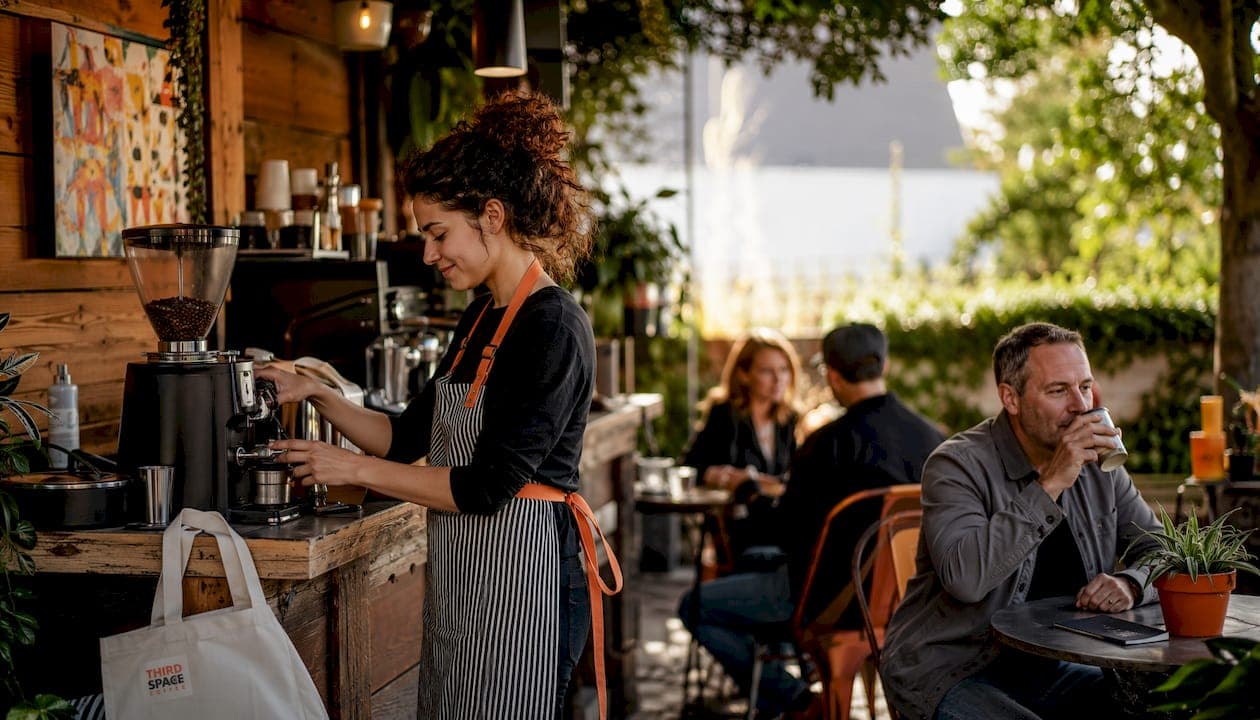
An espresso bar is a specialized coffeehouse that centers its entire menu on espresso and espresso-based drinks. That focus is the defining trait. Where a general coffee shop might offer drip coffee, pour-over, French press, and a rotating list of brewing methods, an espresso bar builds everything around one thing: high-pressure espresso extraction.
The setup reflects that priority. You will typically find a long counter, a professional espresso machine, and a barista who knows the difference between a ristretto and a lungo. The menu runs deep on espresso drinks rather than wide on brewing styles.
Thirdspacecoffee in Colorado Springs is a good example of how this concept translates in an American context. It roasts its own beans in-house and serves specialty espresso-based drinks alongside a genuine community atmosphere, which is exactly what the espresso bar format is built around.
- Core focus: Espresso and espresso-based beverages
- Defining equipment: Professional espresso machine, precision grinder
- Menu depth: Lattes, cappuccinos, Americanos, macchiatos, cortados
- Service style: Counter-forward, often quick, barista-driven
- Atmosphere: Social, often compact, designed for interaction
How does an espresso bar differ from a coffee shop or cafe?
The distinction comes down to menu and equipment focus. A coffee shop typically offers multiple brewing methods, drip coffee, pour-over, cold brew, and sometimes even siphon or Chemex. An espresso bar treats those methods as secondary, if they appear at all.
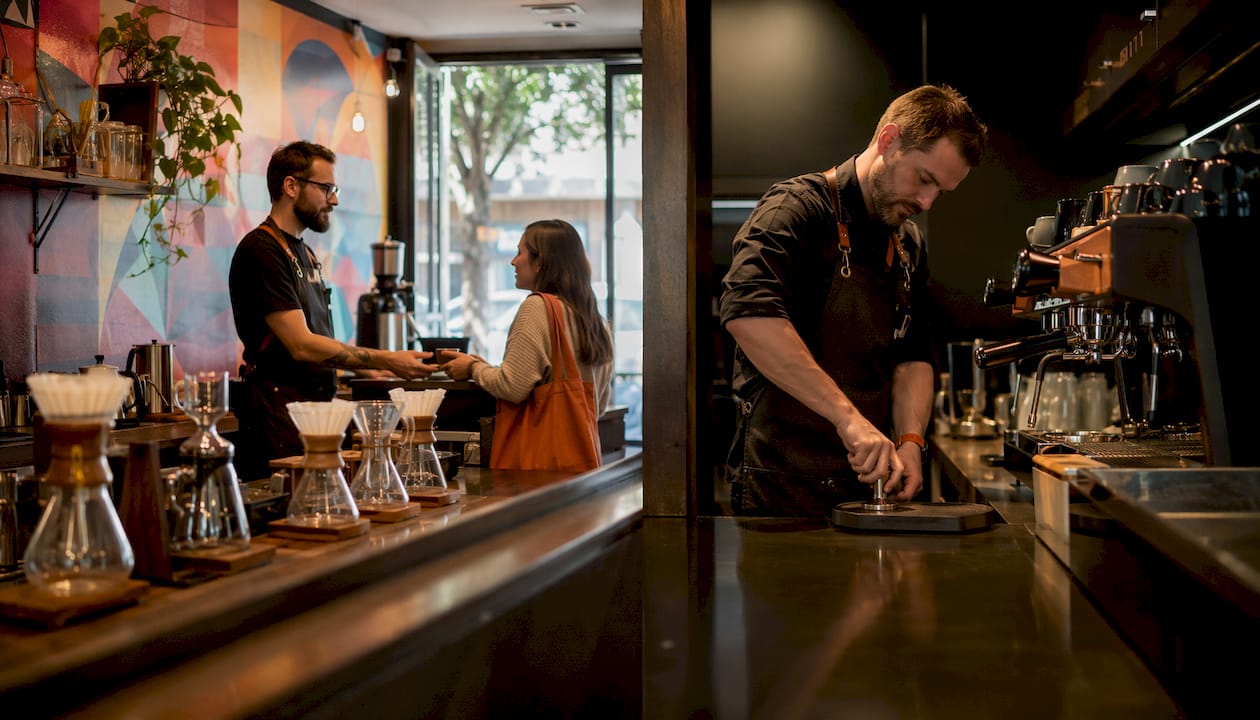
Equipment tells the story clearly. A coffee shop might have a drip brewer as its workhorse. An espresso bar invests in a commercial espresso machine, often a semi-automatic or automatic pump-type model, and a high-quality burr grinder. The barista's skill set shifts accordingly, toward dialing in grind size, managing extraction time, and texturing milk correctly.
Service style also differs. Espresso bars tend toward faster, counter-based service. You order, you wait briefly, you drink. The coffee shop hospitality model at a broader cafe often encourages longer stays, laptop work, and a more relaxed pace. Both are valid, but they serve different needs.
- Espresso bar: Espresso-first menu, specialized equipment, counter service, compact footprint
- General coffee shop: Multiple brewing methods, broader menu, often more seating
- Cafe: May include full food service, alcohol in some countries, and a wider social function
Where did espresso bars come from, and why do they matter?
Espresso bars originated in Italy as places for quick, social coffee pauses. The format was never about lingering. You walked in, stood at the counter, drank a small, intense shot, exchanged a few words, and left. The whole ritual took three minutes.
The Italian espresso bar was designed around the idea that great coffee should be fast, affordable, and social, not a luxury reserved for long afternoons. That philosophy still shapes how espresso bars operate worldwide.
That model spread globally through the second half of the twentieth century, adapting as it traveled. In the United States, the format absorbed American preferences for seating, larger drink sizes, and customization. The result is a hybrid: the espresso bar's technical precision and drink focus, combined with the American cafe's comfort and community function.
- Italian origins: Espresso bars emerged as quick-service social spots built around standing consumption.
- Pricing by position: Traditional Italian bars charge more for seated customers than for those standing at the counter, reinforcing the speed-first culture.
- Global spread: The format traveled through Europe, then to North America, where it anchored the specialty coffee movement.
- American adaptation: U.S. espresso bars added free seating, Wi-Fi, and larger drink formats while keeping the espresso focus.
- Community role: Both in Italy and the U.S., the espresso bar functions as a neighborhood gathering point, a third place between home and work.
What is espresso, and what drinks does an espresso bar serve?
Espresso is not a bean or a roast. It is a brewing method. Hot water is forced at 9 bars of pressure through finely ground, compacted coffee in roughly 20–30 seconds, producing a concentrated 25–30 ml shot with a coffee-to-water ratio of 1:2. The result has two distinct layers: the dark, syrupy body and the crema, a velvety golden-brown foam on top.
Any roast can be used for espresso. The idea that you need special "espresso beans" is a common misconception. Roasters often create specific blends to complement espresso's flavor profile, but the method works with light, medium, or dark roasts.
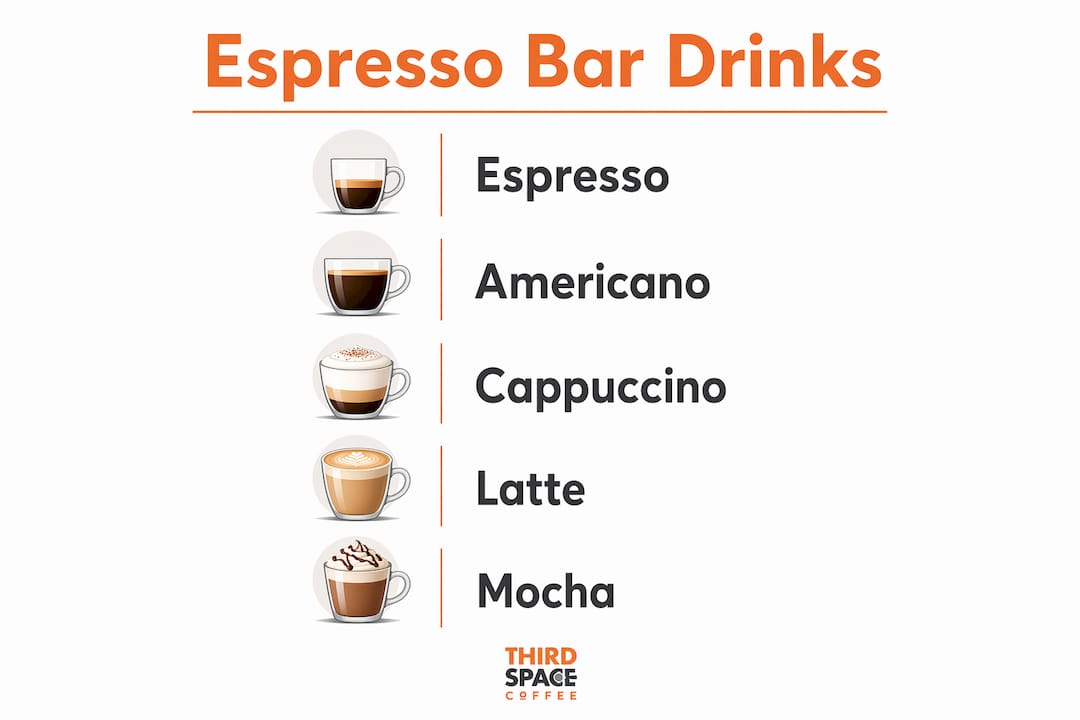
| Drink | Base | What's added |
|---|---|---|
| Espresso | Single or double shot | Nothing |
| Americano | Espresso | Hot water |
| Cappuccino | Espresso | Equal parts steamed and foamed milk |
| Latte | Espresso | Steamed milk, light foam |
| Macchiato | Espresso | Small amount of milk or foam |
| Cortado | Espresso | Equal part warm milk |
| Flat White | Espresso | Microfoam milk, less than a latte |
Espresso bars also serve iced versions of most of these drinks. North American espresso bar culture popularized drinks like iced lattes and blended beverages. You can explore the full range of espresso drink types to see how far the menu can stretch from a single shot.
- Single shot: About 25–30 ml, the foundation of every espresso drink
- Double shot (doppio): The standard at most American espresso bars
- Ristretto: Shorter extraction, more concentrated, sweeter
- Lungo: Longer extraction, more water, slightly more bitter
What does a typical espresso bar look and feel like?
Walk into an espresso bar and the layout tells you immediately what matters. A long counter runs across the front, anchored by a professional espresso machine, usually a semi-automatic or automatic pump model. Behind it, a barista manages the grinder, the portafilter, and the milk steamer simultaneously.
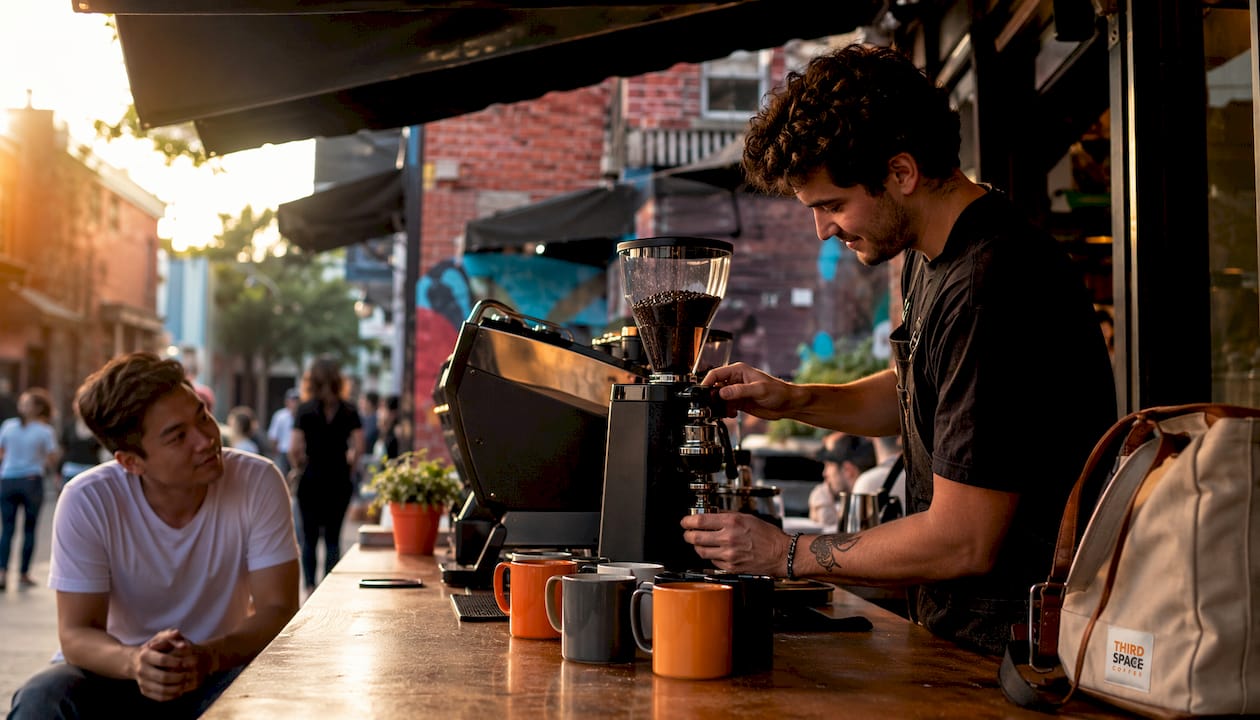
Pro Tip: When you visit an espresso bar, watch how the barista handles the grind. Adjusting grind size for humidity and bean age is one of the clearest signs of a skilled operator.
The espresso bar environment typically includes a display case with pastries, biscotti, or light sandwiches. Seating in American espresso bars is usually free and often plentiful, a departure from the Italian standing model. Many also offer Wi-Fi, making them practical spots for remote work.
The design of the space tends to balance speed with comfort. Stools at the counter, a few tables, and good lighting create an environment that works for a five-minute stop or a two-hour work session.
- Equipment: Commercial espresso machine, burr grinder, tamper, milk steamer
- Food: Pastries, biscotti, croissants, muffins, light sandwiches
- Drinks beyond espresso: Teas, iced drinks, sometimes masala chai
- Extras: Some espresso bars sell whole bean coffee, brewing gear, and accessories
- Atmosphere: Counter-forward, social, designed for both quick visits and longer stays
The barista role is central to the whole experience. This is a skilled position requiring knowledge of extraction variables, milk texturing, and drink recipes. A good barista at an espresso bar is not just making drinks; they are managing a technically demanding process dozens of times per hour.
Expert insights on espresso bars in America
Espresso is far more concentrated than most people realize. Coffee expert Dillon Edwards puts it plainly: espresso is 5 to 7 times more concentrated by volume than drip coffee. That concentration is why the flavor hits so hard in such a small cup.
"The strength of a cup of coffee is determined by the concentration of coffee solids dissolved in water. Generally speaking, espresso is five to seven times more concentrated than a cup of drip coffee of the same volume." — Dillon Edwards, coffee expert and founder of Parlor Coffee
The caffeine picture is more nuanced than most people expect. Espresso contains more caffeine per milliliter than drip coffee, but because the serving size is so much smaller, a single shot typically delivers less total caffeine than a standard mug of drip. Add milk to make a latte and the caffeine content stays the same while the volume grows considerably.
Machine pressure is another area where marketing creates confusion. Some home espresso machines advertise 15 or even 20 bars of pump pressure, but actual brew pressure is regulated near 9 bars. High-end machines include a valve that caps extraction pressure regardless of what the pump can generate. Exceeding 9 bars produces over-extracted, harsh-tasting espresso.
American espresso bar culture has also driven some genuine global contributions. North American espresso bars were early adopters of public Wi-Fi, and the culture here popularized masala chai as a mainstream cafe drink. The format continues to evolve, with specialty roasters like Thirdspacecoffee pushing coffee extraction quality and community focus simultaneously.
Good customer service in hospitality settings like espresso bars shapes whether a guest returns. Speed matters, but so does the quality of the interaction at the counter.
Try specialty espresso drinks at Thirdspacecoffee
Thirdspacecoffee in Colorado Springs roasts its beans in-house and serves a full menu of specialty espresso drinks, from classic cappuccinos to the Third Space Americano. Whether you want a quick shot at the counter or a place to settle in for the afternoon, the space is built for both. Stop in, order something you have never tried, and see what a well-pulled espresso actually tastes like.
Key Takeaways
An espresso bar is defined by its commitment to high-pressure espresso extraction, specialized equipment, and a menu built entirely around espresso-based drinks.
| Point | Details |
|---|---|
| Espresso bar definition | A coffeehouse specializing in espresso and espresso-based drinks, not general brewing methods. |
| Espresso basics | Brewed at 9 bars of pressure in 20–30 seconds, producing a 25–30 ml concentrated shot with crema. |
| Espresso vs. drip coffee | Espresso is significantly more concentrated by volume than drip coffee, though smaller serving size means less total caffeine. |
| Italian roots | Espresso bars originated in Italy as quick, standing-service social spots; American versions added free seating and larger drinks. |
| Barista role | A skilled barista manages extraction variables, milk texturing, and drink recipes, making them central to the espresso bar experience. |